

Το παρόν άρθρο πρωτοπαρουσιάστηκε στο Αμερικανικό διαδικτυακό περιοδικό Αμέρικαν Κρόνικλ, στις 14 Φεβρουαρίου, 2011
Miltiades Elia Bolaris
February 15, 2011

Bogus scholarly witchcraft in the age of Antikvizatsiyja
In notoriously unreliable sources, such as the "Slavic Nationalist Forum" (1) or the expatriate Skopjan misinformation website "MakNews" (2), it is naturally expected to stumble upon products of pseudo-scholarly emesis such as "A new theory about the Trojan era", by Tomáš Spevák, which in all seriousness proclaims nothing less than: "Ancient Trojans were SLAVS"!
The first question now is: Why should anybody waste their time answering such preposterous claims. The answer is clear: This text has been used in every internet posting imaginable to promote its obviously anachronistic case to unsuspecting readers that take its word at its face value. Why should it not? While the text is not backed up by any documentation to speak off, it does include some rather impressive quotes by none other than Homer, the poet of Iliad and Odyssey himself as well as by Tiberius Claudius, the Roman Emperor and by Professor Eugene Borza.
The "new theory about the Trojan era" starts with the following question:
"with all the research conducted for so many years and the enormous amount of funds invested in it, why hasn´t the question, "who were the Trojans" been answered? Since Heinrich Schliemann discovered Troy in 1870, no one has bothered to ask, "what was the ethnicity of the Trojans and who were the Achaeans"?"
Fair question, I would say, for anyone who has obviously never bothered to follow discussions on various Homeric questions, since this question has been asked since and partially answered.
"The assumption all along was that they were "Greek", but were they? In literature and in the movies, they are represented as Greeks; using Greek weapons, Greek architecture, Greek art, etc."
First of all we are pleased to find out that whoever this Tomáš Spevák is, he is obtaining a sufficient component of his education from Hollywood movies, a peerless source of intellectual enrichment, no doubt.
"In history books we were told without a doubt that the "Achaeans were actually early Greeks".
Really now, how could that be? Were 'nt we all in agreement that Homer had been writing about the Sino-Japanese wars all along? Where did this doubtful rabbit about Achaeans being Greeks appear from?
"Something is rotten in the state of Denmark", as a famous Makedonski (3) once said.
"But, has anyone inquired as to how they arrived at this conclusion? Where is the proof that the Achaeans and Trojans actually shared a common heritage with the "Greeks"; language, culture, art, weapons or any other characteristic that would qualify them to be "Greek"?"
I don´t believe that anyone can truly say what they really were."
 |
| Linear B, the earliest script for writting Greek, circa 1450BC |
"But we can, with some certainty, say that they were not Greek."
Now we know: it is definitely "B": the man obviously has no clue, or worse yet, he decides to twist the truth to fit his means!
Nevertheless, we want to hear what more he has to say:
"Allow me to elaborate.
Let us begin with a quote from Tiberius Claudius;
"Among these Celts, if the word is to have any significance, even the ´Achaean´ Greeks, who had established themselves for some time in the Upper Danube Valley before pushing southward into Greece. Yes, the Greeks are comparative newcomers to Greece. They displaced the native Pelasgians ... This happened not long before the Trojan War; the Dorian Greeks came still later - eighty years after the Trojan War."
This is serious stuff, indeed. If Tiberius Claudius said it, indeed emphatically and in bold letters: "Yes, the Greeks are comparative newcomers to Greece" it must be true!
Doubts about the "newcomers Greeks" now hit me like a train hits a broken down Yugo stranded on a rail pass. I had to find out what else Tiberius Claudius wrote about them, so I tried to locate the full quote, with a quick search on the internet. To my surprise, of the dozen or so websites that carried this quote, not one of them was from a University or any other scholarly source. Every single one of them was either from Slavomacedonian or Albanian ultra-nationalist sites (4), hardly sympathetic to Greeks and not necessarily intent to promote the Classics.
Not knowing much about Tiberius Claudius apart that he was a Roman emperor, related to Caligula, I read up a little to find out what is known about what he wrote. It seems like he wrote on diverse subjects from the history of Augustus' reign to a history of the Etruscans and the history of Carthage. He also compiled a Latin-Etruscan dictionary as well as a book on dice. Nothing of what he wrote has survived, apart from a couple edicts, one in France and one in Egypt. With this in mind, let us now re-write what we read above, the way it SHOULD HAVE BEEN written:
Let us begin with a FABRICATED quote, SUPPOSEDLY from Tiberius Claudius.
"Among these Celts, if the word is to have any significance, even the ´Achaean´ Greeks, who had established themselves for some time in the Upper Danube Valley before pushing southward into Greece. Yes, the Greeks are comparative newcomers to Greece. They displaced the native Pelasgians ... This happened not long before the Trojan War; the Dorian Greeks came still later - eighty years after the Trojan War.",
in other words:…WAAAAY LATER than either the Slavo-macedonians or Albanians who are OF COURSE "autochthonous" to the Balkans and have been there since before the Big Bang!
Now that we know we are dealing with a shameless nationalistic history falsifier who has no qualms about forging fake "documents" to promote his case, we need to be on alert about what we read:
"The theory was, according to Herodotus and Homer, that "barbarian" tribes from the north, known as the Dorians, threatened the ancient Achaean cities even before the great (Trojan) war. They say that these tribes came from as far as the Danube River valley."
I wonder where Homer says these things. To begin with, Homer NEVER EVEN MENTIONS the Danube river and he only mentions the Dorians, the best I know, ONLY ONCE:
Κρήτη τις γαῖ᾽ ἔστι, μέσῳ ἐνὶ οἴνοπι πόντῳ,
καλὴ καὶ πίειρα, περίρρυτος: ἐν δ᾽ ἄνθρωποι
πολλοί, ἀπειρέσιοι, καὶ ἐννήκοντα πόληες. [175]
ἄλλη δ᾽ ἄλλων γλῶσσα μεμιγμένη: ἐν μὲν Ἀχαιοί,
ἐν δ᾽ Ἐτεόκρητες μεγαλήτορες, ἐν δὲ Κύδωνες,
Δωριέες τε τριχάϊκες δῖοί τε Πελασγοί.
Homer, Odyssey 19.148
Crete is called a land, in the midst of the wine-dark sea,
a beautiful, rich land, well watered, and many men live there,
countless, and ninety cities. [175]
in speech among themselves their languages are mixed: There live Achaeans,
and bighearted native Cretans, there are Cydonians,
and Dorians of waving plumes and divine Pelasgians.
Homer, in other words hardly mentions the Dorians in passing, just once, and there only as an anachronism, since when the Trojan war was fought the Dorians were not even known to the Achaeans and for sure they were not in Crete. It is obvious that they entered his poetry much later as it is obvious that they play no part in it. Now we go to Herodotus who, speaking of Croesus´s inquire he tells us:
[2] ἱστορέων δὲ εὕρισκε Λακεδαιμονίους καὶ Ἀθηναίους προέχοντας τοὺς μὲν τοῦ Δωρικοῦ γένεος τοὺς δὲ τοῦ Ἰωνικοῦ. ταῦτα γὰρ ἦν τὰ προκεκριμένα, ἐόντα τὸ ἀρχαῖον τὸ μὲν Πελασγικὸν τὸ δὲ Ἑλληνικὸν ἔθνος. καὶ τὸ μὲν οὐδαμῇ κω ἐξεχώρησε, τὸ δὲ πολυπλάνητον κάρτα. (5)
[2] He found by inquiry that the chief peoples were the Lacedaemonians among those of Doric, and the Athenians among those of Ionic stock. These races, Ionian and Dorian, were the foremost in ancient time, the first a Pelasgian and the second a Hellenic people. The Pelasgian race has never yet left its home; the Hellenic has wandered often and far. (6)
[3] ἐπὶ μὲν γὰρ Δευκαλίωνος βασιλέος οἴκεε γῆν τὴν Φθιῶτιν, ἐπὶ δὲ Δώρου τοῦ Ἕλληνος τὴν ὑπὸ τὴν Ὄσσαν τε καὶ τὸν Ὄλυμπον χώρην, καλεομένην δὲ Ἱστιαιῶτιν: ἐκ δὲ τῆς Ἱστιαιώτιδος ὡς ἐξανέστη ὑπὸ Καδμείων, οἴκεε ἐν Πίνδῳ Μακεδνὸν καλεόμενον: ἐνθεῦτεν δὲ αὖτις ἐς τὴν Δρυοπίδα μετέβη καὶ ἐκ τῆς Δρυοπίδος οὕτω ἐς Πελοπόννησον ἐλθὸν Δωρικὸν ἐκλήθη. (5)
[3] For in the days of king Deucalion it inhabited the land of Phthia, then the country called Histiaean, under Ossa and Olympus, in the time of Dorus son of Hellen; driven from this Histiaean country by the Cadmeans, it settled about Pindus in the territory called Macedonian; from there again it migrated to Dryopia, and at last came from Dryopia into the Peloponnese, where it took the name of Dorian.(6)
Having seen that Homer mentions nothing or almost nothing of the Dorians, we now see that Herodotus, far from speaking of imaginary " "barbarian" tribes from the north, known as the Dorians", who supposedly "threatened the ancient Achaean cities even before the great (Trojan) war", he also never mentions anything about Danube River valley hearsay "They say that these tribes came from as far as the Danube River valley."
Herodotus clearly calls the Dorians Greeks and he clearly states that they came south from the mountainous Pindus range areas of Epirus and Macedonia, both of which are localities in what was then and now northwestern Greece.

Therefore, his second quote:
"The theory was, according to Herodotus and Homer, that "barbarian" tribes from the north, known as the Dorians, threatened the ancient Achaean cities even before the great (Trojan) war. They say that these tribes came from as far as the Danube River valley",
is proven to be a fraudulent one too. This is two out of two! One more strike and he is out!
Yet he continues unabated:
"Modern scholars however have doubts. There is no archeological evidence to support this theory.
According to professor Eugene Borza:
"The theory of Dorian invasions is largely an invention of 19th century historiography, and is otherwise unsupported by either archaeological or linguistic evidence. Most archaeologists and many linguists have abandoned the belief that Greek speaking Dorians devastated Mycenaean centers at the end of the Bronze Age..."
Since no book reference is given, I now have my serious doubts as to whether this one is a valid quote too. Once again, this particular quote is disseminated in the usual Skopjan internet sites that drip of anti-Greek hateful venom, so my suspicion is that this quote is also a fake. If anything, both linguistic and archaeological arguments, not to mention historic and mythological ones can be used to support a Dorian invasion. The Dorian dialect for example flowed down from the Peloponnese to a crescent that drops south to Crete and then rises up to Rhodes, and across into Caria, while on the other side it also goes west of Western Greece, beyond the Ionian Sea to Cicily and Southern Italy up to Neapolis, Naples. On the other hand, the Achaean dialect survived in mountainous Arcadia, in the center of the Peloponnese, surrounded by Dorians and it also survived in far away Cyprus, making later linguists call it the Arcado-Cyprian. The Aeolian and Ionian dialects held their ground in Eastern Greece (except Boeotia, Thebes) and the central and northern part of the Western coast of Asia Minor. As for the Archaeology, if it was not the Dorians who destroyed the fabled Achaean citadels, it must certainly be the ones who took lasting advantage of their demise. This is why it is doubtful that Eugene Borza would have written such a quote.
Since we speak of Eugene Borza, I need to say that he is the darling of the Skopjan pseudo-macedonians, since he is honestly of the (obviously naïve) opinion that the Macedonians became Hellenized by the southern Greeks, AFTER they conquered them, a first in world history where a dominant and demographically strong imperial society lets itself lose its own language by a conquered people who is not numerically superior. His arguments, real or imaginary, are all over the internet, in support of a separate (albeit closely related to Greek) Macedonian ethnicity in the ancient times, before the 4thcBC.
Darling of the Skopjans (for the wrong reasons!) or not, Eugene Borza is still a serious academic. While the Slavomacedonians beat the drums trying to make a case for non-Greek ancient Macedonians, whose descendants (obviously) they claim to be, Eugene Borza brutally brings them back to earth:
"Modern Slavs, both Bulgarians and Macedonians, cannot establish a link with antiquity, as the Slavs entered the Balkans centuries after the demise of the ancient Macedonian kingdom. Only the most radical Slavic factions—mostly émigrés in the United States, Canada, and Australia—even attempt to establish a connection to antiquity [...] The twentieth-century development of a Macedonian ethnicity, and its recent evolution into independent statehood following the collapse of the Yugoslav state in 1991, has followed a rocky road. In order to survive the vicissitudes of Balkan history and politics, the Macedonians, who have had no history, need one…Their own so-called Macedonian ethnicity had evolved for more than a century, and thus it seemed natural and appropriate for them to call the new nation "Macedonia" and to attempt to provide some cultural references to bolster ethnic survival..."
Eugene Borza, Macedonia Redux (7)
This was of course written in 2003, years before the Antikvijatsija theories invaded Skopje via Toronto and Melbournetook and captured it by a storm and Nikola Gruevski's VMRO-DPMNE party put the regime propaganda engines full blast, turning the Slavic-speaking part of FYROM's population into "Antickite Makedonci", descendants of Александар Велики/Aleksandar Veliki, Alexander the Great!
Now we move to some hard core anti-scientific arguments…it is all about "belief" and "certainty", nevertheless:
"It is my belief that the Achaeans and the Dorians have always lived in Thessaly or on the Ionian coast. To which language group they belong I can´t say with certainty, but their language nonetheless created a large part of the classical Greek vocabulary."
It is also my belief that the Italians arrived into Italy during the late Renascence coming from the Western coast lands of southern Japan and Eastern Korea and they spoke a Classic Chinese dialect, though I am not too sure of it. How is that for a theory? And, more importantly…who in this world cares for my theory if I have nothing to back it up with and document it and, additionally, it flies in the face of every historical fact we have at our disposal. Italian Renascence art, after all, does not remind someone of Japanese, Korean or Chinese art.
Further down we are treated to some infantile geopolitical analysis of the late bronze age that could be considered age-appropriate for a third grade student, had it not been written in such a mediocre way:
"If the Trojan War indeed took place, taking Homer´s word who so eloquently described it, one can conclude that it left the Achaeans and their allies devastated and in a state of weakness. The Trojan War in fact could have been far more devastating than Homer described it. Some scholars believe, mythology aside, it was a war for economic dominance. Troy, the richest city in the known world, presented a threat to the Achaeans because it controlled most of the trade through the Dardanelle pass. Troy had many allies and could have easily taken full control of the pass. Control of the pass would have meant controlling the entire sea trade between the Mediterranean and Black Seas.
The prospect of Troy controlling the pass worried the Achaeans who tried by every means possible to find a solution. Unfortunately, Troy continued to ignore them. Unable to find a peaceful solution, the Achaeans declared war on Troy.
The Achaeans amassed a great army, a size never before seen, and set out for Troy. When they arrived, the Trojans met them before the great walls of their city. The armies clashed and fought endless battles. It was a war of the worlds as each side drew in on its allies. Each side used its genius to outdo the other and many men in great numbers on both sides were killed.
When it was over, the Achaeans returned home victorious. Unfortunately, it was a bitter sweet victory which left them devastated. Many kings and nobles died in the battlefields and many more died at home through sinister plots and intrigues. Even the High King Agamemnon was murdered.
Weakened, leaderless and with a population in decline, the war brought more suffering than it did prosperity. With new and inexperienced leadership, a shortage of men and material, defense from the savage invaders from the north became a serious challenge."
Further down we are getting apocryphal:
"The Pelasgi (Belasci), the ancient settlers of the Balkans, called these new savages from the north, Xellenes (newcomers). They were later named Greeks by the Romans. "
The reader is advised not to even bother searching for either "Belasci" or "Xelenes", since they are the tail of the dog that is chasing it…all internet references bring us back to this same article: Purely invented ethnonyms. We keep the "Xellenic" on hold for now and we will return to it later on.
Now the reader is leaving behind any contact with history and enters the abode of pure fantasy:
"The Xellenic tribes of Dorians, arrived on the Peloponnesus eighty years after the Trojan War. They raided the countryside, destroying the rich Achaean culture, cities and enclaves along with the native Achaean population. Their arrival brought dramatic change to the region. They no longer had a High King to rule over all the tribes and cities. Art, architecture and science also changed, modified by the mixing of new cultures; Egyptians, Phoenicians, Xellenes, Pelasgians, Anatolians and others. All these people helped shape Greece to become what it was during the classical period.
We cannot draw conclusions from studying the Achaeans and Trojan cultures alone, we need archeological evidence to corroborate our theories. Based on cultural evidence alone, we can equally assume the Trojans were a Slavic people."
The reader can now conclude, and I do not need to explain why, since it is known from Virgil who told us about the Xitalians, of Xitaly, who left Trojagrad and with the help of Korean and Egyptian colonists, established the Japanese colony of Nova Trojagrad also known as Romevo or Romavo and further north the Proto-Slavic Veneti established Venezziagradovo. It goes without saying that "Based on cultural evidence alone, we can equally assume the Xlatin Xitalians were a Slavic people." This historic dogma should be de facto accepted, no questions asked! After all,
"According to historian Alexander Donski, if one reads the description of the customs practiced by Trojans as per Homer´s Iliad, without knowing who the Trojans were, one would get the impression that they were the modern Balkan Slavic peoples."
If my cousin the liar said it, it must be true! Aleksandar Donski (8) is pseudo-makedonism´s all time favorite Antikvizatsiyja promoter prima dona. It is well known that the Trojan proto-Slavs lived in Zadrugas inside Troy-Trojagradovo and their most famous Czar was Priam-Priamovski whose Czarina was Ecabe-Ekavska.
Our torture is not over:
"On a side note, many contemporary scholars today believe that the ancient Pelasgi, the inhabitants of the Greek Peninsula, before the classical Greeks, were proto-Slavic. Other ancient Balkan peoples such as the Thracians, Paeonians, Dardanians, Veneti, Bryges, Illyrians, Minoans and people from Asia Minor such as the Lydians, Phrygians, Mysians and even Scythians and Sarmatians (Amazons) are also believed to be proto-Slavic speaking people."
It is upsetting that these "contemporary scholars" fail to mention the Indians and the Han Chinese as proto-Slavic, but I sigh with relief that the single-breasted Amazons have been included in the lot!
"Several factors have led scholars this conclusion, art, customs, ancient relics with inscriptions of written languages, etc. Scholars Vasil Ilyov, Sergei V. Rjabchikov, Prof. V. A. Chudinov, Matej Bor, Anthony Ambrozic and others…"
I cannot help mentioning that there are more nuts in this group of pseudo-scholars than in a macadamia nut jar.
"…have deciphered many ancient scripts from Phrygian, Venetic, Etruscan, Linear A, ancient Macedonian, Vincha, ancient Russian and other sources with the use of contemporary Slavic languages. In fact a number of so-called undecipherable scripts have now been deciphered and translated by using the Slavic languages, something never seriously done before."
The recipe is simple: is there an unknown undecipherable stone age script (or even a well known Ptolemaic one like the Egyptian Demotic (9) on the Rosetta stone ) out there? Bring it on, to Vasil Iliov (10) and he will read it be it, whether it is 5.5 or 102 thousand year old (you read it right! ), using the Cyrillic script and the Slavomacedonian language as spoken today in FYROM!
"Why didn´t anyone think of using Slavic, the vast family of languages of one of the largest nations on Earth? I believe because of political reasons: communism and all the propaganda surrounding it, not to mention the isolation the Slavic states suffered."
This quote above, these precise three sentences, have been used in their EXACT form by at least two Skopjan propagandists that I know, this one and the pseudonymous author of the Homeric Hoax par excellence: "Slavic elements in Homer" (11). Plagiarism, it seems, is unknown among these frauds, they shamelessly copy and misquote everything, even each other. The question to the reader might arise: Why do I say Skopian propagandists when the name of the author of the article in question, Tomáš Spevák, is apparently Czech? We continue with the next paragraph and the answer will become even more apparent:
"What is also interesting is that contemporary scholar Odisej Belchevsky and others are now studying the language in which Homer wrote the Iliad & Odyssey and are finding that it was written in a proto-Slavic language, closely related to modern Macedonian dialects."
What do we have here? Once again, exactly the same paragraph apparently plagiarized, word by word, from "Slavic elements in Homer". But the author of "Slavic Elements in Homer" is also using this article as his own source:
"A new theory about the Trojan era by Tomáš Spevák: On a side note, many contemporary scholars today believe…" , which means that this article came first.
Who is the author of "Slavic elements in Homer". Petrus Invictus himself. But, Petrus Invictus being his "spiritual identity and it is one I was given a loooong time ago"(sic), you can also call him John Donne. But you can also call him Perica, or Petro, or just plainly John. He admits that "Perica Sardzoski is my current identity", yet "my new identity as John Donne is my own trust me!" Of course we trust you Petro-Perica-Petrus-John (12)! Why shouldn't we?
Furthermore, the word "contemporary scholar" has been used to describe this contemporary pseudo-scholarly fraud, Odisej Belchevski (13), by none other than the infamous, Toronto based Skopjan expatriate propagandist, the one who has raised anti-Hellenic scatology to levels of hatred previously unimaginable, Odisej´s buddy, Risto "Velikiot" (as in Aleksandar Velikiot, the Great!) himself.
Something is happening here, obviously, more than simple plagiarism, which for a good propagandist is not a crime, anyway, but second skin. The first giveaway is the name: it is Czeck, yet nothing is to be found by this "author" again, in fact the article has been erased from the MakNews website, though at the moment this is being written it is still appearing on the list of the available articles (14).
I sent an email to the imaginary Mr. Tomáš Spevák (at brumi@neobee.net) asking for his exact references for quotes used in this article yet the email was returned as undeliverable (15). The hosting company, Neobee (16), is Serbian, based in Belgrade. It is obvious that there is no Czech author writing and operating out of Beograd who is writing nonsense about the ancient Slavic Trojans. The name was made up to confuse, and the article was written to build on Odisej Belshevski´s (17) original hoax and also to become the basis for what came next, the more comprehensive "Slavic Elements in Homer". All three are interwoven and cross referenced. Who is the real author of this particular fraud? Follow the traces in the crime scene and you will find the source, is what I would suggest. All crooks leave their fingerprints or something belonging to them and racing back to their true identity, on the crime scene. There are two emails at the end of this article. One of them is long ago disconnected. If the first one fails to respond, try the second…
An even more hilarious detail needs to be exposed. Further up on the text we found the puzzling and rather apocryphal references to "Xellenic tribes" and to "Xellenes". We keep in mind that Hellenic and Hellenes is the ethnonym of the Greeks in Greek. Hellenic in Greek is spelled Ἑλληνικόν and Ἕλληνες, respectively. If you were to spell it in Czech it would be Hellenic and Hellenes too, using the Latin script rules. But spell that in Slavomakedonski and the Cyrillic script shows us what happened. The Skopjan fraud left his traces once again: : Xэлленик became Xellenic instead of Hellenic and Xэллинес became Xellenes, instead of Hellenes, something a Czech person, used to write in his native Latinized Slavonic would never even think of...
Having said that, let´s entertain ourselves a bit longer:
"And now back to the Trojans and Achaeans. It is my belief that the Achaeans did not speak a proto-Slavic language."
Now we are truly amazed: If Aegean Pelasgians, Illyrians Thracians, Macedonians, Trojans, Phrygians and one-breasted Amazons babes, among others, spoke proto-Slavic, why this exception with the Greek Achaeans?
"If their vocabulary contained proto-Slavic words it is most likely they were borrowed from the Pelasgi or other Slavic-speaking tribes. I believe the Achaeans spoke a language that was more closely related to the language family of the later City States, but surely it wasn´t the same as that which was brought from Thessaly by the Dorians."
This makes a lot of sense...or maybe not? We cannot help but note here that this Balkan hate monger cannot even bring himself to utter the word "Hellenic" or "Greek" when speaking of the language, but goes through a whole paraphrase "a language that was more closely related to the language family of the later City States", just to avoid it. This is why I insist that Risto is Velikiot, the greatest in his craft indeed: he does what he is a specialist in, namely anti-Hellenic scatology, and he does it with the passion of the convert, or the well compensated clerk. He was an office assistant before he became an "author" after all.
Pseudo-historical science continues:
"The Peloponnesus was settled by various peoples. Egyptians [Ethiopians (18) as well], Phoenicians, Libyans [I believe the Sea People], Anatolians (Ionians) and Italics all contributed to the creation of the Mycenaean civilization and ethnicity.
The ancient Greek language (Attic) was less than 50% Indo-European and only 20% of Greek names and toponyms (aside the numerous Slavic ones) were Indo-European. Thus, it is no surprise that scholars classified linear B as Greek, because "Greek" encompasses elements of many languages including Egyptian, Phoenician, Anatolian and others, that don´t belong in the Balkans. In other words, all the languages spoken in the Peloponnesus before the arrival of the "Greek" Dorians.
Even the so-called "Greek gods" have roots in Egypt and elsewhere. I do not believe the inhabitants of ancient City States ever "founded" a god themselves.
It is interesting that some Spartan kings claimed relation to the lords from the Middle East, Egypt and the shrine: pyramid at Menelaion. It is also interesting that the Achaean architecture has a striking resemblance to the Egyptian."
Are we still there? Let´s take a deep breath of fresh air and dive in the mud again:
"As for the Trojans, we don´t have evidence of their written language (thus far ) (19)&(20), but we do know that most of their allies were proto-Slavic speaking peoples related to them (Trojans) whose customs are surprisingly very similar to those of the modern Balkan Slavs. According to Anthony Ambrozic and others, the Trojans were related to the Phrygians (21), whom we know were related to the proto-Slavic Veneti.
I believe more evidence is required to conclusively prove this, but finding it for the time being is beyond the scope of this article."
True, but who needs boring "evidence" when "belief" and membership to the VMRO-DPMNE party is enough to get you into Slavomakedoniot paradise and all the perks associated with support of the Gruevskian regime in Skopje?
"If my theory is correct, a new chapter in history will soon be written, a chapter that will include the Slav contribution to the world.",
...not to speak of his contribution to endless material for stand-up comedy clubs worldwide or to the anthropology of a people that have been mesmerized by Skopje´s Antikvizatsiyja´s BIG LIE or the psychology of a pathetic liar who is passing himself off as a pseudo-Scientist.
To cup it off, here is another Homeric quote, or so we are led to believe:
"As Homer puts it (describing the Slav barbarian tribes) in his epic:
"They are numerous like leafs in the forest… with chariots and weapons decorated with gleaming gold and silver... like gods." "
How should I put this?...: The reader is advised to not even bother tracing this quote down in Homer.! I already wasted precious time looking for it. Simply put, it simply does not exist! Yet another great day in the daily routine of forgery, fraud, deception and History falsification by the good folks of MakNews.com! Four out of four fabricated quotes in the same paper! If they were forging checks, under the "third strike and you are out" law of California, most of these pseudo-macedonians would be facing life in the slammer with no parole!
The closest Homer ever said to this, that I was able to find is the following excerpt from the Iliad, when Odysseus is interrogating a Trojan captive that he and Diomedes caught on a reconnaissance mission:
"τὸν δ᾽ ἀπαμειβόμενος προσέφη πολύμητις Ὀδυσσεύς:
πῶς γὰρ νῦν Τρώεσσι μεμιγμένοι ἱπποδάμοισιν
425εὕδουσ᾽ ἦ ἀπάνευθε; δίειπέ μοι ὄφρα δαείω.
τὸν δ᾽ ἠμείβετ᾽ ἔπειτα Δόλων Εὐμήδεος υἱός:
τοὶ γὰρ ἐγὼ καὶ ταῦτα μάλ᾽ ἀτρεκέως καταλέξω.
πρὸς μὲν ἁλὸς Κᾶρες καὶ Παίονες ἀγκυλότοξοι
καὶ Λέλεγες καὶ Καύκωνες δῖοί τε Πελασγοί,
430πρὸς Θύμβρης δ᾽ ἔλαχον Λύκιοι Μυσοί τ᾽ ἀγέρωχοι
καὶ Φρύγες ἱππόμαχοι καὶ Μῄονες ἱπποκορυσταί.
ἀλλὰ τί ἢ ἐμὲ ταῦτα διεξερέεσθε ἕκαστα;
εἰ γὰρ δὴ μέματον Τρώων καταδῦναι ὅμιλον
Θρήϊκες οἷδ᾽ ἀπάνευθε νεήλυδες ἔσχατοι ἄλλων:
435ἐν δέ σφιν Ῥῆσος βασιλεὺς πάϊς Ἠϊονῆος.
τοῦ δὴ καλλίστους ἵππους ἴδον ἠδὲ μεγίστους:
λευκότεροι χιόνος, θείειν δ᾽ ἀνέμοισιν ὁμοῖοι:
ἅρμα δέ οἱ χρυσῷ τε καὶ ἀργύρῳ εὖ ἤσκηται:
τεύχεα δὲ χρύσεια πελώρια θαῦμα ἰδέσθαι
440ἤλυθ᾽ ἔχων: τὰ μὲν οὔ τι καταθνητοῖσιν ἔοικεν
ἄνδρεσσιν φορέειν, ἀλλ᾽ ἀθανάτοισι θεοῖσιν.
ἀλλ᾽ ἐμὲ μὲν νῦν νηυσὶ πελάσσετον ὠκυπόροισιν,
ἠέ με δήσαντες λίπετ᾽ αὐτόθι νηλέϊ δεσμῷ,
ὄφρά κεν ἔλθητον καὶ πειρηθῆτον ἐμεῖο
445ἠὲ κατ᾽ αἶσαν ἔειπον ἐν ὑμῖν, ἦε καὶ οὐκί."
"Then in answer to him spοke Odysseus of many wiles: "How is it now, do they sleep mingled with the horse-taming Trojans, [425] or apart? tell me at large that I may know." Then made answer to him Dolon, son of Eumedes: "Verily now this likewise will I frankly tell you. Towards the sea lie the Carians and the Paeonians, with curved bows, and the Leleges and Caucones, and the godly Pelasgi. [430] And towards Thymbre fell the lot of the Lycians and the lordly Mysians, and the Phrygians that fight from chariots and the Maeonians, lords of chariots. But why is it that ye question me closely regarding all these things? For if ye are fain to enter the throng of the Trojans, lo, here apart be the Thracians, new comers, the outermost of all, [435] and among them their king Rhesus, son of Eïoneus. His are verily the fairest horses that ever I saw, and the greatest, whiter than snow, and in speed like the winds. And his chariot is cunningly wrought with gold and silver, and armour of gold brought he with him, huge of size, a wonder to behold. [440] Such armour it beseemeth not that mortal men should wear, but immortal gods. But bring ye me now to the swift-faring ships, or bind me with a cruel bond and leave me here, that ye may go and make trial of me, [445] whether or not I have spoken to you according to right."
No mention of any Slavs or Proto-Slavs, of course, and we should not expect such a ludicrous anachronism: there would be no mention of Slavs by anyone, for the next 1400 to 1800 years in that area of the world.
"For more details on the subjects covered in this article, consult the works of:
Homer, Herodotus, Anthony Ambrozic, Eugene Borza, Mario Alinei, Vasil Ilyov, Valeriy A. Chudinov, and Sergei V. Rjabchikov."
Since we already checked the works of Homer and Herodotus, lets us leave the assorted delirious nuts of the Ambrozic, Alinei, Ilyov, Chudinov, and Rjabchikov type out of the mix for now and go will go back to Professor Eugene Borza, as we were asked, for a moment.
We will not consult Professor Borza on the Slavic nature of the imaginary Trojan-ovskis or the single-breasted proto-Slavianki Amazon-ovas. We will ask him something simpler, to talk about the ethnic nature of the Macedonians, since that is where the juice of the matter is concentrated, and the true reason why such hilarious pseudo-scholarly articles are being crafted and so effectively promoted in the Slavomacedonian ultra-nationalist and other international Slavic-related websites:
"Our understanding of the Macedonians' emergence into history is confounded by two events: the establishment of the Macedonians as an identifiable ethnic group, and the foundation of their ruling house. The "highlanders" or "Makedones" of the mountainous regions of western Macedonia are derived from northwest Greek stock; they were akin both to those who at an earlier time may have migrated south to become the historical "Dorians", and to other Pindus tribes who were the ancestors of the Epirotes or Molossians. That is, we may suggest that northwest Greece provided a pool of Indo-European speakers of Proto-Greek from which were drawn the tribes who later were known by different names as they established their regional identities in separate parts of the country... First, the matter of the Hellenic origins of the Macedonians: Nicholas Hammond's general conclusion (though not the details of his arguments) that the origin of the Macedonians lies in the pool of proto-Greek speakers who migrated out of the Pindus mountains during the Iron Age, is acceptable."
Eugene Borza, "Makedonika", Regina Books, Claremont CA
As for the imaginary author, the Czech named "Tomáš Spevák",
"For comments and inquiries contact the author Tomáš Spevák at brumi@neobee.net (an e-mail which we already know that does not work!) or Risto Stefov at rstefov@hotmail.com"
P.S.Cherry on the pie:
Since no two liars can ever agree on the same lie, here is another loony theory from the land of loony theories. Professora Margarita Kitan Ivanoska from Skopje appearing on national TV (22) where she is in all seriousness "proving" that Troy was not in Anatolia, where Homer and the ancients tell us that it lay, and where Schliemann found it, but somewhere in Southwestern FYRoMakedonija. The question is now pseudo-"linguistic": was it Mariovo-Troyjovo (3:10 in the video), or was it in Ostrovo-Troyjovo (4:40 in the video)!
Zeus help us!
http://www.youtube.com/watch?v=FyBZ-IhZwfA&feature=related
NOTES & REFERENCES:
1. http://slavija.proboards.com/index.cgi?action=display&board=general&thread=4504&page=1#38083
2. http://www.maknews.com/html/articles.html#spevak
3. I do not want to hear any doubts about the historic certainty that Shakespeare was a Slavomakedonski. Even if he has not been claimed as such till now, that is only because upcoming books of Donski and Stefov "proving" that he was a Skopjan, like Alexander the Great, Aristotle, George W. Bush and Queen Elizabeth, among others, have not hit the Toronto and Melbourne bookstores as yet: patience!
4. http://forum.kajgana.com/archive/index.php/t-21356.html, http://illyria.proboards.com/index.cgi?board=ancientgreece&action=print&thread=23027 , etc
5. Ηροδότου Ιστορίαι Α.56.2&3
6. Ηerodotus I.56.2&3, Herodotus, with an English translation by A. D. Godley. Cambridge. Harvard University Press. 1920.
7. "Macedonia Redux", in "The Eye Expanded: life and the arts in Greco-Roman Antiquity", ed. Frances B Tichener & Richard F. Moorton, University of California Press, 1999
8. http://macedonianissues.blogspot.com/2010/06/macedonian-names-and-makedonski-pseudo_16.html, http://macedonianissues.blogspot.com/2010/05/macedonian-names-and-makedonski-pseudo_29.html, etc.
9. http://macedonianissues.blogspot.com/2010_01_01_archive.html
10. http://www.youtube.com/watch?v=Ds1yjWYmb60&feature=related
11. http://issuu.com/petro_invictus/docs/slavic_elements_in_homer
12. Perica and Dissosiative Identity Disorder:
http://www.facebook.com/topic.php?uid=7149853022&topic=5277
13. http://macedonianissues.blogspot.com/2011/01/can-classical-mythology-be-explained.html
14. http://www.maknews.com/html/articles.html#spevak
15. Mail Delivery Subsystem
to me
show details 11:18 AM (22 hours ago)
Delivery to the following recipient failed permanently:
brumi@neobee.net
Technical details of permanent failure:
Google tried to deliver your message, but it was rejected by the recipient domain. We recommend contacting the other email provider for further information about the cause of this error. The error that the other server returned was: 550 550 This account is too old and inactive. This is a permanent error. (state 14).
16. NEOBEE.NET | Novi Sad, Narodnog fronta 55a | Beograd, Kralja Petra 20 | Niš, Cara Dušana 35
17. http://macedonianissues.blogspot.com/2011/02/amazingly-amusing-musings-on.html
18. http://www.youtube.com/watch?v=xYDJ_i4cZxY&feature=related
19. "There was not enough evidence fruitfully to speculate upon the language of Troy until 1995, when a late Hittite seal was found in the excavations at Troy, probably dating from about 1275 BC. Not considered a locally-made object, this item from the Trojan "state chancellery" was inscribed in Luwian and to date provides the only archaeological evidence for any language at Troy at this period. It indicates that Luwian was known at Troy, which is not surprising since it was a lingua franca of the Hittite empire, of which Troy was probably in some form of dependency." From: http://en.wikipedia.org/wiki/Trojan_language#cite_note-3
20. Another sphere of research concerns a handful of Trojan personal names mentioned in the Iliad. Among sixteen recorded names of Priam's relatives, at least nine (including Anchises and Aeneas) are not Greek and may be traced to "pre-Greek Asia Minor".[3] On this basis Calvert Watkins in 1986 argued that the Trojans may have been Luwian-speaking. For instance, the name Priam is connected to the Luwian compound Pariya-muwa, which means "exceptionally courageous".[4]Additionally, the Alaksandu treaty describes Mira, Haballa, Seha and Wilusa (usually identified with Troy) as the lands of Arzawa, although this "has no historical or political basis",[5] suggesting that it was the language that they had in common. Frank Starke of the University of Tübingen concludes that "the certainty is growing that Wilusa/Troy belonged to the greater Luwian-speaking community".[6] http://en.wikipedia.org/wiki/Trojan_language#cite_note-5
21. http://www.scribd.com/doc/44668910/Midas-and-the-Phrygians
22. http://www.youtube.com/watch?v=FyBZ-IhZwfA&feature=related
Now that we know we are dealing with a shameless nationalistic history falsifier who has no qualms about forging fake "documents" to promote his case, we need to be on alert about what we read:
"The theory was, according to Herodotus and Homer, that "barbarian" tribes from the north, known as the Dorians, threatened the ancient Achaean cities even before the great (Trojan) war. They say that these tribes came from as far as the Danube River valley."
I wonder where Homer says these things. To begin with, Homer NEVER EVEN MENTIONS the Danube river and he only mentions the Dorians, the best I know, ONLY ONCE:
Κρήτη τις γαῖ᾽ ἔστι, μέσῳ ἐνὶ οἴνοπι πόντῳ,
καλὴ καὶ πίειρα, περίρρυτος: ἐν δ᾽ ἄνθρωποι
πολλοί, ἀπειρέσιοι, καὶ ἐννήκοντα πόληες. [175]
ἄλλη δ᾽ ἄλλων γλῶσσα μεμιγμένη: ἐν μὲν Ἀχαιοί,
ἐν δ᾽ Ἐτεόκρητες μεγαλήτορες, ἐν δὲ Κύδωνες,
Δωριέες τε τριχάϊκες δῖοί τε Πελασγοί.
Homer, Odyssey 19.148
Crete is called a land, in the midst of the wine-dark sea,
a beautiful, rich land, well watered, and many men live there,
countless, and ninety cities. [175]
in speech among themselves their languages are mixed: There live Achaeans,
and bighearted native Cretans, there are Cydonians,
and Dorians of waving plumes and divine Pelasgians.
Homer, in other words hardly mentions the Dorians in passing, just once, and there only as an anachronism, since when the Trojan war was fought the Dorians were not even known to the Achaeans and for sure they were not in Crete. It is obvious that they entered his poetry much later as it is obvious that they play no part in it. Now we go to Herodotus who, speaking of Croesus´s inquire he tells us:
[2] ἱστορέων δὲ εὕρισκε Λακεδαιμονίους καὶ Ἀθηναίους προέχοντας τοὺς μὲν τοῦ Δωρικοῦ γένεος τοὺς δὲ τοῦ Ἰωνικοῦ. ταῦτα γὰρ ἦν τὰ προκεκριμένα, ἐόντα τὸ ἀρχαῖον τὸ μὲν Πελασγικὸν τὸ δὲ Ἑλληνικὸν ἔθνος. καὶ τὸ μὲν οὐδαμῇ κω ἐξεχώρησε, τὸ δὲ πολυπλάνητον κάρτα. (5)
[2] He found by inquiry that the chief peoples were the Lacedaemonians among those of Doric, and the Athenians among those of Ionic stock. These races, Ionian and Dorian, were the foremost in ancient time, the first a Pelasgian and the second a Hellenic people. The Pelasgian race has never yet left its home; the Hellenic has wandered often and far. (6)
[3] ἐπὶ μὲν γὰρ Δευκαλίωνος βασιλέος οἴκεε γῆν τὴν Φθιῶτιν, ἐπὶ δὲ Δώρου τοῦ Ἕλληνος τὴν ὑπὸ τὴν Ὄσσαν τε καὶ τὸν Ὄλυμπον χώρην, καλεομένην δὲ Ἱστιαιῶτιν: ἐκ δὲ τῆς Ἱστιαιώτιδος ὡς ἐξανέστη ὑπὸ Καδμείων, οἴκεε ἐν Πίνδῳ Μακεδνὸν καλεόμενον: ἐνθεῦτεν δὲ αὖτις ἐς τὴν Δρυοπίδα μετέβη καὶ ἐκ τῆς Δρυοπίδος οὕτω ἐς Πελοπόννησον ἐλθὸν Δωρικὸν ἐκλήθη. (5)
[3] For in the days of king Deucalion it inhabited the land of Phthia, then the country called Histiaean, under Ossa and Olympus, in the time of Dorus son of Hellen; driven from this Histiaean country by the Cadmeans, it settled about Pindus in the territory called Macedonian; from there again it migrated to Dryopia, and at last came from Dryopia into the Peloponnese, where it took the name of Dorian.(6)
Having seen that Homer mentions nothing or almost nothing of the Dorians, we now see that Herodotus, far from speaking of imaginary " "barbarian" tribes from the north, known as the Dorians", who supposedly "threatened the ancient Achaean cities even before the great (Trojan) war", he also never mentions anything about Danube River valley hearsay "They say that these tribes came from as far as the Danube River valley."
Herodotus clearly calls the Dorians Greeks and he clearly states that they came south from the mountainous Pindus range areas of Epirus and Macedonia, both of which are localities in what was then and now northwestern Greece.

Therefore, his second quote:
"The theory was, according to Herodotus and Homer, that "barbarian" tribes from the north, known as the Dorians, threatened the ancient Achaean cities even before the great (Trojan) war. They say that these tribes came from as far as the Danube River valley",
is proven to be a fraudulent one too. This is two out of two! One more strike and he is out!
Yet he continues unabated:
"Modern scholars however have doubts. There is no archeological evidence to support this theory.
According to professor Eugene Borza:
"The theory of Dorian invasions is largely an invention of 19th century historiography, and is otherwise unsupported by either archaeological or linguistic evidence. Most archaeologists and many linguists have abandoned the belief that Greek speaking Dorians devastated Mycenaean centers at the end of the Bronze Age..."
Since no book reference is given, I now have my serious doubts as to whether this one is a valid quote too. Once again, this particular quote is disseminated in the usual Skopjan internet sites that drip of anti-Greek hateful venom, so my suspicion is that this quote is also a fake. If anything, both linguistic and archaeological arguments, not to mention historic and mythological ones can be used to support a Dorian invasion. The Dorian dialect for example flowed down from the Peloponnese to a crescent that drops south to Crete and then rises up to Rhodes, and across into Caria, while on the other side it also goes west of Western Greece, beyond the Ionian Sea to Cicily and Southern Italy up to Neapolis, Naples. On the other hand, the Achaean dialect survived in mountainous Arcadia, in the center of the Peloponnese, surrounded by Dorians and it also survived in far away Cyprus, making later linguists call it the Arcado-Cyprian. The Aeolian and Ionian dialects held their ground in Eastern Greece (except Boeotia, Thebes) and the central and northern part of the Western coast of Asia Minor. As for the Archaeology, if it was not the Dorians who destroyed the fabled Achaean citadels, it must certainly be the ones who took lasting advantage of their demise. This is why it is doubtful that Eugene Borza would have written such a quote.
Since we speak of Eugene Borza, I need to say that he is the darling of the Skopjan pseudo-macedonians, since he is honestly of the (obviously naïve) opinion that the Macedonians became Hellenized by the southern Greeks, AFTER they conquered them, a first in world history where a dominant and demographically strong imperial society lets itself lose its own language by a conquered people who is not numerically superior. His arguments, real or imaginary, are all over the internet, in support of a separate (albeit closely related to Greek) Macedonian ethnicity in the ancient times, before the 4thcBC.
Darling of the Skopjans (for the wrong reasons!) or not, Eugene Borza is still a serious academic. While the Slavomacedonians beat the drums trying to make a case for non-Greek ancient Macedonians, whose descendants (obviously) they claim to be, Eugene Borza brutally brings them back to earth:
"Modern Slavs, both Bulgarians and Macedonians, cannot establish a link with antiquity, as the Slavs entered the Balkans centuries after the demise of the ancient Macedonian kingdom. Only the most radical Slavic factions—mostly émigrés in the United States, Canada, and Australia—even attempt to establish a connection to antiquity [...] The twentieth-century development of a Macedonian ethnicity, and its recent evolution into independent statehood following the collapse of the Yugoslav state in 1991, has followed a rocky road. In order to survive the vicissitudes of Balkan history and politics, the Macedonians, who have had no history, need one…Their own so-called Macedonian ethnicity had evolved for more than a century, and thus it seemed natural and appropriate for them to call the new nation "Macedonia" and to attempt to provide some cultural references to bolster ethnic survival..."
Eugene Borza, Macedonia Redux (7)
This was of course written in 2003, years before the Antikvijatsija theories invaded Skopje via Toronto and Melbournetook and captured it by a storm and Nikola Gruevski's VMRO-DPMNE party put the regime propaganda engines full blast, turning the Slavic-speaking part of FYROM's population into "Antickite Makedonci", descendants of Александар Велики/Aleksandar Veliki, Alexander the Great!
Now we move to some hard core anti-scientific arguments…it is all about "belief" and "certainty", nevertheless:
"It is my belief that the Achaeans and the Dorians have always lived in Thessaly or on the Ionian coast. To which language group they belong I can´t say with certainty, but their language nonetheless created a large part of the classical Greek vocabulary."
It is also my belief that the Italians arrived into Italy during the late Renascence coming from the Western coast lands of southern Japan and Eastern Korea and they spoke a Classic Chinese dialect, though I am not too sure of it. How is that for a theory? And, more importantly…who in this world cares for my theory if I have nothing to back it up with and document it and, additionally, it flies in the face of every historical fact we have at our disposal. Italian Renascence art, after all, does not remind someone of Japanese, Korean or Chinese art.
Further down we are treated to some infantile geopolitical analysis of the late bronze age that could be considered age-appropriate for a third grade student, had it not been written in such a mediocre way:
"If the Trojan War indeed took place, taking Homer´s word who so eloquently described it, one can conclude that it left the Achaeans and their allies devastated and in a state of weakness. The Trojan War in fact could have been far more devastating than Homer described it. Some scholars believe, mythology aside, it was a war for economic dominance. Troy, the richest city in the known world, presented a threat to the Achaeans because it controlled most of the trade through the Dardanelle pass. Troy had many allies and could have easily taken full control of the pass. Control of the pass would have meant controlling the entire sea trade between the Mediterranean and Black Seas.
The prospect of Troy controlling the pass worried the Achaeans who tried by every means possible to find a solution. Unfortunately, Troy continued to ignore them. Unable to find a peaceful solution, the Achaeans declared war on Troy.
The Achaeans amassed a great army, a size never before seen, and set out for Troy. When they arrived, the Trojans met them before the great walls of their city. The armies clashed and fought endless battles. It was a war of the worlds as each side drew in on its allies. Each side used its genius to outdo the other and many men in great numbers on both sides were killed.
When it was over, the Achaeans returned home victorious. Unfortunately, it was a bitter sweet victory which left them devastated. Many kings and nobles died in the battlefields and many more died at home through sinister plots and intrigues. Even the High King Agamemnon was murdered.
Weakened, leaderless and with a population in decline, the war brought more suffering than it did prosperity. With new and inexperienced leadership, a shortage of men and material, defense from the savage invaders from the north became a serious challenge."
Further down we are getting apocryphal:
"The Pelasgi (Belasci), the ancient settlers of the Balkans, called these new savages from the north, Xellenes (newcomers). They were later named Greeks by the Romans. "
The reader is advised not to even bother searching for either "Belasci" or "Xelenes", since they are the tail of the dog that is chasing it…all internet references bring us back to this same article: Purely invented ethnonyms. We keep the "Xellenic" on hold for now and we will return to it later on.
Now the reader is leaving behind any contact with history and enters the abode of pure fantasy:
"The Xellenic tribes of Dorians, arrived on the Peloponnesus eighty years after the Trojan War. They raided the countryside, destroying the rich Achaean culture, cities and enclaves along with the native Achaean population. Their arrival brought dramatic change to the region. They no longer had a High King to rule over all the tribes and cities. Art, architecture and science also changed, modified by the mixing of new cultures; Egyptians, Phoenicians, Xellenes, Pelasgians, Anatolians and others. All these people helped shape Greece to become what it was during the classical period.
We cannot draw conclusions from studying the Achaeans and Trojan cultures alone, we need archeological evidence to corroborate our theories. Based on cultural evidence alone, we can equally assume the Trojans were a Slavic people."
The reader can now conclude, and I do not need to explain why, since it is known from Virgil who told us about the Xitalians, of Xitaly, who left Trojagrad and with the help of Korean and Egyptian colonists, established the Japanese colony of Nova Trojagrad also known as Romevo or Romavo and further north the Proto-Slavic Veneti established Venezziagradovo. It goes without saying that "Based on cultural evidence alone, we can equally assume the Xlatin Xitalians were a Slavic people." This historic dogma should be de facto accepted, no questions asked! After all,
"According to historian Alexander Donski, if one reads the description of the customs practiced by Trojans as per Homer´s Iliad, without knowing who the Trojans were, one would get the impression that they were the modern Balkan Slavic peoples."
If my cousin the liar said it, it must be true! Aleksandar Donski (8) is pseudo-makedonism´s all time favorite Antikvizatsiyja promoter prima dona. It is well known that the Trojan proto-Slavs lived in Zadrugas inside Troy-Trojagradovo and their most famous Czar was Priam-Priamovski whose Czarina was Ecabe-Ekavska.
Our torture is not over:
 |
| Confusion! Amazonian Slavs or Slaves of the Amazons? |
It is upsetting that these "contemporary scholars" fail to mention the Indians and the Han Chinese as proto-Slavic, but I sigh with relief that the single-breasted Amazons have been included in the lot!
"Several factors have led scholars this conclusion, art, customs, ancient relics with inscriptions of written languages, etc. Scholars Vasil Ilyov, Sergei V. Rjabchikov, Prof. V. A. Chudinov, Matej Bor, Anthony Ambrozic and others…"
I cannot help mentioning that there are more nuts in this group of pseudo-scholars than in a macadamia nut jar.
"…have deciphered many ancient scripts from Phrygian, Venetic, Etruscan, Linear A, ancient Macedonian, Vincha, ancient Russian and other sources with the use of contemporary Slavic languages. In fact a number of so-called undecipherable scripts have now been deciphered and translated by using the Slavic languages, something never seriously done before."
The recipe is simple: is there an unknown undecipherable stone age script (or even a well known Ptolemaic one like the Egyptian Demotic (9) on the Rosetta stone ) out there? Bring it on, to Vasil Iliov (10) and he will read it be it, whether it is 5.5 or 102 thousand year old (you read it right! ), using the Cyrillic script and the Slavomacedonian language as spoken today in FYROM!
"Why didn´t anyone think of using Slavic, the vast family of languages of one of the largest nations on Earth? I believe because of political reasons: communism and all the propaganda surrounding it, not to mention the isolation the Slavic states suffered."
This quote above, these precise three sentences, have been used in their EXACT form by at least two Skopjan propagandists that I know, this one and the pseudonymous author of the Homeric Hoax par excellence: "Slavic elements in Homer" (11). Plagiarism, it seems, is unknown among these frauds, they shamelessly copy and misquote everything, even each other. The question to the reader might arise: Why do I say Skopian propagandists when the name of the author of the article in question, Tomáš Spevák, is apparently Czech? We continue with the next paragraph and the answer will become even more apparent:
"What is also interesting is that contemporary scholar Odisej Belchevsky and others are now studying the language in which Homer wrote the Iliad & Odyssey and are finding that it was written in a proto-Slavic language, closely related to modern Macedonian dialects."
What do we have here? Once again, exactly the same paragraph apparently plagiarized, word by word, from "Slavic elements in Homer". But the author of "Slavic Elements in Homer" is also using this article as his own source:
"A new theory about the Trojan era by Tomáš Spevák: On a side note, many contemporary scholars today believe…" , which means that this article came first.
Who is the author of "Slavic elements in Homer". Petrus Invictus himself. But, Petrus Invictus being his "spiritual identity and it is one I was given a loooong time ago"(sic), you can also call him John Donne. But you can also call him Perica, or Petro, or just plainly John. He admits that "Perica Sardzoski is my current identity", yet "my new identity as John Donne is my own trust me!" Of course we trust you Petro-Perica-Petrus-John (12)! Why shouldn't we?
Furthermore, the word "contemporary scholar" has been used to describe this contemporary pseudo-scholarly fraud, Odisej Belchevski (13), by none other than the infamous, Toronto based Skopjan expatriate propagandist, the one who has raised anti-Hellenic scatology to levels of hatred previously unimaginable, Odisej´s buddy, Risto "Velikiot" (as in Aleksandar Velikiot, the Great!) himself.
Something is happening here, obviously, more than simple plagiarism, which for a good propagandist is not a crime, anyway, but second skin. The first giveaway is the name: it is Czeck, yet nothing is to be found by this "author" again, in fact the article has been erased from the MakNews website, though at the moment this is being written it is still appearing on the list of the available articles (14).
I sent an email to the imaginary Mr. Tomáš Spevák (at brumi@neobee.net) asking for his exact references for quotes used in this article yet the email was returned as undeliverable (15). The hosting company, Neobee (16), is Serbian, based in Belgrade. It is obvious that there is no Czech author writing and operating out of Beograd who is writing nonsense about the ancient Slavic Trojans. The name was made up to confuse, and the article was written to build on Odisej Belshevski´s (17) original hoax and also to become the basis for what came next, the more comprehensive "Slavic Elements in Homer". All three are interwoven and cross referenced. Who is the real author of this particular fraud? Follow the traces in the crime scene and you will find the source, is what I would suggest. All crooks leave their fingerprints or something belonging to them and racing back to their true identity, on the crime scene. There are two emails at the end of this article. One of them is long ago disconnected. If the first one fails to respond, try the second…
An even more hilarious detail needs to be exposed. Further up on the text we found the puzzling and rather apocryphal references to "Xellenic tribes" and to "Xellenes". We keep in mind that Hellenic and Hellenes is the ethnonym of the Greeks in Greek. Hellenic in Greek is spelled Ἑλληνικόν and Ἕλληνες, respectively. If you were to spell it in Czech it would be Hellenic and Hellenes too, using the Latin script rules. But spell that in Slavomakedonski and the Cyrillic script shows us what happened. The Skopjan fraud left his traces once again: : Xэлленик became Xellenic instead of Hellenic and Xэллинес became Xellenes, instead of Hellenes, something a Czech person, used to write in his native Latinized Slavonic would never even think of...
Having said that, let´s entertain ourselves a bit longer:
"And now back to the Trojans and Achaeans. It is my belief that the Achaeans did not speak a proto-Slavic language."
Now we are truly amazed: If Aegean Pelasgians, Illyrians Thracians, Macedonians, Trojans, Phrygians and one-breasted Amazons babes, among others, spoke proto-Slavic, why this exception with the Greek Achaeans?
"If their vocabulary contained proto-Slavic words it is most likely they were borrowed from the Pelasgi or other Slavic-speaking tribes. I believe the Achaeans spoke a language that was more closely related to the language family of the later City States, but surely it wasn´t the same as that which was brought from Thessaly by the Dorians."
This makes a lot of sense...or maybe not? We cannot help but note here that this Balkan hate monger cannot even bring himself to utter the word "Hellenic" or "Greek" when speaking of the language, but goes through a whole paraphrase "a language that was more closely related to the language family of the later City States", just to avoid it. This is why I insist that Risto is Velikiot, the greatest in his craft indeed: he does what he is a specialist in, namely anti-Hellenic scatology, and he does it with the passion of the convert, or the well compensated clerk. He was an office assistant before he became an "author" after all.
Pseudo-historical science continues:
"The Peloponnesus was settled by various peoples. Egyptians [Ethiopians (18) as well], Phoenicians, Libyans [I believe the Sea People], Anatolians (Ionians) and Italics all contributed to the creation of the Mycenaean civilization and ethnicity.
The ancient Greek language (Attic) was less than 50% Indo-European and only 20% of Greek names and toponyms (aside the numerous Slavic ones) were Indo-European. Thus, it is no surprise that scholars classified linear B as Greek, because "Greek" encompasses elements of many languages including Egyptian, Phoenician, Anatolian and others, that don´t belong in the Balkans. In other words, all the languages spoken in the Peloponnesus before the arrival of the "Greek" Dorians.
Even the so-called "Greek gods" have roots in Egypt and elsewhere. I do not believe the inhabitants of ancient City States ever "founded" a god themselves.
It is interesting that some Spartan kings claimed relation to the lords from the Middle East, Egypt and the shrine: pyramid at Menelaion. It is also interesting that the Achaean architecture has a striking resemblance to the Egyptian."
Are we still there? Let´s take a deep breath of fresh air and dive in the mud again:
"As for the Trojans, we don´t have evidence of their written language (thus far ) (19)&(20), but we do know that most of their allies were proto-Slavic speaking peoples related to them (Trojans) whose customs are surprisingly very similar to those of the modern Balkan Slavs. According to Anthony Ambrozic and others, the Trojans were related to the Phrygians (21), whom we know were related to the proto-Slavic Veneti.
I believe more evidence is required to conclusively prove this, but finding it for the time being is beyond the scope of this article."
True, but who needs boring "evidence" when "belief" and membership to the VMRO-DPMNE party is enough to get you into Slavomakedoniot paradise and all the perks associated with support of the Gruevskian regime in Skopje?
"If my theory is correct, a new chapter in history will soon be written, a chapter that will include the Slav contribution to the world.",
...not to speak of his contribution to endless material for stand-up comedy clubs worldwide or to the anthropology of a people that have been mesmerized by Skopje´s Antikvizatsiyja´s BIG LIE or the psychology of a pathetic liar who is passing himself off as a pseudo-Scientist.
To cup it off, here is another Homeric quote, or so we are led to believe:
"As Homer puts it (describing the Slav barbarian tribes) in his epic:
"They are numerous like leafs in the forest… with chariots and weapons decorated with gleaming gold and silver... like gods." "
How should I put this?...: The reader is advised to not even bother tracing this quote down in Homer.! I already wasted precious time looking for it. Simply put, it simply does not exist! Yet another great day in the daily routine of forgery, fraud, deception and History falsification by the good folks of MakNews.com! Four out of four fabricated quotes in the same paper! If they were forging checks, under the "third strike and you are out" law of California, most of these pseudo-macedonians would be facing life in the slammer with no parole!
The closest Homer ever said to this, that I was able to find is the following excerpt from the Iliad, when Odysseus is interrogating a Trojan captive that he and Diomedes caught on a reconnaissance mission:
 |
| Dimedes killing the Thracian Rhesos and Odysseus taking Rhesos' horses |
"τὸν δ᾽ ἀπαμειβόμενος προσέφη πολύμητις Ὀδυσσεύς:
πῶς γὰρ νῦν Τρώεσσι μεμιγμένοι ἱπποδάμοισιν
425εὕδουσ᾽ ἦ ἀπάνευθε; δίειπέ μοι ὄφρα δαείω.
τὸν δ᾽ ἠμείβετ᾽ ἔπειτα Δόλων Εὐμήδεος υἱός:
τοὶ γὰρ ἐγὼ καὶ ταῦτα μάλ᾽ ἀτρεκέως καταλέξω.
πρὸς μὲν ἁλὸς Κᾶρες καὶ Παίονες ἀγκυλότοξοι
καὶ Λέλεγες καὶ Καύκωνες δῖοί τε Πελασγοί,
430πρὸς Θύμβρης δ᾽ ἔλαχον Λύκιοι Μυσοί τ᾽ ἀγέρωχοι
καὶ Φρύγες ἱππόμαχοι καὶ Μῄονες ἱπποκορυσταί.
ἀλλὰ τί ἢ ἐμὲ ταῦτα διεξερέεσθε ἕκαστα;
εἰ γὰρ δὴ μέματον Τρώων καταδῦναι ὅμιλον
Θρήϊκες οἷδ᾽ ἀπάνευθε νεήλυδες ἔσχατοι ἄλλων:
435ἐν δέ σφιν Ῥῆσος βασιλεὺς πάϊς Ἠϊονῆος.
τοῦ δὴ καλλίστους ἵππους ἴδον ἠδὲ μεγίστους:
λευκότεροι χιόνος, θείειν δ᾽ ἀνέμοισιν ὁμοῖοι:
ἅρμα δέ οἱ χρυσῷ τε καὶ ἀργύρῳ εὖ ἤσκηται:
τεύχεα δὲ χρύσεια πελώρια θαῦμα ἰδέσθαι
440ἤλυθ᾽ ἔχων: τὰ μὲν οὔ τι καταθνητοῖσιν ἔοικεν
ἄνδρεσσιν φορέειν, ἀλλ᾽ ἀθανάτοισι θεοῖσιν.
ἀλλ᾽ ἐμὲ μὲν νῦν νηυσὶ πελάσσετον ὠκυπόροισιν,
ἠέ με δήσαντες λίπετ᾽ αὐτόθι νηλέϊ δεσμῷ,
ὄφρά κεν ἔλθητον καὶ πειρηθῆτον ἐμεῖο
445ἠὲ κατ᾽ αἶσαν ἔειπον ἐν ὑμῖν, ἦε καὶ οὐκί."
"Then in answer to him spοke Odysseus of many wiles: "How is it now, do they sleep mingled with the horse-taming Trojans, [425] or apart? tell me at large that I may know." Then made answer to him Dolon, son of Eumedes: "Verily now this likewise will I frankly tell you. Towards the sea lie the Carians and the Paeonians, with curved bows, and the Leleges and Caucones, and the godly Pelasgi. [430] And towards Thymbre fell the lot of the Lycians and the lordly Mysians, and the Phrygians that fight from chariots and the Maeonians, lords of chariots. But why is it that ye question me closely regarding all these things? For if ye are fain to enter the throng of the Trojans, lo, here apart be the Thracians, new comers, the outermost of all, [435] and among them their king Rhesus, son of Eïoneus. His are verily the fairest horses that ever I saw, and the greatest, whiter than snow, and in speed like the winds. And his chariot is cunningly wrought with gold and silver, and armour of gold brought he with him, huge of size, a wonder to behold. [440] Such armour it beseemeth not that mortal men should wear, but immortal gods. But bring ye me now to the swift-faring ships, or bind me with a cruel bond and leave me here, that ye may go and make trial of me, [445] whether or not I have spoken to you according to right."
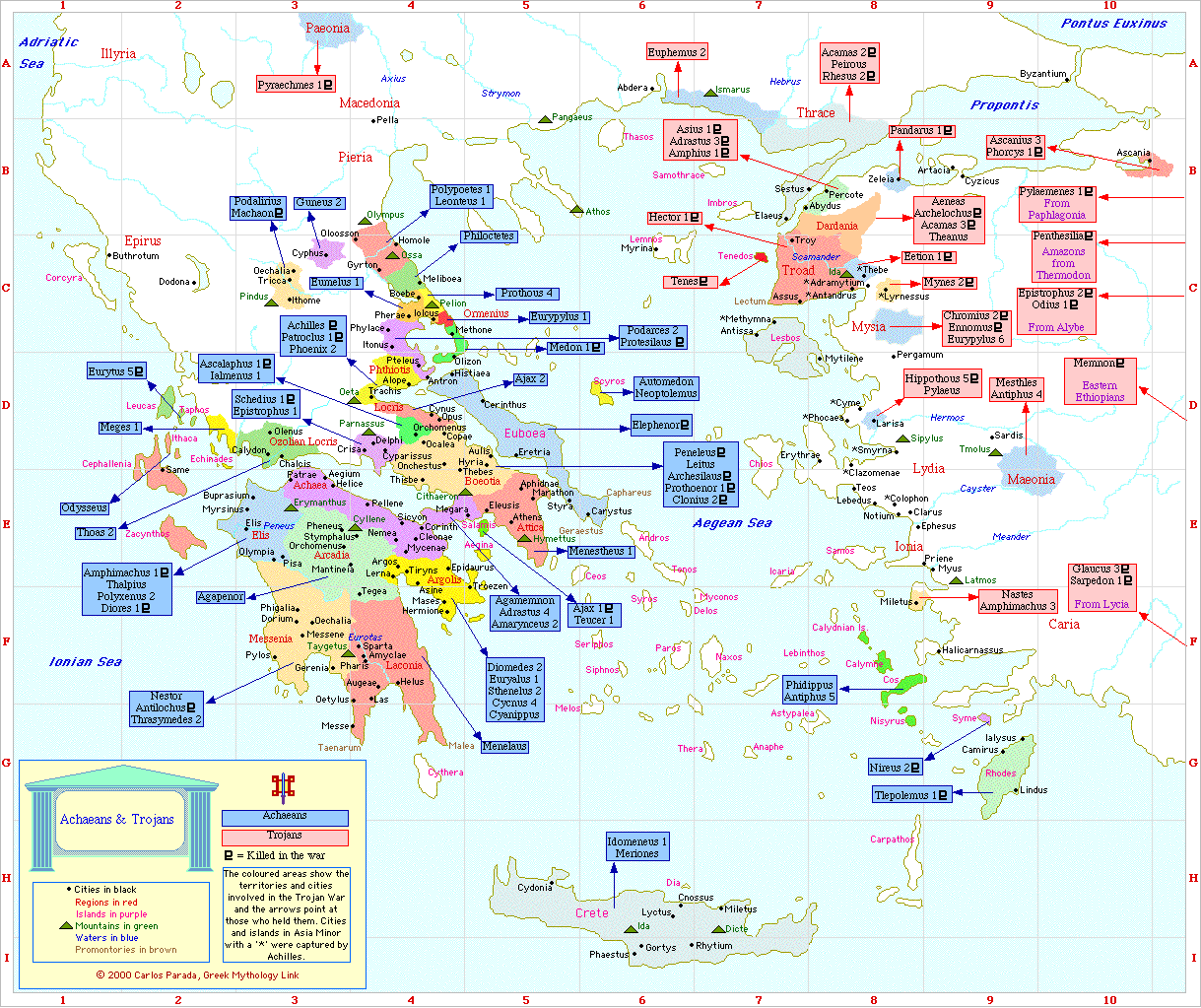 |
| Greeks vs Trojans and their allies in the Trojan war mentioned by Homer |
No mention of any Slavs or Proto-Slavs, of course, and we should not expect such a ludicrous anachronism: there would be no mention of Slavs by anyone, for the next 1400 to 1800 years in that area of the world.
"For more details on the subjects covered in this article, consult the works of:
Homer, Herodotus, Anthony Ambrozic, Eugene Borza, Mario Alinei, Vasil Ilyov, Valeriy A. Chudinov, and Sergei V. Rjabchikov."
Since we already checked the works of Homer and Herodotus, lets us leave the assorted delirious nuts of the Ambrozic, Alinei, Ilyov, Chudinov, and Rjabchikov type out of the mix for now and go will go back to Professor Eugene Borza, as we were asked, for a moment.
We will not consult Professor Borza on the Slavic nature of the imaginary Trojan-ovskis or the single-breasted proto-Slavianki Amazon-ovas. We will ask him something simpler, to talk about the ethnic nature of the Macedonians, since that is where the juice of the matter is concentrated, and the true reason why such hilarious pseudo-scholarly articles are being crafted and so effectively promoted in the Slavomacedonian ultra-nationalist and other international Slavic-related websites:
"Our understanding of the Macedonians' emergence into history is confounded by two events: the establishment of the Macedonians as an identifiable ethnic group, and the foundation of their ruling house. The "highlanders" or "Makedones" of the mountainous regions of western Macedonia are derived from northwest Greek stock; they were akin both to those who at an earlier time may have migrated south to become the historical "Dorians", and to other Pindus tribes who were the ancestors of the Epirotes or Molossians. That is, we may suggest that northwest Greece provided a pool of Indo-European speakers of Proto-Greek from which were drawn the tribes who later were known by different names as they established their regional identities in separate parts of the country... First, the matter of the Hellenic origins of the Macedonians: Nicholas Hammond's general conclusion (though not the details of his arguments) that the origin of the Macedonians lies in the pool of proto-Greek speakers who migrated out of the Pindus mountains during the Iron Age, is acceptable."
Eugene Borza, "Makedonika", Regina Books, Claremont CA
As for the imaginary author, the Czech named "Tomáš Spevák",
"For comments and inquiries contact the author Tomáš Spevák at brumi@neobee.net (an e-mail which we already know that does not work!) or Risto Stefov at rstefov@hotmail.com"
P.S.Cherry on the pie:
Since no two liars can ever agree on the same lie, here is another loony theory from the land of loony theories. Professora Margarita Kitan Ivanoska from Skopje appearing on national TV (22) where she is in all seriousness "proving" that Troy was not in Anatolia, where Homer and the ancients tell us that it lay, and where Schliemann found it, but somewhere in Southwestern FYRoMakedonija. The question is now pseudo-"linguistic": was it Mariovo-Troyjovo (3:10 in the video), or was it in Ostrovo-Troyjovo (4:40 in the video)!
Zeus help us!
http://www.youtube.com/watch?v=FyBZ-IhZwfA&feature=related
NOTES & REFERENCES:
1. http://slavija.proboards.com/index.cgi?action=display&board=general&thread=4504&page=1#38083
2. http://www.maknews.com/html/articles.html#spevak
3. I do not want to hear any doubts about the historic certainty that Shakespeare was a Slavomakedonski. Even if he has not been claimed as such till now, that is only because upcoming books of Donski and Stefov "proving" that he was a Skopjan, like Alexander the Great, Aristotle, George W. Bush and Queen Elizabeth, among others, have not hit the Toronto and Melbourne bookstores as yet: patience!
4. http://forum.kajgana.com/archive/index.php/t-21356.html, http://illyria.proboards.com/index.cgi?board=ancientgreece&action=print&thread=23027 , etc
5. Ηροδότου Ιστορίαι Α.56.2&3
6. Ηerodotus I.56.2&3, Herodotus, with an English translation by A. D. Godley. Cambridge. Harvard University Press. 1920.
7. "Macedonia Redux", in "The Eye Expanded: life and the arts in Greco-Roman Antiquity", ed. Frances B Tichener & Richard F. Moorton, University of California Press, 1999
8. http://macedonianissues.blogspot.com/2010/06/macedonian-names-and-makedonski-pseudo_16.html, http://macedonianissues.blogspot.com/2010/05/macedonian-names-and-makedonski-pseudo_29.html, etc.
9. http://macedonianissues.blogspot.com/2010_01_01_archive.html
10. http://www.youtube.com/watch?v=Ds1yjWYmb60&feature=related
11. http://issuu.com/petro_invictus/docs/slavic_elements_in_homer
12. Perica and Dissosiative Identity Disorder:
http://www.facebook.com/topic.php?uid=7149853022&topic=5277
13. http://macedonianissues.blogspot.com/2011/01/can-classical-mythology-be-explained.html
14. http://www.maknews.com/html/articles.html#spevak
15. Mail Delivery Subsystem
to me
show details 11:18 AM (22 hours ago)
Delivery to the following recipient failed permanently:
brumi@neobee.net
Technical details of permanent failure:
Google tried to deliver your message, but it was rejected by the recipient domain. We recommend contacting the other email provider for further information about the cause of this error. The error that the other server returned was: 550 550 This account is too old and inactive. This is a permanent error. (state 14).
16. NEOBEE.NET | Novi Sad, Narodnog fronta 55a | Beograd, Kralja Petra 20 | Niš, Cara Dušana 35
17. http://macedonianissues.blogspot.com/2011/02/amazingly-amusing-musings-on.html
18. http://www.youtube.com/watch?v=xYDJ_i4cZxY&feature=related
19. "There was not enough evidence fruitfully to speculate upon the language of Troy until 1995, when a late Hittite seal was found in the excavations at Troy, probably dating from about 1275 BC. Not considered a locally-made object, this item from the Trojan "state chancellery" was inscribed in Luwian and to date provides the only archaeological evidence for any language at Troy at this period. It indicates that Luwian was known at Troy, which is not surprising since it was a lingua franca of the Hittite empire, of which Troy was probably in some form of dependency." From: http://en.wikipedia.org/wiki/Trojan_language#cite_note-3
20. Another sphere of research concerns a handful of Trojan personal names mentioned in the Iliad. Among sixteen recorded names of Priam's relatives, at least nine (including Anchises and Aeneas) are not Greek and may be traced to "pre-Greek Asia Minor".[3] On this basis Calvert Watkins in 1986 argued that the Trojans may have been Luwian-speaking. For instance, the name Priam is connected to the Luwian compound Pariya-muwa, which means "exceptionally courageous".[4]Additionally, the Alaksandu treaty describes Mira, Haballa, Seha and Wilusa (usually identified with Troy) as the lands of Arzawa, although this "has no historical or political basis",[5] suggesting that it was the language that they had in common. Frank Starke of the University of Tübingen concludes that "the certainty is growing that Wilusa/Troy belonged to the greater Luwian-speaking community".[6] http://en.wikipedia.org/wiki/Trojan_language#cite_note-5
21. http://www.scribd.com/doc/44668910/Midas-and-the-Phrygians
22. http://www.youtube.com/watch?v=FyBZ-IhZwfA&feature=related


