Showing posts with label Donski. Show all posts

Tuesday, December 7, 2010

Macedonian names and makeDonski pseudo-linguistics: The case of the name Sopolis


Miltiades Elia Bolaris

http://www.americanchronicle.com/articles/view/134835

Balkan Illusion - phantasia archaica:

"...it is very interesting to note that many of the authentic ancient Macedonian words, according to their etymology and pronunciation, have a striking resemblance to the appropriate words used in the modern Macedonian language (and other so called "Slav"[sic] languages). "Sopol(is). This ancient Macedonian name is mentioned by the Greek historian Arrian as the name of a Macedonian officer in the army of Alexander the Great. It obviously contains the root "sopol" (a strong spring) from the so called "Old Slavic language"[sic]. The name Sopol is present in todays' Macedonian onomasticon." Quote taken from: "Similarities between ancient Macedonian and today's' Macedonian Culture (Linguistics and Onomastics)" quote by Aleksandar Donski, celebrity historian and propagandist of pseudo-Makedonism in FYROM.

Sopolis / Σώπολις

An original and very informative book was published by Blackwell Publications in 2005: "Who's Who in the Age of Alexander the Great"; edited by Waldemar Heckel. This book includes more than eight hundred brief biographies of persons from the age of Alexander the Great; names of Alexander´s commanders and soldiers as well as other Greek or Asian personages, found in the literary or epigraphic record. It is widely viewed as the only complete collection of its kind printed in the English language. It is in this book that we find a biography on a Macedonian commander named Sopolis.

Sopolis Hermodorou/Σώπολις Ερμοδώρου (= son of Hermodoros) appears as one of the ilarchs (Ἰλαρχος-cavalry squadron leader) of Alexander's companion cavalry the Hetairoi/Εταίροι.

We first hear of him in the Balkan campaign of Alexander, against the Triballians, leading the ile (cavalry squadron) of Amphipolis, along with Heracleides son of Antiochos, in 335 BC.

Ἡρακλείδην δὲ καὶ Σώπολιν τοὺς ἐκ Βοττιαίας τε καὶ Ἀμφιπόλεως ἱππέας κατὰ τὸ εὐώνυμον κέρας ἐπάγειν ἔταξε. ΄Αρριανοῡ ΄Αλεξάνδρου ΄Ανάβασις, Βιβλίον A',2

Heracleides and Sopolis, who were leading the cavalrymen from Bottiaea and Amphipolis, he ordered them to take up position at the left flank.


Arrian, Alexander Anabasis, Book I,2

We next hear him at his most glorious moment, leading once again the cavalry squadron of the city of Amphipolis against the Persians, at the decisive battle of Gaugamela, in 331 BC.

Ἀλεξάνδρῳ δὲ ἡ στρατιὰ ἐκοσμήθη ὧδε. τὸ μὲν δεξιὸν αὐτῷ εἶχον τῶν ἱππέων οἱ ἑταῖροι, ὧν προετέτακτο ἡ ἴλη ἡ βασιλική, ἧς Κλεῖτος ὁ Δρωπίδου ἰλάρχης ἦν, ἐπὶ δὲ ταύτῃ ἡ Γλαυκίου ἴλη, ἐχομένη δ' αὐτῆς ἡ Ἀρίστωνος, ἐπὶ δὲ ἡ Σωπόλιδος τοῦ Ἑρμοδώρου, ἐπὶ δὲ ἡ Ἡρακλείδου τοῦ Ἀντιόχου, ἐπὶ ταύτῃ δὲ ἡ Δημητρίου τοῦ Ἀλθαιμένους, ταύτης δὲ ἐχομένη ἡ Μελεάγρου, τελευταία δὲ τῶν βασιλικῶν ἰλῶν ἧς Ἡγέλοχος ὁ Ἱπποστράτου ἰλάρχης ἦν. ξυμπάσης δὲ τῆς ἵππου τῶν ἑταίρων Φιλώτας ἦρχεν ὁ Παρμενίωνος.
΄Αρριανοῡ ΄Αλεξάνδρου ΄Ανάβασις Βιβλίον Γ',11

Alexander's army was marshaled as follows: The right wing was held by the cavalry Companions, in front of whom had been posted the royal squadron, commanded by Kleitos, son of Dropidas. Near this was the squadron of Glaucias, next to it that of Ariston, then that of Sopolis, son of Hermodoros, then that of Heraclides, son of Antiochos. Near this was that of Demetrios, son of Althaemenes, then that of Meleagros, and last one of the royal squadrons commanded by Hegelochos, son of Hippostratos. And Philotas led the whole of the companion cavalry, the son of Parmenion.
Arrian, Alexander Anabasis, Book III,11

It is obvious from the text that Sopolis was a high standing member of the Macedonian aristocracy and his son Hermolaos was one of Alexander's Royal Pages (Βασιλικοί Παίδες/Basilikoi Paides). Hermolaos later became involved in the "pages conspiracy" and was executed for it.

Sopolis, the Macedonian aristocrat and cavalry leader was not the only man with that name that left his mark in history. Several other men by this name have come down to us. One of them is mentioned by Isocrates/Ισοκράτης, the celebrated Athenian speech writer of antiquity. Isocrates is the man who wrote the Panegyric speech and the letters addressed to Philip II and to Alexander the Great of Macedonia, urging each of them to unite all other Greeks under their leadership and lead them on an expedition against the Persian empire.

In Isocrates' Aeginiticos/Αίγινητικός, probably the best of his forensic speeches, we hear of a man born of an Athenian father and a mother from the island of Seriphos, in the Cyclades.

9] μετὰ δὲ ταῦτ' ἔγημεν ἐκ Σερίφου παρ' ἀνθρώπων πολὺ πλείονος ἀξίων ἢ κατὰ τὴν αὑτῶν πόλιν, ἐξ ἧς ἐγένετο Σώπολις καὶ Θρασύλοχος καὶ θυγάτηρ ἡ νῦν ἐμοὶ συνοικοῦσα.

Iσοκράτους Αιγινητικός,

9] After this, he married a woman of Seriphos, belonging to a family of greater consequence than might be expected of a native of their island. Of this marriage were born Sopolis, Thrasylochos, and a daughter, who is my wife.

Isocrates, Aeginiticus, translation by George Norlin

The name Sopolis also appears in art, namely in theater. In the second century AD, Lucian(os) of Samosata (Λουκιανός o Σαμοσατεύς) writes his comedy Lexiphanes, where one of main characters appears to be a man named Sopolis:

ΣΩΠΟΛΙΣ Τί δὲ νοσεῖ, ὦ Λυκῖνε, Λεξιφάνης;

SOPOLIS Lycinos, what is the matter with Lexiphanes?

ΛΥΚΙΝΟΣ Αὐτὰ ταῦτα, ὦ Σώπολι. οὐκ ἀκούεις οἷα φθέγγεται; καὶ ἡμᾶς τοὺς νῦν προσομιλοῦντας καταλιπὼν πρὸ χιλίων ἐτῶν ἡμῖν διαλέγεται διαστρέφων τὴν γλῶτταν καὶ ταυτὶ τὰ ἀλλόκοτα συντιθεὶς καὶ σπουδὴν ποιούμενος ἐπ᾽ αὐτοῖς, ὡς δή τι μέγα ὄν, εἴ τι ξενίζοι καὶ τὸ καθεστηκὸς νόμισμα τῆς φωνῆς παρακόπτοι.

ΛΥΚΙΝΟΣ

Αὐτὰ ταῦτα, ὦ Σώπολι. οὐκ ἀκούεις οἷα φθέγγεται; καὶ ἡμᾶς τοὺς νῦν προσομιλοῦντας καταλιπὼν πρὸ χιλίων ἐτῶν ἡμῖν διαλέγεται διαστρέφων τὴν γλῶτταν καὶ ταυτὶ τὰ ἀλλόκοτα συντιθεὶς καὶ σπουδὴν ποιούμενος ἐπ᾽ αὐτοῖς, ὡς δή τι μέγα ὄν, εἴ τι ξενίζοι καὶ τὸ καθεστηκὸς νόμισμα τῆς φωνῆς παρακόπτοι.

LYCINOS

This indeed is the matter, Sopolis, don't you hear what he says? He leaves us his contemporaries, and goes a thousand years off to talk to us, which he does by twisting his tongue and exercising in fact extraordinary ways—taking pride on this in fact, as if it were a great thing to disguise as a stranger yourself, and mutilate the currency of conversation.


Lexiphanes by Lucianus 2nd c AD / Λουκιανού Λεξιφάνης, Β' αιων μΧ.

The Greek epigraphic record is full of mentions of men with this name. We chose a few from very different places. The first is from Athens and it is a list of names of athletes and their respective sport that they won first place:

Regions : Attica (IG I-III) : Attica
IG II² 2313
Att. — Athens: Akr. — 194/3
lines 26-31, only, where Sopolis appears]

Ἀλ]κ[α]ῖος Λευκίππου Ἀλικαρνασ[σεύς]
πάλην
— — —ς Ἡγησιάνακτος Κολοφώνιος
πυγμήν
Ἀρισ]ταῖος Σωπόλιδος Ζμυρναῖος
παγκράτιον

Alcaeos son of Leukipos an Alicarnaseus
Wrestling
— — —s son of Hegesianax a Colophontian
Boxing
Aristaios son of Sopolis a Smyrnaian.
Pangration wrestling


From the city of Eretria, on the island of Euboea, is the following inscription:

IG XII,9 249
Euboia (IG XII,9) : Eretria

Λάκ[εθ]ε[ν]· Σώπολις Φιλίππου.
Φίλιππος Σωπόλιδος. . . .
ἐκ Κωμαιῶν·
Σώπολις Σωκρίτο(υ).
Ταμύνηθεν·

from Lakei
Sopolis son of Philippos
Philippos son of Sopolis
from Komai
Sopolis son of Socritos
From the Tamyne


From Thessaly:
SEG 16:375
Thessaly (IG IX,2) : Malis

Σώπολις Εὐκ-
ρατίδα.

Sopolis son of Euk-
ratidas

From the city of Didyma, with its celebrated temple of Apollon, close to Ephesos, in what is now Turkey, comes a dedicative plaque to a man, named Sopolis that helped built the temple:
The Temple of Apollon at Didyma, now part of Turkey
Didyma 179
Ionia

Σώπολις Ἀντιγόνου τοῦ Εὐκράτου
προνοήσας τῆς οἰκοδομίας τοῦ ναοῦ

Sopolis son of Antigonos from the town of Eucratis
who oversaw the building of the temple


South of Ephesos and Didina, but still in ionia, in the city of Miletos we encounter a long list of Greek names, of the eponymous crown-carriers (stephanephoroi) at the temple of Apollo during the second part of the first cBC:

Regions : Asia Minor : Ionia, Miletos 108
List of eponymous stephanephoroi from 53/2 to 18/7 BC; cut
annually: *Milet I 3, 126 (PH). Ion. — Ephesos(?) — Kat.23 — Milet I 3, 126

Πραξίας Πραξίου
Ἀριστέας Λυσιμάχου
Σώπολις Λυσιμάχου,
Διονύσιος Ἑκαταίου
Λυσίμαχος Λυσιμάχου
Σώπολις Ἀντιγόνου
Ἡγήμανδρος Ἡγημάνδρου

Praxias son of Praxias
Aristeas son of Lysimachos
Sopolis son of Lysimachos ,
Dionysios son o Hecataios
Lysimachos son of Lysimachos
Sopolis son of Antogonos
Hegemandros son of Hegemandros


Further north, by the Crimean peninsula (Chersonesos), close to Kherson of modern Ukraine, a man named Sopolis appears on an inscription as the husband of a woman named Arkeso:
Ruins of the Greek city of Chersonesos-Kherson in the Crimea, in Ukraine

Regions : North Shore of the Black Sea\  NEPKh II 125
N. Black Sea — Chersonesos — 3rd c. BC

Ἀρκ̣ε̣σ̣ὼ̣ Ιπ․․․․λ̣[ι]ος
Σω̣π̣[ό]λιος̣ γυ̣ν̣ὰ
ἱ̣ε̣ρ̣ᾶ̣[ι] Σ̣ω̣τ̣[ε]ί̣[ρ]α̣ι̣.

Arkeso daughter of Hip….lis
wife of Sopolis
to the holy Savior


Ιn the Sicilian city of Segesta/Σεγέστα, close to Palermo, the ancient Panormos/Πάνορμος, we locate a funerary plaque dedicated by a son to his mother:

Sicily, Sardinia, and neighboring Islands
Regions : Sicily, Italy, and the West (IG XIV) : Sicily, IGLPalermo 47
Sikelia — Segesta — 2nd c. BC — IG XIV 288ii

Σώπολις Φαλάκ[ρου τ]ὰν αὐτοῦτα ματέρα
— — — —]αν Φαλ[ακρ]ίαν εὐνοίας ἕνεκα.

Sopolis son of Phalacros to his own mother
— — — —]an Phalacrian for the sake of benevolence/good will.


Another Sicilian man appears on an inscription found Delphi, in Central Greece:

FD III 4:127[2]
Delphi

Σώπολις Νουμηνίου Συ[ρακόσιος]· ...
Sopolis son of Noumenios a Syracusan;...


Southeast of Sicily, in the Greek city of Cyrenaica/Κυρηναϊκή in Libya, yet another Sopolis appears in the epigraphic record:

Regions : Egypt, Nubia and Cyrenaïca : Cyrenaïca
SEG 20:735
Cyrenaica — Cyrene — end 4th bc

Σῶσις — — — — —
Sosis

Πολιάνθης — — — — —
Polyanthes

Χάρων — — — — —
Charon

Σώσιππος — — — — —
Sosippos

Φιλόξενος 
Philoxenos

Πράταρχος Ἰάσονος 
Pratarchos son of Jason

Σώστρατος Πρατάρχω 
Sostratos son of Pratarchos

Ἀριστοτέλης Π̣ρ̣α̣ξιτίμω
Aristoteles son of Praxitimos

Σώπατρος Ἀριστοτέλε[υς
Sopatros son of Aristoteleus


Ἀσκλαπιόδοτος Ἁλιοδώρω 
Asclapiodotos son of Aliadoros

Σώπολις Καρταγόρα
Sopolis son of Kartagoras


Incidentally, Cyrenaica in Libya was also the home city of one of the most illustrious poets and literary critics of Hellenistic antiquity, Callimachos of Cyrene / Καλλίμαχος ὁ Κυρηναίος (310 BC/305 BC-240 BC). He was a prominent scholar at the Great library of Alexandria, in Egypt, under the Greek Pharaohs Ptolemaios II, Philadelphos and Ptolemaios III Euergetes. Although he never became the chief Librarian (his student Apollonios of Rhodos / Ἀπολλώνιος Ῥόδιος did, to Callimachos´ great distress), he is credited with compiling the first catalogue, called the Pinakes/Πίνακες, the Tables of all the manuscript volumes in the library of Alexandria. One of Callimachos´ famous epigrammatic poems is an epitaph, a funerary poem, for a youth that drowned in the Sea. A cenotaph, an empty tomb, was erected in his memory:

Ωφελε μηδ´ ´εγένοντο θοαί νέες ού γάρ άν ημείς
παίδα Διοκλείδου Σώπολιν εστένομεν
Νύν δ´ο μέν είν αλί που φέρεται νέκυς αντί δ´εκείνου
ούνομα και κενεόν σάμα παρερχόμεθα
Σώπολις, Καλλίμαχος

Would that swift ships had never been,
for we should not have bewailed Sopolis son of Diocleides;
but now somewhere in the sea he drifts dead,
and instead of him we pass by a name on an empty tomb.
Sopolis (An empty tomb), by Callimachus


Sopolis is not a unique Greek name, it is rather typical. As a matter of fact, numerous names of similar phonetics and etymology can be found throughout the Greek world. On a recent trip to Monastiri/Bitola, in FYROM, I bought a book Eпнграфски сведоштва за жителите на Cтибера/Epigrafski svedoshtva za zhitelite na Stybera, by the local archeologist Весна Калпаковска/Vesna Kalpakovska, on ancient epigraphy from the ancient Paionian / Macedonian city of Stybera/Στύβερα.

Ancient Greek statues from Stybera used as crude pseudo-makedonist
propaganda props in front of Nikola Gruevski's offices in Skopje


Stybera was originally a Paeonian city, whose population, after their inclusion by Philip II into the Macedonian state, was eventually absorbed becoming completely Hellenized. Its ruins lie in the plains midway between the modern cities of Prilep/ Περλεπἐς/Прилеп and Monastiri/Μοναστήρι-Bitola/Битола, the ancient Heracleia/Ηράκλεια. Both Prilep and Bitola, as well as Stybera, lie now within the borders of former Yugoslavia and FYROM. The area in ancient times was called Pelagonia/Πελαγονία, meaning the "great prairies", a name derived from the word pelages/πέλαγος, signifying "a wide flat area" - in land or sea (see: archipelago). The Modern Slavic inhabitants of FYROM have in fact kept the ancient Greek name for the area, slightly altered to accommodate south-Slavic phonetics: Pelagonija/Пелагонија (same case as with the Hellenic name Macedonia/Μακεδονία which in south Slavic dialects is pronounced Makedonija/Македонија). Stybera/Στύβερα is incidentally the archaeological site from which the Gruevski regime took the ancient Greek statues that it so carelessly and in a very third world parochial way is now exhibiting (exposed to the elements and pollution) in front of the Presidential building in Skopje, in a shameless attempt to make a connection with ancient Macedonia.
Searching for names similar to Sopolis, names that start with So- (Greek: Σω-), in the epigraphic record of Stybera, we soon discover some exciting finds. A funerary dedication on a marble plaque of a certain Ailianos Pantauchos who lived and died in the 3rd c AD we find the female name Sosipatra/Σωσιπάτρα (in masculine form: Sosipatros/Σωσίπατρος):

Αιλιανόν Πάνταυχον
Αιλιανή Σωσιπάτρα
η αδελφή καί οι αδελφίδεις
Μενεκράτης καί Μαξι
μα...

To Ailianos son of Pantauchos
Ailiane Sosipatra
by (his) sister and nephews
Menekrates and Maxi
ma...


Again in Stybera on a marble stele of 41-48 AD we read a long list of names of the city's ephebe (teenage boys) who were exercising in the Gymnasion under the Ephebarch ("leader of the teenagers", an official trainer, appointed by the city council) Epigenos son of Aperos, at the time when Treasurer (Tamias) was Paramonos son of Philippos and member of the council were Apollodoros son of Diocles, etc etc:

ετους,,,,
αλειφουσης της πολεως
εγλαβοντος.............
αλειψαι
κυαθω ηλιψεν δρακτω απο
ωρας τεταρτης αχρι ωρας
δεκατης πωλουμενου
τριων ανεγραψε τους εφεβους
εφεβαρχουντος Επιγενου του Απερος
ταμιευοντος Παραμονου του Φιλιπου
πρωτοσταται Απολλοδω
ρος Διοκλεως Ρουφος Απολ
λλοδωρου Παραμονος Με
νελαου...


and we go down the list of the names until we find the name:

Σωσιστρατος Φιλωνος
Sosistratos Philonos (Sosistratos son of Philon).


On a list of a few years later, from 74-75 AD we find a possible descendant of Sosistratos, most probably his son, named Φιλων Σωσιστρατου / Philon Sosistratou / Philon son of Sosistratos among other names such as Νεικαρχος Φιλωτα / Neikarchos son of Philotas, Απολλωνιος Ευβουλιδου / Apollonios son of Euboulides, Επιγενης Παρμενιωνος / Epigenes son of Parmenion and Ευτυχος Κλεαρχου / Eutychos son of Klearchos, etc etc.

Then on a similar list of the city's ephebe from 74-75 AD, among such poetic Greek names as Αντιγονος Ολυμπιαδου (Antigonos son of Olympiades) and Υμνος Ερωτος / Hymnos son of Eros (a very poetic name, incidentally, whose name in Greek can also be read as: "Hymn to Eros") we find also a certain Παραμονος Σωσιστρατου / Paramonos Sosistratou (Paramonos son of Sosistratos).

In Stybera, among the more than 300 or so names that the epigraphists have been able to discover, we encounter several other Greek names that start with So- / Σω-. Besides the ones mentioned above, we also find: Aιλιανή Σωσιπάτρα / Ailiane Sosipatra (daughter of Sosipatras) and Διονύσιος Σωπάτρου / Dionysios Sopatrou (son of Sosipatros).

Let us isolate for a moment these two names, along with Sosistratos which we encountered above and look at them closer. The similarities between Sopolis, Sopatras, Sosipatros and Sosistratos are obvious and striking: So-polis, So-patras Sosi-patros, Sosi-stratos. To demonstrate this case even further , I would like to mention the name of the :
"International Institute of Ancient Hellenic History" / 
"Διεθνές Ινστιτούτο Αρχαίας Ελληνικής Ιστορίας", also known as: 
"Σωσίπολις / Sosipolis"
Here is how and why the Institute chose its name:

"The International Institute of Hellenic History names "Sosipolis" from "Sosipolin".Sosipolis: According to Pausanias, Sosipolis was worshipped as a local demon in Elis. Tradition holds that during a raid on Elis by the Acardians the attackers were frightened off by the naked infant that the Elians placed at the front of their forces. When the Arcadians attempted to approach the child it turned into dragon. Disturbed by this sight, the Arcadians ran away, leaving the Elians as the victors, who thus named the god Sosipolis. They established a sanctuary at the point where the dragon entered the earth after the battle, and worshipped him alongside Eileithuia (a goddess who assisted in childbirth) as they believed that it was she who brought this child to the people.
The International Institute of Ancient Hellenic History “Sosipolis” is a legal private entity and a non-profit organisation based in the prefecture of Ilia."

http://www.sosipolis.gr/site/content.php?sel=173

Polis/Πόλις in Greek means city and patros/πατρός means "of the father" - father, in the genitive form. Nominative:pater/πατήρ – genitive:patros/πατρός, as it appears in Anti-patros/Ἄντίπατρος (better known in English as: Antipater). Antipatros/ Ἄντίπατρος, a famous Macedonian name, was the name of of Alexander the Great´s viceroy). Stratos/Στρατός means army. The word Strategos/Στρατηγός means the leader of the army, and hence the word strategy, the art of leading an army to victory.
To be more precise, we open a dictionary of the Greek language and we find the nown Sos / Σώς (which in various ancient Greek dialects also appears as Soos / Σώος and Saos / Σάος) which means: safe, sound, someone that keeps far and away from danger. 
Polis/πόλις, as we said earlier means city. I hardly need to explain this word. It has entered many other languages. The American cities Indianapolis and Minneapolis, the Brazilian cities Florianopolis and Petrópolis, Istambul (paraphrase of Constantinoupolis/Κωνσταντινούπολις) and Gelibolu (paraphrase of KallipolisΚαλλίπολις) in Turkey, Lazaropolis/ЛАЗАРОПОЛЕ/Λαζαρόπολη in FYROM, Plovdiv/Пловдив (a paraphrase of Philipoupolis/Φιλιππούπολις), Actopol/Акторол (Actopolis/Ακτόπολις) in Bulgaria, Tarabulus/Tripolis/Τρίπολις in Lebanon, Libya and also in Greece, Napoli of Italy (Neapolis/Νεάπολις) and also again in Greece, Simferopol/Сімферополь/Симферополь (Symferoupolis/Συμφερούπολις) in Ucraine and also Alexandroupolis/Αλεξανδρούπολις in Greece, all have one thing in common: they are all cities containing this word in the end: Polis, meaning city. On top of that, we also keep in mind how Greeks name the fort on the upper part of a city of any city, but most famously the one in Athens: Acropolis/Ακρόπολις (acron + polis) meaning "the citadel".

Sopolis/Σώπολις now makes perfect sense: it is "He who saves (protects) the city": Sopolis=Savior-of-the-city!

Likewise, Sopatros, Sopatras and the variant Sosipatros all mean savior/protector of his father. Sosistratos / Σωσίστρατος (Sos + stratos = army) means savior of the army.

In Stybera we encounter yet more similar sounding Greek names :

We find a certain Lysis Sosistratou / Λύσις Σωσιτράτου / Lysis son of Sosistratos : Lysis is the first name and and it appears in nominative form while the patronym Sosistratos appears in genitive: Sosistratou (the patronym in Greek always appears in the genitive form : i.e. Alexandros Philippou (son of Philippos). In Greek onomastics the patronym played the role of today's last name.

Still in Stybera, in Vesna Kalpakovska´s informative book we find still more marble inscriptions with names such as: Παράμoνος Σωσιστράτου / Paramonos Sosistratou / paramonos son of Sosistratos, Σωσιας Ευβουλίδου / Sosias Euboulidou, Sosias son of Euboulides, Σωσιας Λυσία / Sosias Lysia, Σωσίας Διοσκουρίδου / Sosias Dioskouridou / Φίλων Σωσιτράτου / Philon Sosistratou.

We open Ioannes Stamatakos' monumental Lexicon of the Ancient Greek Language (Lexicon tes Archaeas Hellenikes Glosses, Athens, 1971) and a river of names runs out of it that comes to join Sopolis / Σώπολις:

Sozon / Σώζων=the one who saves.

Sosias / Σωσίας=the one who has been saved.

Sosas / Σώσας=he who has saved someone.

Sobios / Σώβιος=the savior of life (Sos=savior + bios=life).

This name also appears as: Sosibios / Σωσίβιος.

(Sosibio / Σωσίβιο (sos+bios=life) is incidentally the word used in modern Greek for "life jacket", the life-saving floating devise found on boats).

Sogenes / Σωγένης=the savior of the family-tribe (Sos+genos=tribe/family).

This name also appears as Sosigenes / Σωσιγένης

Sodemos / Σώδημος=the savior of the people (Sos+demos=people).

This name also appears as Sosidamos / Σωσίδαμος and Sosidemos / Σωσἰδημος.

Sophilos / Σώφιλος = the one who saves his friends

Sophron / Σώφρων=the one who has safe mind (prudent) (Sos+Phren=mind).
This name also appears as: Σωφρώνιος.

Sotimos / Σώτιμος=savior/protector of the honor (Sos+time´/τιμή=honor).

Sotheos / Σώθεος=savior/protector of the Gods (Sos+Theos/Θεός=God) or, more loosely, of the religion.

Sosandros / Σώσανδρος=savior or men (Sos+aner/ανήρ [genitive: Andros/ανδρός]=man).

Soterios / Σωτήριος=of the Savior.

Socrates, from a Roman fresco
Socrates / Σωκράτης = the one who saves (holds, controls) his strength (Sos+kratos=strength).

This of course is also the name of the Athenian philosopher, Socrates, the teacher of Plato, who put the foundations of Western Philosophy.

Somachos / Σώμαχος=the one who saves/protects in battle (Sos+mache/μάχη=battle).
Sooikos / Σώοικος=savior/protector of the home (Sos+oikos=home).
This name appears also as Sooekides / Σωοικίδης.

Sopatros / Σώπατρος=savior of his father (Sos+patros/πατρός=father).
Sostratos / Σώστρατος=savior of the army (Sos+stratus/στρατός=army).
Soter / Σωτήρ=Savior (a prosonym of Ptolemaios I – Soter Πτολεμαίος Α' – Σωτήρ (The savior), given to him by the Rodians for saving them through his assistance during the siege by Demetrios Poliorketes. The same prosonym was also given to the King of Seleucid Syria Antiochos I, Soter (The savior) /Αντίοχος Α΄ Σωτήρ (324 -261 BC) for his defeat of the Gauls in 275, by the appreciative Ionians.

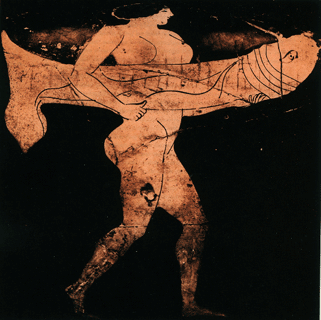
Soter / Σωτήρ=Savior is now as a prosonym for Christ – The Savior, in Italian: Salvatore, in Spanish: Salvador). The early Christians used the fish as a symbol of their faith, along with the cross. This is because in Greek fish is called Ichthys and it is spelled as: ΙΧΘΥΣ. It was used as an acronym for Ιησούς Χριστός Θεού Υιός Σωτήρ -Iesous Christos Theou Yios Soter, meaning: Jesus Christ God´s Son Savior: Soter / Σωτήρ=Savior.

Sopolis/Σώπολις as the literary and epigraphic record indicates is not a name found exclusively in Macedonia. It is a typical Greek name used throughout the Hellenic speaking word, from Athens to Macedonia to the southern Aegean and from Asia Minor and Syria to Southern Italy. The Greek name Sopolis has obviously no connection whatsoever with the Slavic root "sopol" (a strong spring), as professor Donski claims. If he insists, we will have to ask him to find a Slavonic meaning for all the other "So-"/Σω and "-polis"/πολις derived Greek names, starting with Socrates/Σωκράτης, and Amphipolis/Αμφίπολις and continuing with all the names we found at Stybera. 


If he had looked into it a bit further, he would have found that the Bulgarian (and Slavomacedonski) word "sopol/сопол" he is thinking about, is derived from the Old Church Slavonic vъ-slěpljǫ, which is also related to Slavonic*solpъ and Slovenian slâp meaning "waterfall, surge"; Also to Slavic *selpjǫ, *sьlpati `spring' in ds., Infin. and to Church Slavonic slьpati. The original root/lemma, according to Julius Pokorny´s Indo-European Dictionary is: sel-4, which means "to spring". The Slavonic vъ-slěpljǫ is distantly related to the Latin word saltus "sprung", and curiously also to salax "horny, lustful", to the Lithuanian word sálti "flow" and to the Greek ἅλλομαι "spring" from (*seli̯ō), ep. Aor. ἆλτο, Verbaln. and ἅλμα "Sprung", the jump.

http://dnghu.org/indoeuropean.html

It is obvious that professor Donski has the wrong "sopol/сопол" in mind.

The Greek name Sopolis/Σώπολις on the other hand is derived from a completely different root. We look at Pokorny again as our source. The original meaning is derived from the Indo-European root / lemma: tēu-, tǝu-, teu̯ǝ-, tu̯ō-, tū̆- ,, meaning "to swell" but later acquiring the connotation of "being strong". Material, according to Julius Pokorny´s Indogermanisches Etymologisches Woerterbuch is as follows:

Greek σάος (kypr. ΣαFοκλέFης), Kompar. σαώτερος, contracted ion. att. σῶς, σῶος `heil, unversehrt; certainly' (from *tu̯ǝ-u̯o-s); compare M. Leumann Gedenkschrift Kretschmer II 8 f.; in addition hom. σα(F)όω, hom. att. σώζω (*σωΐζω), Fut. σώσω `retten, receive', σωτήρ `Retter' etc; (`voll an Körper = fit, healthy'); σῶμα n. `body' (*tu̯ō-mṇ `Gedrungenes'), σωματόω `fest make, verdichten'; σώ-φρων (*σαό-φρων) `fit, healthy an Geist, vernünftig'; This, as we find in Pokorny, is in turn related to Old Indian tavīti "strong, in battle", and tavás- `strong, stalwart ', tavásā meaning "power, strength"; taviṣá- "strong", Avestani Persian tavah- n. "power, force".

From Apollonia/Sozopolis
How would someone translate Sopolis into a Slavonic Language? In one case at least they left it un-translated, as it happened with the Black Sea town of Sozopol/Созорол/Sozopolis/Σωζόπολις, the ancient Greek city of Apollonia/Απολλωνία. Apollonia during Byzantium was renamed Sozopolis/Σωζόπολις an etymological counterpart to Sopolis (Sozopolis refers to the city, "saved or protected by the Savior" while Sopolis refers to "the man who saves/protects the city"). After its incorporation into Bulgaria, following the Balkan wars, its Greek inhabitants were exchanged for Bulgarians who left Greece, during the 1920´s population exchange between Greece and Bulgaria. Sozopol/Sozopolis the Savior – city, is now a Black Sea resort, only a few kilometers south of Varna/Варна, Bulgaria´s main port city. If I were to translate Sopolis, in Slavic, Russian in particular, I would probably use the words Город /Gorod or Грaд/Grad for city and Cпас/Spas or Cпасител/Spasitel, both meaning savior. As I understand an exact monolectic expression does not exist in Russian. We can probably say: Spasitel Goroda/Сраситель Города. We actually in the same situation if we try to translate Sopolis/Σώπολις in English, since we will be forced to use at least either two or four words to convey the meaning of Sopolis: "City Savior", or "Savior Of The City". If I were to translate the expression Σωτήρ Νεαπόλεως/Soter Neapoleos, to use another example, meaning Savior of the New-city, in Russian, the words I would use would be Cпас/Spas or Cпасител/Spasitel for Savior and Но́вгород /Novgorod for New-City. Finally, Ιησούς Χριστός Σωτήρ/Iesous Christos Soter, Jesus Christ Savior translated into Bulgarian would give us: Иисус Xpистoс Cпасител/Iesous Christos Spasitel.

When I recently visited FYROM, I visited the main national Museum, which is built on the acropolis of Skopje, across from an old Turkish motel, next to the city´s medieval castle. There is also a church nearby, in Skopje´s kule, (kule=Turkish for "castle") on thus hill which is overlooking Skopje. The church is named after Sveti Spas/Cвeти Спас, the Holy Savior. In the courtyard of the Sveti Spas church is the tomb of Gotche Deltchev/Гоце Делчев (1872-1903). Gotche Deltchev is revered equally by both Bulgarians and Slavomakedonci as being the well-known Bulgarian komitatzi and revolutionary who organized against the Ottomans, and was killed in the service of Bulgaria´s irredentist interests. Someone could now easily argue that this hero/protector of Bulgarism, eternally resting on Skopje-grad/Скопје-град´s Acropolis, is FYROM´s adopted Bulgarian Sopolis, FYROM´s own Spacitel´ Goroda / Cпасител´ Городa / State-Savior.

P.M. Nikola Gruevski in front of Gotche Deltchev's tomb, with the irredentist map of "United Makedonija" hanging from above. The church of Sveti Spas/Cвeти Спас-the Saviour/Σωτήρ/Soter in the background

The only problem I see in this is that Nikola Gruevski/Никола Груевски, the corrupt, chauvinistic and dictatorial Pseudo-Makedonist prime minister of FYROM is already vying for the title!

Reference:

ΒΑΣΙΛΕΩΣ ΣΩΤΗΡΟΣ: The coin at the beginning of the article is of the Greek King of Bactria (Modern Afghanistan Pakistan and Northern India) Menandros/Μένανδρος (Menander in English, Milinda in Hindu texts) (155-130 BC). The legend reads: ΒΑΣΙΛΕΩΣ ΣΩΤΗΡΟΣ ΜΕΝΑΝΔΡΟΥ (BASILEOS SOTEROS MENANDROU), of KING SAVIOR MENANDROS. The Bactrian kingdom, known also as Indo-Greek Kingdom, was set up after the break-up of the empire of Alexander the Great and it was for centuries a beacon of Hellenism in South Asia. It outlasted all other Hellenistic kingdoms, and was finally conquered by the Scythians about 30BC.

Who's Who in the Age of Alexander the Great, by Heckel, Waldemar (ed). Blackwell Publishing, 2005

΄Αρριανού ΄Αλεξάνδρου ΄Ανάβασις / Alexander Anabasis by Arrian

Aeginiticos by Isocrates / Ισοκράτους Λόγοι, Δικανικοί Λόγοι, Αίγινητικός

Λουκιανού Λεξιφάνης / Lexiphanes by Lucianus

Callimachus, Hymns and Epigrams

Ulrich von Wilamowitz-Moellendorff, Ed.

Eпнграфски сведоштва за жителите на Cтибера, by Весна Калпаковска, Bitola, 2004

Λεξικόν τής Αρχαίας Ελληνικής Γλώσσης, Ιωάννης Σταματάκος,Athens, 1971

http://dnghu.org/indoeuropean.html

Indogermanisches Etymologisches Woerterbuch, by Julius Pokorny, 1959

Руско Aнлийуский Cловарь / Russian-English dictionary by V.K. Mueller and S.K. Boyanus, Moscow, 2004

Friday, December 3, 2010

Macedonian names and makeDonski pseudo-linguistics: The case of the name Kopria


Το παρόν άρθρο πρωτοεμφανίστηκε στις 2 Αυγούστου του 2009 στο Αμερικανικό διαδικτυακό περιοδικό Αμέρικαν Κρόνικλ:
http://www.americanchronicle.com/articles/view/11266
Μιλτιάδης Ηλία Μπόλαρης
Miltiades Elia Bolaris

Βalkan Illusion - phantasia archaica:

"...it is very interesting to note that many of the authentic ancient Macedonian words, according to their etymology and pronunciation, have a striking resemblance to the appropriate words used in the modern Macedonian language (and other so called "Slav" languages)[sic]"..."Kopria. This name has possible connections to the noun "kopra" (a dill). It is a well-known practice to derive personal names from those of the plant world. In 16th century Macedonia one finds the female name Kopra." From: "Similarities between ancient Macedonian and today's' Macedonian Culture (Linguistics and Onomastics)" by Aleksandar Donski, celebrity propagandist and self proclaimed "historian" from Skopje, FYROM.

Kopria / Copria / Κοπρία:
In the early 1970's, a clay "pithos" type jar was found in Egypt in an illegal excavation. It quickly found its way to the Louvre Museum. Inside it there was a lead sheet insrcibed in Greek and a tiny clay statuette of a female figure in a kneeling, submissive position. Her hands were tied to her back with thirteen bronze pins piercing through her clay body.
In "The ethnic origins of a Roman-Era Philtrokatadesmos (PGM IV 296-434)", Christopher Faraone, professor of Classics at the University of Chicago, describes how this find corresponded closely in text and in the clay doll treatment to another find, inscribed in (PGM IV. 335-406): "Marvelous love binding spell (philtrokatadesmos): Take wax (or clay) from a potter's wheel and make two figurines, a male and a female. Make the male in the form of Ares fully armed, holding a sword in his left hand, and threatening to plunge it into the right side of her neck. And make her with her arms behind her and down on her knees...". Then we hear of several other jars with clay or wax figurines with the thirteen bronze needles pinched in them and the accompanying lead katadesmoi that have been found and are being circulated among museums and legal or (mostly) underground art and antiquities dealers. The (PGM IV 296-434) is unique among them for its length and complexity. It demands from chthonian deities like Pluton, Kore Persephone, Hermes-Thoth and Adonis to bind a girl and "deliver" her - bound through infatuation and erotic passion - to the man who lustfully desires her. The full text of this Philtrokatadesmos can be found in the public domain, but here I will bring the middle part of it, that is of particular interest to us:

"...I adjure you (ἐξορκίζω / exorkizo ), all spirits (δαίμονες / demones ) in this place, to assist this ghost (δαιμων / demon). Rouse yourself for me, corpse spirit ( νεκυδαίμων / nekydemon ), whoever you are, whether male or female, and go into every place, into every quarter, into every house, and bind Κοπρία / Kopria, whom her mother Ταέσις / Taesis bore, the hair of whose head you have, for Αἰλουρίων / Ailourion, whom his mother named Κοπρία / Kopria bore, that she may not submit to vaginal nor anal intercourse, nor gratify another youth or another man except Αἰλουρίων / Ailourion only, whom his mother named Κοπρία / Kopria bore, and that she may not even be able to eat nor drink nor ever get sleep nor enjoy good health nor have peace in her soul or mind in her desire for Αἰλουρίων / Ailourion, whom his mother Κοπρία / Kopria bore, until Κοπρία / Kopria, whom her mother Ταέσις / Taesis bore, whose hair you have, will spring up from every place and every house, burning (with passion), and come to Αἰλουρίων / Ailourion, whom his mother named Κοπρία / Kopria bore, loving (and) adoring with all her soul, with all her spirit, with unceasing and unremitting and constant erotic binding, Αἰλουρίων / Ailourion, whom his mother named Κοπρία / Kopria bore, with a divine love, from this very day, from the present hour, for the rest of Κοπρία / Kopria's life...etc etc...Do not disobey my commands, ghost, whoever you are, whether male or female, but rouse yourself for me and go into every place, into every quarter, into every house, and bind Κοπρία / Kopria, whom her mother Ταέσις / Taesis bore, the hair of whose head you have, for Αἰλουρίων / Ailourion, whom his mother named Κοπρία / Kopria bore, that she may not submit to vaginal nor anal intercourse, nor gratify another youth or another man; and that she may not even be able to eat nor drink nor get sleep nor be at peace in her soul or mind in her desire, day and night, for Αἰλουρίων / Ailourion, whom his mother named Κοπρία / Kopria bore, loving (and) adoring him with all her heart, with all her spirit, like her own soul, Κοπρία / Kopria, whose hair you have, loving with a divine love, until death, Αἰλουρίων / Ailourion, whom his mother named Κοπρία / Kopria bore. Now now quickly quickly! ...and again....and bring Κοπρία / Kopria, her mother Ταέσις / Taesis bore, whose hair you have, to Αἰλουρίων / Ailourion, whom his mother named Κοπρία / Kopria bore, burning, blazing, melting away in her soul, her spirit, her feminine part, loving (and) adoring with a divine love, until death, Αἰλουρίων / Ailourion, whom his mother named Κοπρία / Kopria bore. Now now quickly quickly!..." and so on and so on, it continues...
Bibl.: David G. Martinez, PMich 757: A Greek Love Charm from Egypt, Ann Arbor, 1991.

This is an immensely powerful, deep and dark magical text, that is casting hair-raising spells of magic, witchcraft, desire, fear and curse, repeating itself again and again, pressing, hammering and pounding point after point, word after word, threatening, cursing, begging, exhorting, exorcising and adjuring. It was written sometime between the 2nd and the 4th century AD and it comes to us from Roman-occupied but Greek-speaking Egypt, still fully immersed in her Hellenistic and Ptolemaic legacy. The characters appearing on this Philtrokatadesmos (besides the Demons and Spirits, Gods and other divinities, named or implied) are four persons, whose names the katadesmos preserved for us in posterity: There is young maiden named Κοπρία / Kopria, her mother, Ταέσις / Taesis, a young man, Αἰλουρίων / Ailourion and Ailourion's mother also named Κοπρία / Kopria.

At first sight, to any Greek speaking person Κοπρία / Kopria sounds like a very unusual choice for a name. Kopria as a noun means literally a pile of kopros, dung, the excrement of humans and (mostly) animals. To the modern mind this sounds like a most undesirable word, and just the thought that someone would want to use it as a name for their baby girl is unthinkable, to say the least! But then, I have not seen many modern religious processions where every pious parishioner is partaking in the religious reveling by carrying a huge phallus around the neighborhood either. Yet this was commonplace practice in Greek religion.

In the "Oxford Classical Dictionary", E. Mathews tells us that "While there was a natural tendency for desirable attributes to be chosen, it was not always the case, and it remains a matter of psychological curiosity why some forms where chosen, and even handed down within families: thus, "aisxros" 'ugly' forming "Aisxros", "Aisxra", "Aisxriwn", "Aisxrw"; "kopros" 'dung' forming "Kopriwv", "Kopria, "Kopris"; "simos" 'snub-nosed' forming "Simos", "Simulos", "Simiskos". I dare to say that he is probably wrong, since it is rare, if not impossible that a tradition happens for no reason, hidden or apparent. There is always an explanation; we simply have to look deeply in the undercurrents of it, to discover it.
To the Greeks, dung was simply viewed as an integral part of the cycle of life. A natural byproduct of life, which only created a problem of handling. The myth of the fifth labor of Heracles is very telling.
Having first killed with his bare hands the Nemea Lion, having eliminated through dagger and fire the Lernea Hydra, having caught unharmed the sacred Hind of Ceryneia and having captured alive the Erymanthean Boar, Heracles was now being asked by Eurystheus to do the humanly impossible: to clean the κόπρος / kopros the dunk out of the Augean Stables in one single day. It was such a huge task, that Heracles using brains and engineering as much as brute force to dig out channels to divert two rivers, was able to clean up years of accumulated cow excrement without even getting his hands dirty by it. Such was the effect this monumental task had on him, that having finished it, Heracles instituted the Olympic Games at the very site of his fifth labor (at Olympia, in the Peloponnese), as ancient legend tells us.

The beginning of the first Olympiad marked for the Greeks the beginning of their collective calendar, in the same way Christians count everything from before BC and after AD today, or the founding of Rome was used for the Romans. The fact that such a task was tied to the most important religious festival of the Greeks should give us a powerful and clear hint that the Greeks did not seem to be bothered by this "kopros-related" beginning of this, their most important national religious festival. The photograph in the beginning of this article is from a metope of the temple of Zeus in Olympia, and it is showing Heracles working on his fifth labor, cleaning the kopros of Augeas, under the guidance of Athena.

The existing epigraphical record of Hellenic inscriptions is full of mentions of females that were named Κοπρια / Kopria, and only one in its closest male equivalent, Κοπριανος / Koprianos. Here below are a few characteristic inscriptions:

In the Macedonian city of Beroia we locate inscription I.Leukopetra 128, about a preteen girl named Kopria, that is being dedicated to the Great Mother of Gods:
Μητρὶ Θεῶ<ν> κοράσιον
ὀνόματι Κοπρίαν, ἐτῶν
∙ ιʹ ∙ ὃ λαβὼν ἐξ ἕμα-
To the Mother of Gods a young girl
named Kopria, years
10, which having taken from ema-

A loving dedication by a husband to the memory of his deceased wife from Eordaia in Macedonia in on inscription EAM 131, which reads:
Δάμαχος Κοπρίᾳ Ἀλεξάνδρου ἡρωίδι τῇ
συνβίῳ ἐκ τῶν ἐκείνης μνήμης χάριν.
Damachos to Kopria daughter of Alexandros, a hero lady, to
his life's companion to the grace of the memories of her life

From Thessaloniki, again in Macedonia, comes a simple inscription, IG X, 2 1 387:
Κοπρία Πολυ-
νείκης χαῖρε.
Kopria, daughter of Poly
nike Greetings

Further west, in Sicily we find the funerary stela IG XIV 137 where in a very rare occurrence, as mentioned above) the name is being used in its masculine form, as a man's name, Koprianos:
Κοπριανὸς
ἐνθάδε κῖτε
Koprianos
lies here

From Thebes, in Central Greece, comes inscription SEG 42:538 :
Κοπρία Φιλήτῳ τῷ
ἰδίῳ ἀνδρὶ μνίας χά-
Kopria To Philitos her
own husband in memory

South of Thebes, in Athens, Attica we find inscription IG II² 12221
Μωμὼ Κοπρίᾳ τῇ θυγατρὶ
μνήμης χάριν.
Μomo to Kopria her daughter
in memory's grace

Having gone the full circle, we now return again to Hellenistic Egypt where in the museum of the city of Alexander, Aλεξανδρια / Alexandria / Al Iskendariya, we find inscription Breccia, Alexandria Mus. 359:
Κοπρία (ἐτῶν) λ...ʹ
Kopria (age) 3...

To our amazement we see that the name Kopria, despite modern expectations to the opposite, was a rather wide spread name in the ancient Greek world. It was actually very popular in the fertile plains of Macedonia. To us, removed as we are from the ancient society by more than two thousand some years, this name sounds strange, to say the least, because of the connotation we ourselves bring onto it.
The explanation, I think must lie elsewhere. Everything in life depends on how you decide to view things. In my opinion, the name Kopria, in the mind and the ears of the ancient Greeks did not as much bring the obviously undesirable connection of the foul smell and sight of kopros / dung, as the positive attributes of it. We need to forget, some of us, our city upbringing, and think for a moment as farmers, with cultivated fields, orchards and gardens, and this will bring us on the right track.
An expression exists in modern Greek "από την κοπριά το ρόδο / apo tin kopria to rodo" which translates into "from the manure comes the rose". The expression refers to a child that grew up to become a good person, despite a deficient upbringing, coming from a "bad" family. This expression, I believe, can become the key to understanding the usage of the name Kopria among all ancient Greeks, and the Macedonians in particular. It vividly and clearly expresses what we must understand the Greeks saw in manure, in kopros : not the pile of smelly dung, that the city person sees in it, but the promise of a fertile field that the farmer reads into it. The ancient Greek word κόπρος / kopros, which incidentally has exactly the same meaning in modern Greek, is a direct derivative of the Indo-European root word *kokwr, of the same meaning : dung / manure.
Like the huge erect phalluses at the religious processions of the ancient Greeks, kopros was also seen by them as a blessing to the fertility of the agricultural land. Until very recently, horse and cow dung was used not only as a source of excellent field and garden fertilizer (as it is still used today, despite its foul smell, even in the gardens of expensive homes, albeit now sold in colorful plastic bags that have photos of beautiful roses printed on them), but it was also saved and used in winter as a fuel to heat the home. It was even used as a very practical heat insulation, being spread on the exterior walls of the humble, unbaked-brick walls of the farmers' homes.
 Today we cannot even begin to comprehend the mere idea of spreading animal excrement on the exterior walls of our homes, but in ancient times, and in fact up to recent memory, this was simply a practical fact of life, as it still is in less advanced parts of the modern world.
This is why the name Kopria, literary meaning "of the manure" despite the impossible odds to us, was in fact to them a very normal name. It is a well documented fact that this was an immensely popular name with the ancient Greeks, as attested in the epigraphical record from Macedonia to Athens and from Egypt to Sicily. This therefore, should make us think in this direction. Since the name Κοπρία / Kopria, was being given as a name almost exclusively to female babies ( with only one rare exception from Sicily, that we were able to find in the epigraphical record, in similar male equivalent as Κοπριανός / Koprianos and the also the names Kόπρις / Kopris and Κοπρίων / Koprion, found in the LPGN : http://www.lgpn.ox.ac.uk/publications/vol3a/vol3a_names/v3amk_u.html), I believe that it must be seen as a family investment towards the good will of the fertility deities; an assurance for agricultural fecundity, a hope for wealth through fruitfulness and finally as a promise for familial growth through health and fertility of the female body.
In fact it not very unusual that the name Κοπρος / Kopros and Κοπρια / Kopria appear also as toponyms in several places of the Greek world. There is the ancient municipality of Κοπρος / Kopros in Λαυρεωτικη / Laureotike, near the modern village of Legrena, in Αττικη / Attica. There is a small Aegean island called Κοπρια / Kopria, in the Cyclades, between Naxos, Keros, Koufonesia, Amorgos and Donoysa (Greece, Cyclades, Eparhia Naxou [coordinates: 36.9875 25.63833] (http://www.geonames.org/maps/google_36.988_25.638.html). There is a town square called Kopria in the island of Alonissos and a cape Kopria in Pelion, in Thessaly.

Strabo / Στραβων the Geographer in his description of Sicily and the terrible double monster of Scylla and Kharybdis, he also speaks of a beach shore by the straits of Messina, between the tip of the boot of Italy and Sicily. It is close to the Sicilian Greek city of Tauromenion / Ταυρομενιον which in Greek means the city of the bulls, and the Italians now call it Taormina. The beach was named by the Sicilian Greeks Kopria. Despite the explanation for the name of Kopria beach that Strabo passes to us, I think that considering that it was next to the city of the bulls, we can already start guessing quite accurately how the beach got its name:

"ἐντεῦθεν δὲ καὶ τὴν φυγὴν ἐποιήσατο ἐκπεσὼν ἐκ τῆς νήσου. δείκνυται δὲ καὶ ἡ Χάρυβδις μικρὸν πρὸ τῆς πόλεως ἐν τῶι πόρωι, βάθος ἐξαίσιον, εἰς ὃ αἱ παλίρροιαι τοῦ πορθμοῦ κατάγουσι φυσικῶς τὰ σκάφη τραχηλιζόμενα μετὰ συστροφῆς καὶ δίνης μεγάλης· καταποθέντων δὲ καὶ διαλυθέντων τὰ ναυάγια παρασύρεται πρὸς ἠιόνα τῆς Ταυρομενίας, ἣν καλοῦσιν ἀπὸ τοῦ συμπτώματος τούτου Κοπρίαν."

"In the ship-channel, only a short distance off the city, is to be seen Kharybdis, a monstrous deep, into which the ships are easily drawn by the refluent currents of the strait and plunged prow-foremost along with a mighty eddying of the whirlpool; and when the ships are gulped down and broken to pieces, the wreckage is swept along to the Tauromenian shore, which, from this occurrence, is called Kopria."
Στραβων Γεωγραφια 6.3.2 / Strabo, Geography 6.2.3

Finally there is a Κόπραινα / Kopraina beach by the city of Arta in 'Ηπειρος / Epeiros and a Kopria beach οn the island of Ρόδος / Rhodes.

Beauty, someone could argue, is not just in the eye, but also in the ear of the beholder. Words are only vocalizations. They are meaningless sounds in themselves. It is for us to attach the meaning to them.

Once a baby girl was born and the fertility-wishing name of Kopria was given to that girl, the girl was in turn giving new meaning to the word, like all babies bring new meaning to the name we sometimes randomly attach to them.

The Artan boys and girls going with their parents to the "full of dung" beach shown above, might initially laugh at hearing the name, but they do love going to the beach and the name then becomes synonymous with the fun and play they enjoy and the beautiful childhood memories it brings to them later on.

What´s in a name? that which we call a rose 
By any other name would smell as sweet;
tells us William Shakespeare (1564–1616) in Romeo and Juliet Act II, Scene II, 47-48.

Yet, despite Shakespeare, who wrote his play some eighteen centuries too late for her, on a tombstone inscription belonging to a girl from Macedonia, we find traces of a naïve grievance of this girl for the name given to her by her parents:

Οὔνομα μὲν Μακέταις ἐπιχώριον.
οὔνεκα μεμφθή μηδέ ενί.
Κοπρίαν μ' ὠνόμασαν γενέται.
Kaibel, Epigr. Graeca 313 (also mentioned by G. Babiniotis)

"The name itself is local to the Maketais" (note: Μακέταις / Maketais was another name for the Macedonians) "because of it the blame should go to no one" (μηδέ ενί = μηδενί). "Kopria I was named by my parents".

So then, we realize that this would not have been this Macedonian girl's first name of choice, had she been given a voice on the matter. Yet she accepts it because it is traditional and "local with the Maketais", the Macedonians (Μακέταις ἐπιχώριον). But personal names are never a matter of personal choice: they are always given to us, as children, as a matter of tradition. Parents have their own reasons (tradition based, ideological or religious) for choosing names for their offspring.

Professor Donski from Skopje has (not unwittingly) confused the ancient Greek name Kopria, with the Slavonic word for dill, the aromatic plant whose seeds are used to give the anisette taste to ouzo and other similar anise drinks. We comprehend his agony in trying to try to find some phonetic excuses to hold on from, and try to create imaginary connections with the ancient Greek past of the Macedonians, but we cannot allow him to get away with such an unscientific trick in support of Skopje's Slavomacedonian nationalism.
The aromatic plant dill, which the Greeks call Anethos / Ἄνηθος or Aneson / Ἄνησον, appears in most Slavonic languages in a word that is similar sounding to Kopria, yet it comes from a completely different linguistic root.

Dill in Bulgarian is kopur [копър], in Ukrainian krip [кріп], in Russian ukrop [укроп], in Slavomacedonian kopra [Копра] in Slovak kôpor, in Polish koper and in Czech kopr. Through association with the Slavs, it was also taken on by the Albanians [Kopër, Kopra] and the Yiddish speaking Jews of Eastern Europe [קאָפּער, קראָפּ, קריפּ, אוקראָפּ Koper, Krop, Krip, Ukrop ]. The Slavonic names for dill are all derived from a common Slavonic root *kapr´ = dill, which in turn is related to the Baltic-Lithuanian kvapas = smell, aroma and kvepia = fragrant.
There is absolutely no relation that can be credibly established between the (attested 1500 years later) Slavonic name for dill, therefore, and the ancient Macedonian Greek name Kopria/Κοπρία.


Note: My thanks to Soteria Tsimoura / Σωτηρία Τσιμούρα a graduate student of Media and Communications in Germany, for her invaluable assistance in the creation of this article and her tireless suggestions and corrections of this and many other manuscripts. M.B.

Macedonian names and makeDonski pseudo-linguistics: The case of the name Zaika

Το παρόν άρθρο πρωτοεμφανίστηκε στο Αμερικανικό διαδυκτιακό περιοδικό Αμέρικαν Κρόνικλ, στις 14 Ιανουαρίου του 2010
http://www.americanchronicle.com/articles/view/136624
Mιλτιάδης Η. Μπόλαρης


Balkan Illusion - phantasia archaica:

"Zaika. This is one of the most interesting ancient Macedonian female names. It may represent a female form of the present day Macedonian "zajak" (rabbit). In any case, there are numerous examples of names taken from names of animals. The names Zaia (Zaja) and Zaiko (Zajko) are present in todays' Macedonian onomasticon.." Quote taken from: "Similarities between ancient Macedonian and today's' Macedonian Culture (Linguistics and Onomastics)" by Aleksandar Donski, celebrity historian and propagandist of pseudo-macedonism from FYROM.


Zaika/Ζάϊκα

The southern edge of ancient Paionia, the land of the Paionians, was originally starting from the Aegean coast of Northern Greece (Macedonia proper), went up into the southwestern part of what is now Bulgaria and then continued north to the central lands of what is now the ex-Yugoslav republic of Slavic Makedonija (ПОРАНЕШНАТА ЈУГОСЛОВЕНСКА РЕПУБЛИКА МАКЕДОНИЈА / FYROM). It included the lands on either side of the Axios/Αξιός river (ВАРДАР in Slavic) and the Strymon/Στρυμων river (СTРУМА in Slavic) and their respective watersheds.
Ancient Thrace included most of the lands of what is now Bulgaria, including parts of modern Romania as well as the provinces of Eastern Thrace of Turkey and Western Thrace of Greece. Thracians also lived in parts of Chalcidice and even Pieria, just north of mount Olympus.
Beginning around the 8th or 9th century BC, the Greek-speaking Macedonians started coming down from their original homelands in upper Macedonia(upper meant "mountainous" not "northern"), slowly pressing Thracians and Paionians out of the flat-lands in Pieria, Emathia and Amphaxitis. The Paionians gradually lost the coastline (early 5th cBC) and kept being pressed northward. A little more than a century later, in a series of campaigns between 358BC and 346BC Philip II of Macedon defeated the Paionians and extended his kingdom by either incorporating lands that previously belonged to the Paionians and to various neighboring Thracian tribes, or converting their kingdoms into Macedonian client states, creating a loyal buffer zone to his north, against attacks from the Illyrians and from other barbarians beyond the Danube. Two centuries later, Philip V / Φίλιππος Ε΄ feeling the pressure of the Romans and their Illyrian allies in a strategically defensive rather than offensive move, to stabilize his northern frontiers, shed all semblance of Paionian independence and incorporated their semi-independent kingdom into Macedon.
The Thracians suffered a similar fate, being slowly pushed north and east while many of their cities resigned to accepting incorporation into the Macedonian state, whether under Philip II, Alexander II (the Great) or later under Lysimachos/Λυσίμαχος (360 BC - 281 BC), an epigonos of Alexander who created his own Macedonian kingdom within Thrace proper. Philip, we know from history kept on shuffling populations around, bolstering his frontiers with Greek Macedonians and building new cities where needed, like Heracleia Lynkestis/Ηράκλεια Λυγκιστίς (Μοναστήρι/Bitola/Битола) in Pelagoneia or Veroia/Βέροια (Stara Zagora/Стара Загора) and Philippoupolis/Φιλιππούπολις (Plovdiv/Пловдив) in Thrace, or reorganizing cities like Callindeia/Καλλίνδεια, Amphipolis/Ἄμφίπολις or Crenides/Κρηνίδες (renamed: Philippoi/Φίλιπποι).
The ancient historians have left us a grim picture of this population engineering, of bringing barbarians into the cities to be assimilated and sending Greeks to be established in settlements along the frontiers, which Philip II used in his attempt to unify his dominions and the promotion of the Greek language was his tool to achieve this:

"7 Reversus in regnum, ut pecora pastores nunc in hibernos, nunc in aestivos saltus traiciunt, sic ille populos et urbes, ut illi vel replenda vel derelinquenda quaeque loca videbantur, ad libidinem suam transfert. 8 Miseranda ubique facies et excidio similis erat. 9 Non quidem pavor ille hostilis nec discursus per urbem militum erat, non tumultus armorum, non bonorum atque hominum rapina, 10 sed tacitus maeror et luctus, verentibus, ne ipsae lacrimae pro contumacia haberentur. 11 Crescit dissimulatione ipsa dolor, hoc altius demissus, quo minus profiteri licet. 12 Nunc sepulcra maiorum, nunc veteres penates, nunc tecta, in quibus geniti erant quibusque genuerant, 13 considerabant, miserantes nunc vicem suam, quod in eam diem vixissent, nunc filiorum, quod non post eam diem nati essent.
VI. Alios populos in finibus ipsis hostibus opponit; alios in extremis regni terminis statuit; quosdam bello captos in supplementis urbium dividit. 2 Atque ita ex multis gentibus nationibusque unum regnum populumque constituit."

Historiarum Philippicarum in Epitomen redacti A M Iuniano Iustino, Book VIII

"On his return to his kingdom, as shepherds drive their flocks sometimes into winter, sometimes into summer pastures, so he transplanted people and cities hither and thither, according to his caprice, as places appeared to him proper to be peopled or left desolate. The aspect of things was every where wretched, like that of a country ravaged by an enemy. There was not, indeed, that terror of a foe, or hurrying of troops through the cities, or seizure of property and prisoners, which are seen during a hostile invasion; but there prevailed a sorrow and sadness not expressed in words, the people fearing that even their very tears would be thought signs of discontent. Their grief was augmented by the very concealment of it, sinking the deeper the less they were permitted to utter it. At one time they contemplated the sepulchres of their ancestors at another their old household gods, at another the homes in which they had been born, and in which they had had families; lamenting sometimes their own fate, that they had lived to that day, and sometimes that of their children, that they were not born after it.6 Some people he planted upon the frontiers of his kingdom to oppose his enemies; others he settled at the extremities of it. Some, whom he had taken prisoners in war, he distributed among certain cities to fill up the number of inhabitants; and thus, out of various tribes and nations, he formed one kingdom and people."

Epitome of the Philippic History of Pompeius Trogus. Marcus Junianus Justinus

This is the best explanation of how Paeonians and Thracians eventually became Hellenic in speech, though many kept their names and religious beliefs as the epigraphical record amply shows. History, unfortunately is not lending a hand to her falsifiers.
The Romans eventually defeated Philip V in the battle of Cynos Cephalai (197 BC) and later Perseus in the battle of Pydna (168 BC), and Macedonia became a Roman province. During the Roman era, all areas previously under the Macedonians went through a period of bilingualism, with Greek eventually replacing Thracian and Paionian as the dominant language in the southern part of the Balkans. Unlike the northern lands of the Balkan Peninsula, Latin never made much inroad in Macedonia or lower Thrace. The coins of Macedonia kept on being issued in Greek, and all the funeral and votive inscriptions were written in Greek, reflecting the dominant Hellenic language of the area. By the dawn of the early Christian era, and certainly by the fourth century AD, the lower Balkans had become completely Hellenic-speaking areas, while the north had become Latinized in speech. The Jireček Line, has been used as the imaginary linguistic boundary separating the Hellenic-speaking and the Latin-speaking areas of the Balkans, before the Slavic invasions.
Russian map showing 7th-8th cAD entry of Slavs into Byzantine areas
The Slavs started raiding the south Balkans towards the mid to end of the 6th cAD, and by the 7th and 8th centuries AD they had breached the Danube frontier of the Byzantine Empire and had established themselves in many settlements in the Balkans. The Slavs had never been in contact with the ancient people of the Balkans, namely the Greeks, the Illyrians, the Thracians, the Dacians or the Paionians. The Albanians, another Balkan people, are related to the ancient Dacians, but during the Greek and Roman antiquity they were not living in what is now modern Albania. They are not related to the Illyrians, despite what their own state national mythology propagates. The Albanians moved south to their present location, sometime in the eleventh cAD, from their original the Carpathian homeland. The Romanians, although Latin in speech are to a great extend descended from the ancient Dacians too, as well as from Greek and Latin-speaking populations of Thrace and the Black Sea. The Thracians were either Latinized or Hellenized and many of their descendants became Slavic in speech after the Bulgarians and the Slavs took over part of their lands from Byzantium. Later on, some also became Turkish in speech and identity, and it is believed that the Slavic speaking Muslims of Thrace, the Pomaks/ Помаци/Πομάκοι are to a great degree of Thracian stock.
Most serious modern researchers seem to agree that the most probable original homeland of the Slavs was the Pripet Marshes, between Belorussia, Poland and Ukraine. The Slavic languages are grouped together with the Baltic languages in a common Balto-Slavic linguistic family. The Balkans as homeland of the proto-Slavs is as serious a theory as suggesting a Chinese descent for the inhabitants of the Indian subcontinent. It has only been suggested by discredited pseudo-scientific circles in Skopje, in the service of irredentist and ultra-nationalist goals.
Any attempt, to make a linguistic connection between the ancient inhabitants of these lands and the Slavs cannot be taken seriously by anyone except some extremist nationalist groups and their supporters in political parties like the VMRO, a fascist-irredentist group until recently in the list of terrorist groups of the US State Department but now the political party in power in Skopje.
It is easy for someone without the classical language background to get carried over and starting with some superficial phonetic similarities of an ancient name (Zaika) of a completely alien and now extinct language (in this case Thracian, as we shall prove) then connect it to a word of his own modern language (the Sloveno-macedonski dialect of Bulgarian) and finally try to explain one from the other. The Slavonic dialect spoken by the majority population in the former province of Yugoslavia that is now FYROM, cannot be credibly named "Macedonian", for many reasons, chief among which is that it creates confusion between a modern Slavonic dialect and the Greek dialect of the ancient Macedonians. Secondly, the Slavic Macedonians are not the only people that live in Macedonia. In FYROM itself there are Albanians, Vlachs, other Greeks, Turks, Bulgarians, Serbs etc. In Greece, where the vast majority of the land of historic Macedonia lies, the spoken language is Greek. Therefore, calling the Slavonic dialect spoken in parts of Macedonia THE "Macedonian" language is a complete misnomer, and one with political undertones which many unsuspecting linguistic scientists naively ignire. It is also an attempt to usurp a GENERAL geographic term and make a PARTICULAR ethnic term out of it. Macedonia, the geographic area, is first and foremost inhabited by Greeks, secondly by Slavs, thirdly by Albanians, fourthly by Bilingual Vlachs, then by Roma-Gypsies, Jews, Turks, Serbs, Bulgarians, etc. Not one of these nationalities should have the right to usurp the general geographic determinant name for themselves. After all, it is not the right of some of the Slavs who live in a small part of historic Macedonia to call themselves by the name of the province that belongs to all the other nationalities living in it. The Greeks of Macedonia are very content to call themselves Greeks by nationality and language, and Macedonians by cultural and provincial identity, and so do the Albanians, the Vlachs, the Bulgarians and others.
If we want to be taken seriously, we have to go to the sources and base our research on what is epigraphically available.
We have located three Inscriptions with the name Zaika/Ζάϊκα. Τhe first two are from Sintike/Σιντική, an area on the upper run of the river Strymon/Στρυμών, in Bulgaria, just north of Greece. The third one if close to Prilep/Прилеп, inside FYROM:

IGBulg IV 2311
Macedonia : Sintike: Vranya
Βειθυς Παραμόνου ἑαυ-
τῷ καὶ Ζαικᾳ τῇ γυ-
ναικεὶ καὶ Πυρουσαλᾳ τῇ θυγα-
Beithys son of Paramonos to him-
self and Zaika his wi-
fe and Pyrousala his daught-

We have three names here: Paramonos/Παράμονος is most certainly a Greek name but it is quite possibly also a Greek/Paionian isogloss. It is obviously related to the name Parmenion/Παρμενίων, of the famous general of Philip II and Alexander the Great. It has been suggested (Ian Worthington) that Parmenion himself was of Paionian ethnic descent. Parmenion means "son of Parmenon" (the ending -ion notes descend) and Parmenon is obviously a cut off version of Par(a)menon/Παραμένων (Delta I 642,7 , Egypt and Nubia: Παραμένων με ἀνέθηκε τὠπόλλωνι.), "the one with staying power", which makes it similar in etymology to the Latin name Constantius.

Beithys/Βειθυς seems to appear in the epigraphic record along with other Thracian names. It is probably Thracian. It is certainly not Hellenic, neither in form nor etymology. It is also found written as Bithys/Βιθυς (ΙGBulg IV, 2322), and in the very Thracian form: Beithykenthos/Βειθυκενθος (IGBulg III, 1714).
Pyrousala is a Thracian name too. The word Pyr sounds like the Greek word for fire, but pyros/πυρός is also the maise, the barley seed and it is not exclusive to Greek, so its appearance in Thracian should not surprise us. We will encounter this name further down once again, and we will try to explore a plausible etymology. Salas is a well attested Thracian name, as shown in the following inscription:
IGBulg III,1 1441 [Σαλ]α̣ς Βειθυος. εὐχήν.
Zaika is inconclusive for now.

We now go to the second inscription, which is from SW Bulgaria, part of ancient Sintike/Σιντική

IGBulg IV 2303
Macedonia : Sintike: Kovachevo
Πύρρος Ἀγάθωνος ∙ ἑαυ-
τῷ καὶ Ζαικᾳ τῇ γυναι-
κὶ ἑαυτοῦ ζώων ἐποίει.
Pyrros son of Agathon him-
self and Zaika his wi-
fe and while still alive he made it.

Out of the three names on this inscription, Pyrros/Πύρρος and his patronym Agathon/Ἄγάθων are both Greek names, while Zaika is definitely not.
Our third inscription is from FYROM, close to the town of Prilep/
IG X,2 2 164
Macedonia : Pelagonia: Vitolište: Caracina niva Prilep
Ι#⁷․[— — —]ΛΝ Μυρω-
[— — — —] καὶ Ζαικα
[— — —]ο̣ς ἑ[α]υτο [— — —]LN
Myro-
[— — — —]and Zaika
[— — —]os himself

Myron/Μύρων is a Hellenic name, (see Myron/Μύρων the Athenian sculptor, known by "The discobolus", the discus thrower, mid-fifth century BC). Zaika/Ζάϊκα, once again, is not Greek.

How can we be so confident in saying that Zaika is either a Thracian or a Paionian name? First of all, it is encountered in lands historically inhabited by both Paionians, Thracians and Greeks, but it is not a Greek name. Since it also appears all too often in areas too far east (in modern Bulgaria) to be Illyrian, then the logical deduction is that is has to be either Thracian or Paionian. Geography, therefore, is our first clue, but the epigraphical record is what defines it, and clarifies the issue for us, so let us proceed further down. We expand our research and we find a name that sounds very similar to Zaika / Ζαικα appearing on an inscription: Zaikis / Ζαικις. It is from historic Macedonia, though the place of its original exact location is not known.
SEG 52:651
Macedonia : Unkn. Provenance
Ζαικις Ἀνδρονίκου Βαστικείλᾳ τῷ ἀνδρὶ καὶ τοῖς τέκνοις
Ἀνδρονείκῳ καὶ Ἀλλωπόρει καὶ Μητόκῳ καὶ ἑατῇ, ζῶσα.
Zaikis, daughter of Andronikos to Bastikeila, her husband and to her children
Andronikos and Alloporis and Metokos and to herself, while living.

The names Alloporis/Αλλωπορις and Bastikeila/Βαστικείλᾳ are clearly Thracian. The ending "-poris" means "the son of" and is a typical ending for a Thracian name. Epte-poris/Επτή̣-πορις Dindi-poris/Δινδι-πορις, Dili-poris/Διλι-πορις, Raskou-poris/Ρασκού-πορις, Ketri-poris/Κετρι-πορις, etc.
The name Andronikos/Ανδρόνικος (female: Andronike/Ανδρονίκη) is clearly a Greek name from andras/άνδρας, man and nike/νίκη, victory: "Victorious over men"..
Metokos/Μητοκoς sounds like a Greek name but it is not, unless it is a dialectical paraphrase of Metoikos/Μέτοικος (μετά/meta, after + οίκος/oikos, home), meaning the immigrant resident. As Metokos it only appears in a few inscriptions in Thrace, always coupled with other Thracian names: Metokos son of Taroulos/Μητοκος Ταρουλου (IGBulg I² 400), or Metokos son of Mestos/Μήτοκος Μέστ[ο]υ (IG XII,Suppl 471).
Finally, we come to Zaikis: The name Zaikis/Ζαικις is too similar-sounding to Zaika not to be related, both probably being different forms (male-female) of the same name.

Extending our search to names of the area that start with Zai- / Ζαι- , that there are indeed several names to be found on inscriptions, all from historic Peonia, part of which is now in Bulgaria.
IGBulg V 5918
Macedonia : Sintike: Parthikopolis (Sandanski): Laskarevo
Δείδος Πυρούλᾳ τῷ πατρ[ί],
Ζαιβαλῳ, Πυρούλᾳ τῷ ὑῷ {υἱῷ},
Πυρούλᾳ τῷ μεικρῷ ζῶν ἐπύ-
Deidos son of Pyroulas to his father
Zaibalos, to his son
Pyroulas to the little one epy-

None of the names is Greek here, though the Paionians or Thracians who wrote these are on their way to become Hellenized, since we see them using Greek but with spelling variances, betraying variances in dialectical pronunciation (ei/ει instead of i/ι, y/υ instead or yi/υι). The name Pyroulas, is a typical Thracian name, attested as "Pyrumerulas (variants: Pyrmerulas, Pyrymerylas, Pirmerulas), which occurs as an epithet of the Thracian deity of Heros", according to the Bulgarian Linguist Ivan Duridanov. Duridanov believes it to be related to the Greek word pyros/πυρός the maize, and he is suggesting a meaning of something like: The Powerful one of the maize seed. I would say we would not be off the mark if we were to expand it to mean something like: The Great Farmer, or Farmer Protector, which the Thracian mounted Hero was.
Deidos sounds Greek but it is probably a Thracian name too. The ending "-dos" is not unusual in Thracian onomastics. The Thracian God Zberthurdos was the closest equivalent to being the Thracian "Zeus".
Zaibalos is most probably related to Zaika and Zaikis, possibly its male version.

Another Inscription from now Bulgarian Thrace speaks of a Zaipas/Ζαιπας. It seems plausible that this name is linguistically also related to the name Zaika/Ζαικα.
IGBulg IV 2112
Thrace and Moesia Inferior
Thrace and the Lower Danube (IG X)
IGBulg IV 2112
Thrace and Moesia Inferior
Ροιμος
Ταρσου Ζαι-
πᾳ συμβί-
ῳ τῇ καλ-
Roimos
son of Tarsos to Zai-
pa his life part-
ner the most beau-

Yet another inscription has been found in the same area, this one with the name Zairdainos/Ζαιρδαίνος:
IGBulg III,2 1743
Thrace and Moesia Inferior
Ζαιρδαι[νῳ — — — — — —]
Αυλουζεν̣[— — — — — —]
to Zairdan[os — — — — — —]
son of Aulouzeṇ[— — — — — —]

Zairdanos again starts with "Zai-" and the ending "-rdanos" is very Thracian, reminiscent of and quite probably related to the Thracian ethnonym: Dardanos. Dardania was roughly the land enclosing what is now Kosovo and the northern part of FYROM, and Skopje, far from being a Macedonian city, ever, was the capital of Dardania, yet now it is the capital of the so called Republica "Makedonija".

Yet another Thracian name that starts with Zai- / Ζαι- is found again in Bulgarian Moesia:
IGBulg I² 130
Thrace and Moesia Inferior
[υ]τ̣ῷ καὶ τῇ γ̣[υναι]-
κὶ Ζαινειλᾳ Η[․c.4․]
[τ]ὸ̣ μνημεῖ̣[ον ἔστησε].
...self and to his wi-
fe Zainela H.......
the monument he erected

An interesting name appears in another Greek inscription from Sintike, by the Bulgarian city of Sandanski, ancient Parthikopolis:
Northern Greece (IG X)
IGBulg IV 2291
Macedonia : Sintike: Parthikopolis (Sandanski): Laskarevo
τῷ ἀδελφῷ
Δ̣ε̣ιτουζαι-
που ἡ γυνὴ
Ἀμύντου
to brother
Deitouzaipas'
wife

Δ̣ε̣ιτουζας / Deitouzaipas seems to be a combination of two well-attested Thracian names that we just encountered above: Deidos/Δειδος and Zaipas/Ζαιπας.

Another indication that Zaika/Ζαικα is most probably a Thracian name is in on some inscriptions from Thrace, Northern Greece and Paionia from the Roman times, long before the descent of the Bulgarians and the Slavs (during the middle ages) into these areas:

SEG 53:663
Macedonia : Sintike: Neine (G. Gradeshnitsa-Ilindentsi)
Σεβήρᾳ τῇ συμβίῳ καὶ Ἰουλίῳ Μαξίμῳ τῷ
υἱῷ καὶ Ζαικαιδενθῃ τῇ ἀδελφῇ κατωχη-
κόσι κατεσκεύασεν μνήμης ἕνεκα.
…to Severa his wife, and to Ioulios Maximos his
son and to Zaikaidenthe, his sister, to be buried,
he erected in their memory

Northern Greece (IG X)
Mt. Olympe 479,28
Macedonia : Pieria: Nea Ephesos
Ζαιπύρου Μέξτεως
(of) Zaipyros son of Mextes

Ζαικαιδενθη/Zaikaidenthe means child of Zaika, in Thracian. The endings -denthes /-δενθης and -denthe /-δενθη are typical of many names in the Thracian language. It means: "child of", equivalent to English "-son": John-Johnson, James-Jameson, etc.
Examples: Καρδένθης/Kardenthes, Σκαιδένθης/Skaidenthes, Βαργιδένθης/Bargidenthes, Αυλουδένθης/Auloudenthes, Επτακένθης/Eptakenthos - a frequent Thracian name ´Epta´s (a goddess) child´, Διασκενθης/Diascenthus - ´god´s child´. Dia is related to Greek Διός/Dios (genitive of Zeus), and to the Latin Deus, among others. We also find: Δενθηβαρις / Denthevaris, with δένθη/denthe appearing here in the beginning of the word.

Zaika/Ζαικα, Zaikaidenthe/Ζαικαιδενθη, Zaikis/Ζαίκις, Zairdainos/Ζαιρδαίνος, Zainela/Ζαινείλα and Ζαίπα/Zaipa are all Thracian names, for most of which we do not know the exact meaning. The only thing we can do is speculate basing ourselves on existing linguistic data.

The first clue comes from Bulgarian Thracologist professor Ivan Duridanov´s list of Thracian names, where we find the following names: Zipyros, Zeipyros, Ziepyrus, Zypyr, Zipyron, Zeipyron, all of which mean: God´s boy, God´s son.
Zan/Ζάν (genitive: Zanos/Ζανός, plural: Zanes/Ζάνες) is but another name for Zeus/Ζεύς. Zea/Ζέα (a name that survives in one of Peireus´three ports even today: Limani Zeas/Λιμάνι Ζέας), Hesechios tells us was another name for the underworld Goddess hekate/Εκάτη, Godess also of three-roads junctions. Zeus in genitive is Dios/Διός, a cognate of Deus in Latin and Theos/Θεός in Greek, all of which mean "God". Zeus and Deus and Dios might seem very different at first sight, but the letter Ζ/Ζ is interchangeable with D/Δ in some Greek dialects: Dia/Διά, in the Aeolian dialect was pronounced and written as Ζa/Ζά. Dia nyktos/διά νυκτός, through the night, in Aeolian would be: za nyktos/ζα νυκτός. Zeter/Ζητήρ is Zeus in Cyprus (Ζεύς εν Κύπρω, according to Hesechios, again), which seems like a possible paraphrase of Zeus-Pater, a cognate of the Latin Jupiter. The interchangeability between Z and D exists not only in Greek but in Thracian too:
Deopus - ´son of god´, Deospor, Deospuris - ´son of god´, Desakenthos - ´god´s child´, Diaskenthos, Diascenthus, Diascinthus - ´god´s child´, Diazelmis - ´god´s descendant´, Diazenis, Diuzenes ´born of Zeus, divine´, Dizapes - ´god´s son´, Dizapor - ´god´s son, boy´, Dizazelmis - ´god´s child, descendant, are cognates of the Thracian names we encountered earlier: Zipyros, Zeipyros, Ziepyrus, Zypyr, Zipyron, Zeipyron.
Proposing that Zaika is a Thracian name, with a name that means the divine one, or the blessed by the gods, in the spirit of equivalent Greek names Theone/Θεόνη or Theone/Θεώνη and Διώνη/Διόνη or Dione/Διόνη, for example, is more plausible to me than trying to equate this name with no regard to historical geography to the Slavonic rabbit, or hare.
Professor Donski from Skopje, FYROM, tells us that "Zaika…is one of the most interesting ancient Macedonian female names. It may represent a female form of the present day Macedonian "zajak" (rabbit)".
Let us see what the Bulgarians, who never claimed to be descendants of the ancient Macedonians, call their hare/rabbit: заек/zaek, which is the same as the Slavomacedonians of the Prespa region, call it too: a very Bulgarian-sounding заек/zaek, instead of the proper, Skopje-sanctioned: заjак/zajak. The Serbs and Croats give it a slightly different twist: зец/zec and: zec. The Czechs call it: zajíc, the Slovenians: zajec, which is identical to the Ukrainian hare: заєць/zajec. The Upper Sorbians, a Slavic minority in Germany, whose name betrays ancient fraternal connections to the Serbians of the Balkans call their rabbit: zajac, which is identical in pronunciation to the Russian: заяц/zajac, Belarusian: заяц/zajac, and Slovak: zajac and almost identical to the Polish: zając.
Now, I will have a very hard time trying to convince myself that the Slovenomakedonski заjак/zajak or заек/zaek for that matter, is ancient Macedonian and that Zaika is a hare-related name. All the Slavs have similar sounding and linguistically very tightly related rabbits/hares. In fact, the Slavonic long-eared lovable creatures are linguistically very close to the Baltic ones, the Latvian: zaķis and the Lithuanian: zuikis. This, of course, is to be expected, since the Baltic and the Slavic languages used to be part of the same linguistic Balto-Slavic group, before they split, sometime in the first millennium BC, long before (probably a thousand years or so) some of their descendants descended to the warm and fertile lands of Thrace, Paionia and Macedonia. Incidentally, the hare in Ancient Greek: λαγός/lagós and λαγώς/lagós or λαγωός/lago'os and in Modern Greek: λαγός/lagós.
Πτολεμαίου Βασιλέως / (belonging to) King Ptolemaios


This brings us to Ptolemy Lagos, the Macedonian general who later became Pharaoh of Egypt: Ptolemy, the childhood friend and comrade of Alexander the Great, whose full name was Ptolemaios Lagos/Πτολεμαίος Λάγου. He is the one who started the dynasty of the Ptolemies/Πτολεμαίοι, who were also called Lagidai/Λαγίδαι, from Lagos/Λάγος or Λαγός, the name of Ptolemaios´ father. Ptolemaios himself gladly abandoned his own rabbit/hare-sounding patronym once he himself became a king, the Pharaoh of Hellenistic Egypt. He adopted the prosonym which the Rhodians in gratitude offered him: Soter/Σωτήρ, the Savior! The hare connection of Ptolemaios Lagos is possible and almost obvious, but another, more plausible explanation exists, especially given the fact that Lagos must have been a Macedonian chief himself (little if anything is known of him, and Ptoleμaios spread the royal rumor that Philip II was in fact his own father from Arsinoe/Αρσινόη, his mother).
The alternative theory would be that the name Lagos/Λαγος is possibly a dialectical short rendering of Lagetes/Λαγέτης or Lagetas/Λαγέτας. Lagetas is derived from Λάας-Λαός, meaning "the people" and specifically, in ancient Greek, "the people in arms", the army, and from ago/άγω, to lead. Lagetas/Λαγέτας appears also much earlier, in pre-Homeric Lawagetas/ΛαFαγέτας. The earliest attestation of Lawagetas/ΛαFαγέτας is in the Linear B tablets of Pylos and Knossos: ra-wa-ke-ta, transliterated by Michael Kendris, the decipherer of the Linear B tablets as: Lawagetas/ΛαFαγέτας, "military commander". In modern Greek Laos/Λαός means "people", and Lagetas or Lagetes and Lawagetas can be rendered as Laoegetes/Λαοηγέτης, or Laou egetes/Λαού ηγέτης, both meaning "leader of the people". The transformation of the -es and/or -as ending into an -os ending can be confusing but not at all unusual in Greek. The same evolution can be seen in the Greek word for "hunter":
Achaean-Linear B Greek: ku-na-ke-ta =, transliterated as Kynagetas/κυναγετας from kyn/κυν = dog + egetas/ηγετας=leader [ku-na-ke-ta-i (PY Na 248, TH) [kuna:geta:hi] 'hunters'32. 28. a-stems, loc. plur., Ref.: Autosegmental Phonology and Word-Internal -h- in Mycenaean Greek,  S Colvin - 2006], meaning literally: "leader of the dogs", hunter. Kynagetas/κυναγετας developed into Kynegos/κυνηγος from:
Kynagetas/Κυναγετας --- Kynegos/Κυνηγος
Likewise: Lawagetas/ΛαFαγετας --- Lagetes/Λαγέτης - Lagos/Λαγος
If this is correct, then the rabbit connection needs to be erased completely from the patronym of Ptolemaios. We need to be suspicious of easy, phonetic-based explanations. Lagos sounds exactly like a hare in both ancient and modern Greek, but probably not so in all the Hellenic dialects. Macedonian Greek was notorious in omitting vowels for example, and this can be very confusing for us today. Many Greeks still think that Perdikas/Περδίκας the Macedonian general took his name from perdix/πέρδιξ, the partridge bird. On a closer inspection, his name is actually from the preposition peri/περί, around, concerned with, and dika/δίκα δίκη, justice: Peridikas/Περιδίκας. In this sense it is linguistically and grammatically closer to that most famous of Athenian names: Perikles/Περικλής, whose name is also derived from peri/περί and is combined with kleos/κλέος, "glory".
Tito's geostrategic dream: Greater Yugoslavija from the Adriatic to the Black Sea
The modern Македонски Словени/ Makedonski Sloveni, the self-proclaimed "ethnic Macedonians" have absolutely no linguistic or historical relation to the ancient Greek Macedonians, or the Thracians and Paionians of Macedonia proper. They inhabit a sizeable part of the land that used to be ancient Paionia, and only tiny parts of ancient Macedonia and ancient Thrace. Misnaming what is now the Former Yugoslav Republic of Makedonija as "Macedonia" might have made sense at some point, from the perspective of the advancement of Tito´s Yugoslav expansionist dreams. These dreams included the creation of a Titoist fiefdom from the Adriatic to the Aegean sea and to the shores of the Black Sea. The hope, of course, was to incorporate not only northern Greece but the whole of Bulgaria too, and extend this Balkan Mega-Sclavenia to the Black sea. This did not see the light of day, due to the Stalin-Tito break, or possibly, Tito´s demands may have caused it. These considerations, dating back to the 1940´s and 1950´s have no basis on either geography or history and never had any. Jugoslavija, instead of usurping the rest of the Balkan Peninsula, Greek Macedonia and Bulgaria included, ended up breaking up itself, exploding in flames and genocide during the 1990´s.
This process is still painfully with us until now, simmering in Kosovo, Bosnia-Herzegovina and FYROmacedonia. It is in all these areas that short-sighted Euro-American interests imposed temporary solutions that sought to create mini-Yugoslavias or Mini-Albanias or mini-Afghanistans in the middle of the proverbial Balkan powder keg. None of them has any long term future, not under their respective leaderships anyway and not the way they have been formed and imposed upon the locals, fermenting oceans of ethnic hatred in the process. These ethnic morphemes are all accidents waiting to happen. It is only a matter of when and how, not a question of if.
Edo einai Balkania, den einai paixe gelase/ Εδώ είναι Βαλκάνια, δεν είναι παίξε γέλασε, is how music composer and song-writer Dionysis Savopoulos /Διονύσης Σαββόπουλος prophetically put it in the song Ballos, back in the early 1970´s: This is the Balkans…this is not a play-and-laugh field! For the international community to be tolerating, nay, encourage Skopjan irredentism and extreme ultra-nationalism that borderlines fascism and fringe political lunacy, like the policies of the governing VMRO party of prime minister Nikola Gruevski/Никола Груевски, and all this in a country that for all practical purposes is nothing but a microcosm of Yugoslavia is utterly incomprehensible to the locals. One of the reasons, besides flawed and idiotically near-sighted geopolitics (of the type that led the US into quagmires in Iraq, or Vietnam and now Afghanistan) that Globomagicians-in-training from Washington, London and Brussels are gleefully playing with matches in the midst of the Balkan powder keg is simple: it is not their own backyard! Greeks, Bulgarians and Serbs want none of that and they view the likes of Nikola Gruevski and his VMRO political goons as dangerous left-overs from ages past.
To bring this home, and to see how Greeks, Bulgarians, and Serbs view the neo-Ottoman-Great Turkish, Kosovarian-Great Albanian and Skopjan-Antico-Slavomakedonci dreams of Grandeur and land annexation, is to ponder at an analogy: how would the US government and the American people react to any talk of Mexican irredentism, vis-à-vis California, Texas and New Mexico, to name a few states, that some hotheaded Politicos in Mexico city would demand to carve away from the USA and annex to Mexico?
It does not sound good, now, does it? This is, unfortunately the raison d'être behind professor Donski´s laughable theories. They are a medley of nonsense in support of a false and utterly imaginary ethnogennesis, trying to prove that somehow, the Slavs of FYROM are the direct descendents of the Greek-speaking ancient Macedonians, and therefore, Greeks, who have a historically and archaeologically proven presence of four thousand years in Macedonia, should be considered invaders that need to be thrown into the Aegean sea. When you play with history, history has a way to get its revenge. The archaeological and epigraphic record always comes to our rescue and proves professor Donski (and all his fellow propagandists in Skopje) wrong. All they are left with is folk etymology, invented pseudo-history and bogus science.
The limits of folk etymology are very narrow and they rarely hit the mark. Pulling a proverbial rabbit out of a Jugoslavic hat, is not as easy as it seems at first, as it is amply illustrated by our point in case: a counterfeit identity is not going to make a Sloveno-Makedonka out of an ancient Thracian girl. Zaika/Ζάϊκα, our Thracian girl is as closely related to Zajak/Заjaк the rabbit as the girl with the fluffy bunny ears, shown at the beginning of this article, is.
Pretending is not the same as being: PRETENDING to be a Macedonian does not make you an "ethnic" Macedonian. Skopje´s propaganda machine has been tirelessly at work, since 1944, trying to bolster an unsustainable national cohesion (and to avoid Yugoslavia´s fate of dissolution) through an officially-sanctioned pseudo-Macedonian forged ethnic identity. Reality has a way of getting back to those who disregard it. A person that escapes his own reality ends up with a split personality (clinically diagnosed as Dissociative Identity Disorder-DID). Tragic as it is for a person, it can be devastating when applied to a whole population by a repressive state apparatus that "knows best", as it happened with Tito´s former Yugoslav Republic of Makedonija. The permanent identity crisis that has plagued this mini state from its inception has spilled over, creating problems of ethnic tension, hatred and irredentist passions for everyone else in this volatile Balkan neighborhood. This obvious clash with reality has created a national obsession with identity-searching within the majority of the population in FYROM: a Torbeshi (Bulgarian-speaking Muslim Slav) thinks he is a Turk, a Vlach Greek thinks he is a Slav and a Slav thinks he is a Macedonian Greek (though violently refuses to accept that the Hellenism of the Macedonians). More often than not, the pseudo-Makedonist state propaganda´s version of ethnic reality transcends into the realm of the bizarre and the surreal crosses over and establishes itself well within the borders of the outright ludicrous, ending up with such national-identity-bolstering gems like this:
http://www.youtube.com/watch_popup?v=RLCj7Luu5Ko

Our Thracian Zaika/Ζάϊκα notwithstanding, pulling propaganda rabbits out of a hat seems to be part of the daily Show in Skopje´s "Greater Macedonija - Fantasija Balkanika" Circus.


FURTHER READING – REFERENCES:
http://epigraphy.packhum.org/inscriptions/main
Philip II of Macedonia, by Ian Worthington, Yale university Press, 2008
Historiarum Philippicarum in Epitomen redacti A M. Iuniano Iustino, Book VIII
Epitome of the Philippic History of Pompeius Trogus. Marcus Junianus Justinus
translation by John Selby Watson. London 1853
http://www.forumromanum.org/literature/justin/english/trans8.html
Езикът на траките/The Language of the Thracians, by Ivan Duridanov, Nauka i izkustvo, Sofia, 1976 http://groznijat.tripod.com/thrac/index.htmlpaionia
Greek-English Lexicon, Liddell & Scott, Oxford, 1951 (1843)
Hσύχιος/Hesychios, Λεξικόν, Aρχαία Ελληνική Γραμματεία, "Οι Ελληνες»», Οδυσσέας Χατζόπουλος, Athens 2004
http://www.youtube.com/watch?v=SBcJp1dywHA
Linear B – An introduction. J.T.Hooker, Bristol Classical Press, London, 2001
The Decipherment of Linear B, John Chadwick, Cambridge University Press, 1958