Το παρόν άρθρο εμφανίστηκε ταυτόχρονα και στο Αμρικανικό διαδικτυακό περιοδικό Αμέρικαν Κρόνικλ:
http://www.americanchronicle.com/articles/view/216783Miltiades Elia Bolaris
February 07, 2011
 |
| Homer's Slavonic 9 Muses or Odisej's Slavomakedonian Sirenes? |
A disaster of amusing proportions befell the world of Slavonic linguistics when a Skopian expatriate from Canada, sometime in November of 2003, decided to make public his utter confusion on the subject: "Musings on the Macedonian Language"( http://www.maknews.com/html/articles/belchevsky/belchevsky1.html )
"If someone were to tell you there are words in the English language (as well as other European languages) that have their roots in Slavomakedonski (Cлавомакедонски)** it might sound unusual and you may not readily accept the idea."
Not necessarily, I would say. When the world over has accepted the word "bikini", starting with the French, from a Polynesian word of the name of a tiny Pacific Ocean island, and the Greek word for paprika is Bukovo, the name of a village next to Monastir-Bitola that is famous for this product, then nothing is out of question. We need to keep our mind open.
"After much study, however, I have analyzed some 2000 words and my work indicates they are related to the Slavomakedonski language."
Now we need to start getting a bit suspicious. One or two words from an obscure Balkan dialect slipping into other European languages, is not unusual, ten, fifty or even a hundred words slipping into a neighboring language, especially close by the frontiers, where people are in constant contact, is likewise not unusual either, but 2000 words? Something is happening here that we need to pay closer attention to.
"I have gone back to 1500 BC and confirmed the existence of Slavomakedonski words in Europe's most ancient writings -- The Homeric Poems."
Now we feel that a brick wall fell on us as we were casually strolling by…did we read this right? 1500BC? That sounds bizarre, to say the least. No written record exists of the Homeric Poems from that age. The only written record from 1500 to 1000 BC is in Linear B, the syllabic writing of the Achaean Greeks, also known as Mycenaeans. The Mycenaean or Achaean was a very ancient dialect of Greek, of the second millennium BC, the first Greek dialect ever attested, which was first deciphered by Michael Ventris in 1952, and all that we have in our disposal are palace records of financial, military and religious significance but nothing in the form of literature, or poetry.
The Homeric poems start with description of events of the Trojan War which, according to Eratosthenes happened around 1194–1184 BC, a date that amazingly corresponds exactly with modern uncovered archaeological evidence of the burning of Troy VIIa.
The fact that Odisej Belchevski claims to "have gone back to 1500 BC and confirmed the existence of Macedonian words in Europe's most ancient writings -- The Homeric Poems.", is even more puzzling when all the educated world knows that the Iliad and Odyssey, while they were composed sometime after the fall of Try and as late as the 10th or 9th cBC, they were initially oral poetry and they were not written down until sometime during or after the 7th cBC in the Greek alphabet of the time, in Athens.
Greek tradition mentions that it was the Athenian Peisistratos – Πεισίστρατος who commissioned the first officially transcribed copies of the Iliad and Odyssey. He governed Athens for most of the years between 561 and 528, which is roughly about a thousand years after Mr. Belchevski´s "research" findings seem to indicate. With that in mind, we continue:
"I have found words with roots in Slavomakedonski that lead to other words. Many are actual language concepts with their structure in Slavomakedonski. They form, or are part of, "families of words." These concepts do not exist in English, German or French, but are found in the so-called Slavonic languages."
An explanatory note is necessary here. The reason why Mr. Belchevski considers the Slavonic languages as "so called Slavonic" is simple: The Slavomacedonian ultra-nationalists trying to compromise their unhistorical claims of ancient Macedonian descent with their Slavic language, have suitably invented their own delirious pseudo-history that conveniently combines both:
"Did the Slavs come to the Balkans from behind the Carpathians or did they cross the Carpathians fleeing north to avoid the Roman invasions? This is a problem that can be easily and logically remedied.
After five Macedonian-Roman wars fought in the second century BC with Philip V and his son Perseus, a large number of Macedonians including most of the elite and ruling class, fled Macedonia and headed north away from the conflict. Fearing a slaughter from the Roman armies descending on Macedonia from the south, from Peloponnesus, they fled the Balkans and resettled north as far as Siberia. No people leave their homes voluntarily on masse unless they are coerced. This massive evacuation was certainly coerced by the violent Roman invasion which accounted for about half of Macedonia's population leaving Macedonia. The other half still remained and lived on Macedonian territory.
We cannot accept the notion that the Macedonian-Roman wars "cleansed out" the entire Ancient Macedonian population as much as we cannot accept the notion that the Ancient Macedonians who fled the conflict disappeared altogether. There are well documented historic facts that prove that Ancient Macedonians not only survived the Roman invasion but many who fled north in fact, over time, returned to their ancestral lands in the Balkans."
"Ancient Macedonian Words Found in the Modern Macedonian Language", Liljana Ristova´s interview with Professor Tome Boshevski. http://www.maknews.com/html/articles/ristova/rosetta_stone_boshevski.html
When someone is treating history as a "problem that can be easily and logically remedied" just by fabricating a story that comfortably fits their nationalist agenda, yet with total and absolute disregard to archaeological evidence and examination of historical documents, inscriptions, and other research venues that can lead to a clear understanding of what and how and why past events happened, he is not engaged with history but with fables.
First of all, there were never five Macedonian-Roman wars and, second, the Romans did not "descend on Macedonia from the south, from Peloponnesus" (you usually "ascent" from the south and "descent" from the north and, at any rate, the Romans did not descent or ascent to Macedonia from Peloponnesos, but this is small change to what follows…)
Most importantly, where on earth did these pseudo-scientist Skopian chauvinists dug up the "well documented historic facts" which prove that "a large number of Macedonians including most of the elite and ruling class, fled Macedonia and headed north away from the conflict…" who indeed "… fled the Balkans and resettled north as far as Siberia". The Macedonians fled to Siberia? Any high school student who would write such foolish nonsense in a college entry examination would guarantee himself the boisterous laughter of his examiner and a glorious "Fail" grade to show to his co-workers, later on, in his professional career as a MacDonald´s hamburger flipper.
Yet, the man who came up with this pseudo-historical rubbish is none other than the illustrious Skopian academic and professor Tome Boshevski (Академик проф. Томе Бошевски) of the UKIM (Cyril and Methodius University of Skopje) and a lifelong member of the MANU (Slavomacedonian Academy of Arts and Sciences).
To make this loop of a fable close into a full pseudo-history circle, the good professor now brings the long ago exiled Makedonskis back from Siberia, et viola΄, here finally appear, a thousand years later, the "so called Slavs" into the ancestral land of Makedonija! To hear it from an Academic´s mouth:
"…we cannot accept the notion that the Ancient Macedonians who fled the conflict disappeared altogether. There are well documented historic facts that prove that Ancient Macedonians not only survived the Roman invasion but many who fled north in fact, over time, returned to their ancestral lands in the Balkans."
With such "documented historic facts" in perspective, we can now understand why the hard core Skopjans never speak of themselves as being Slavs in denial. They speak instead of Slavs as being "Makedontsi" in denial! There are no Slavs, in the Skopian universe, there are only "so called Slavs" who just never realized that they should be more proud of Alexander the Great and Aristotle rather than Chopin, Dostoyevsky, Tolstoy or Gagarin. This is why Odisej Belchevski speaks of "so-called Slavonic languages".
While we are not necessarily concerned with what some of these pseudo-scholars are smoking while coming up with such "easily and logically remedied…documented historic facts", we also need to be vigilant and fully aware of the history-invention culture permeating (since Marshal Tito´s time) every aspect of the so called "Macedonian" nationalist mythology emanating from Skopje and its rabidly ultra-nationalistic Diaspora.
Further down in his narrative, Odisej Belchevski fills in on our ignorance:
"How many are even aware that in 2003 the World Association for Rock Art Inscriptions established Macedonia as having the world's highest number of stone carvings and inscriptions since prehistory?"
I, for one, admit that I had no clue. On the other hand, I also wonder whether Odisej B. even knew that Brazil´s largest river accounts for almost one fifth of the world´s total river flow...? The reader might wonder: What on earth does Brazil´s largest river water flow has to do with Homer´s Iliad and Odyssey?...to which we would reply: probably a tad more than Skopian rock carvings do! It is called "Amazon", after all, and the Amazons fought alongside the Trojans in Homer´s Iliad! Beat that, if you can!
But this scholar is a lot more than a rock carvings enthusiast. He has studied hard. He has indeed cut new trails into the science of Linguistics: "functional etymology", as he calls it!
"As part of my studies I have created a rule for establishing the roots of a word by the use of what I call "functional etymology.
In simple terms, most words can be explained by finding their family and related or "sister" words and then searching for their functional meaning in practical life. I have taken a number of years to test this rule and proven it in many instances.
In official Oxford sources the root of many English words is given as "of unknown" or "obscure" origin. However, by using the Macedonian language some of them can be explained."
"Koutsoi- stravoi ston Ayio Panteleemona", we say in Greek: "Lame and blind, rush to St. Panteleemon" (his name means "all-merciful")! Words "of unknown" or "obscure" origin, be happy! You just found your merciful new home in Skopje! Belchevski & Assoc. will try his own "functional etymology" on you!
"I have talked to linguists about this but usually their comments are evasive as they try to avoid the subject. There is not a single linguist in the Western world I know of that has done any related studies."
Now, what exactly does he mean by saying that linguists "...are evasive as they try to avoid the subject"? I think it is only natural for a well mannered educated person to avoid embarrassing the occasional ignoramus who comes up with some wacky speculation of a theory and pretends to know-it-all. Would he prefer to hear them say:
"Man, you got some weird ideas in your head!" and
"I´ve heard people talk crap before, but you really make it hit the fan!"? Or maybe:
"You are not one of those loonies from Skopje!...are you? You are not one of those you think they are Napoleon or Macedonian or Alexander the Great...are you?"
Well, actually, yes and no..just maybe not Napoleon...yet! Once you claim you are a full-blooded descendant of Alexander the Great´s SLAVIC Macedonians, taking the next step and claiming yourself a world class linguist with no par is a small step indeed:
"There is not a single linguist in the Western world I know of that has done any
related studies."…in "functional etymology".
The man knows he is a "misunderstood" world genius, the problem is that nobody (except his autodidact buddy Risto Stefov, I suppose) recognized it yet.
It is a shame indeed that "not a single linguist in the western world", saw the light of "functional etymology" yet, but go you may to Skopje and you will find them by the dozen!
Take the name Alexandros/Αλέξανδρος, Alexander for example: You naively thought that it means "defender, the one who repels men" (from αλεξ/alex = to repel and ανδρος/andros = man, in gen., idealistically trusting the etymologies of Oxford and Webster and other scholarly Dictionaries. This is most definitely off beam, according to a rising star of Skopjan pseudo-linguistics.
Here is the bogus explanation: his name, was never Alexandros after all, we are told by this Skopian falsifier who chose the pseudonym "Makedon", but "Alokasunder" of all things! It may be true that the word Alokasunder does not appear in any historic document or scholarly reference in the millions of pages that have been written on Alexander, nor in any ancient inscription or any kind of book, anywhere, while Alexandros appears (the name Alexandra, to be exact) as early as the 13th cBC on linear B templates of Achaean Greek and in thousands of ancient Greek inscriptions, later on, but if we believe the "non-western linguists" in Skopje, then it must have been Alokasander! Believe and do not search!
"Why Alokasunder ?
Man of incomparable beauty is called Alokasunder in Sanskrit (Ramajana)."
Here is applied Belchevski´s own "functional etymology" in action:
First you take a Sanskrit word: "Aloka"
"Aloka=looking , seeing , beholding ; sight , aspect , vision ,light..."
Then you add some Germanic word: "Sunder"
"O.E. sundrian, from sundor "separately, apart," from P.Gmc. *sunder (cf. O.N. sundr, O.Fris. sunder, O.H.G. suntar "aside, apart"), from PIE base *sen(e)- denoting "separation" (cf. Skt. sanutar "far away," Avestan hanare "without," Gk. ater "without," L. sine "without," O.C.S. svene "without," O.Ir. sain "different")."
(http://my.opera.com/ancientmacedonia/blog/2008/11/14/meaning-of-the-name-alexander-and-etymology-of-the-name-alexander)
You mix them in a bowl, add some Bukovo pepper spice from FYROM, and shake them well. Then you add some yellow Bulgarian Lions and some Greek Sun symbols, you throw them on an ox blood red background and you come up with a "functional etymology" of Alexander that is as far from a Hellenic Alexandros as Germany is from India. Fraud accomplis! http://my.opera.com/ancientmacedonia/blog/2008/11/14/meaning-of-the-name-alexander-and-etymology-of-the-name-alexander
The whole idea of course is not original to this Skopian genius in training. Somehow, Skopian falsifiers - propagandists are attracted to any pseudo-scientific lunacy floating in outer space (provided it has an anti-Greek flavor to it) like hungry flies to fresh dung.
We located the Hindu nationalist original where our whiz kid "Makedon" found his "Alokasunder" source, clumsily misspelling even what he copied (spelled "Alokasundar", with an "a", in the "original"):
"India - The mother of Western Civilization" http://www.indianresurgence.com/hindutva4.htm
Here is the excerpt:
"As said above, the early Indian settlers were from Magadh, and people from Magadh were called Madadhan in Greece. After passage of time this ´Magadhan´ became ´Makedan´ or ´Macedan´, and finally ´Macedonia´, the birth place of Alexander. Where from the name Alexander had been derived? A man of incomparable beauty in this world is called ´Alokasundar´ in Sanskrit and after passage of time, Sanskrit ´Alokasundar´ became ´Alexander´ in Greece. It may be mentioned here that there are many variations variuations(sic) in spelling of Alexander in Europe and a few of them are Alexandre, Aleksander, Aleksunder(sic) and so on, and these variations supports the above view."
(PS: He conveniently forgets to mention the original : Alexandros)
We note of course that in "Makedon´s" text there is no mention of the source, while to make his fraud even more believable this Skopjan con artist added "(Ramajana)", and let his deception pass through unnoticed. Having enough experience with their fraudulent methods, I checked the lemma "Aleksunder" in my "Monier Williams Sanskrit Dictionary" (1899, Motinal Banarsidass Publishers Delhi, rep. 2005), and I also checked the freely available online "Sanskrit and Tamil Dictionaries" http://www.sanskrit-lexicon.uni-koeln.de/scans/MWScan/tamil/index.html but to no avail: No such word exists in Sanskrit, plain and simple!
The fate of a scam is at some point or another, to sooner or later be uncovered. All someone needs to do is trace it and find its crooked source. This is why science thrives on traceable references and proof, while pseudoscience thrives on scam, hoax and fraudulent deception.
Now let us follow how Mr. Belchevski came up with his amazing "theory":
"Let me make it clear that I am not talking here of universal words such as radio, tank, television, radar, coffee, laser, etc."
That is indeed a relief, because I was dying to know how a tank operator, in the army of "Alokasunder" "Veliki" (the Great), drinking his coffee and listening to radio or watching television, on his break, just before he would start operating his radar-guided lasers against the Persians in the battle of Gaugamela would call these things: he would have been at a loss, but, thankfully,
"I am talking about basic, fundamental words like: water, watch, wade, warden, book, trek, shire, path, meek, divine, odometer, etc. This, of course, is only a tiny example.
When comparing these words with Slavomakedonski words I had to go back and use the Old English and Old Germanic forms in order to acquire the proper meaning. I discovered that the older form is usually closer to the Slavomakedonski meaning. Let me offer a few examples that explain how we can find the meaning of a word, its family relations, its roots and concepts:
Water - Wota - Woda – Voda"
I understand "Water" and I understand "Voda" or "Woda (water in Russian, Polish and other Slavic languages), but what on earth is Wota? We can understand if someone wants to practice the linguistic witchcraft of "functional etymology", they need to invent strange words like that, and make them sound like some sort of intermediary bridge words between say English and Slavomakedonski. Wota is one of those non words.
"Water - Wota - Woda – Voda" is simply a senseless line of words that are meant to confuse us into thinking that the English word for water is derived from Slavonic "voda", with "Wota" added for flavor as a bait, to make Slavomakedonski seem as a linguistic source for English.
Water is related to and is derived from the same root as the German word Wasser with which it shares a common ancestor: the old Germanic Wazzar. The original Indo-European roots are*wódr and *wédōr , from which not only the German Wasser and the English water, but also the Islandic Vatn is derived, as well as the Scottish (Celtic family) Uuisge (see: Whiskey) and the Irish Uisce come from. In The Slavonic languages *wódr transformed into Bода, Woda and Voda (and "little water" became Vodka). In the Baltic languages we find the Lithuanian Vanduo and the Latvian Udens. In Greek, the Indo-European *wédōr became ὕδωρ, hydor. This is what every "single linguist in the Western world I know" would agree with and put his signature under.
Odisej B. seems to have his own creative ideas on the subject:
"Water (Voda) conceptually derives its name because it is a liquid and moves. When we pour it, it takes the lead or moves ahead and creates its own path. By simply observing nature we see that rivers move and flow. These rivers, if large enough, are used as natural paths and roadways."
The obvious conclusion then, we are led to believe, is that Indo-Europeans held off on naming this liquid stuff, and first waited to invent river navigation, then they sat down, had a pow wow, thought about the whole process and eventually came up with the word to describe water *wódr and *wédōr!, since "Voda (Water) relates to vodi meaning to lead or to carry."
It all makes sense now:
"In Slavomakedonski this word is important and at the root of the concepts of movement and leading as well as other related words. This is the "key" that unlocks the meaning of many other words and concepts.
Voda (Water) relates to vodi meaning to lead or to carry."
If this is the case, would it explain why in Greek Vodi (Βόδι) means cattle, cow (in ancient Greek was Bούς, related to Latin Bovinus, hence the words beef and bovine, all derived from the Indo-European root *gʷou-)? Because cattle are is being led and they...flow like water? That gets a bit confusing. Greeks actually seem to identify Vodi with slowness…when someone is slow in action or mind (not someone like Odisej...!) we call him a Vodi!
In Odisej Belchevski´s Slavomakedonski things are different:
"From here we have odi - to go, to travel, to move. This contains two fundamental word particles in Macedonian that indicate movement or displacement.
These are: "od" (from), and "do" (to) and together they create oddo (od + do) that again leads to "odi" meaning to go, to travel, to move. These particles are always used when describing movement, from one point to another."
In reality the Slavomakedonski word оди/odi has no relation to od and do or to their Siamese union in an imaginary "oddo". The Slavomakedonski оди is identical to the Bulgarian оди and both are derived from the Protoslavic *Xодь which is more clearly saved in the Russian Xод/Hod and Xодить /Hodit "to go" describing going or coming on foot. All of them are in turn derived from the original Indo-European root *sed- meaning "to go". Obviously we will not try to convince anyone of this and for sure not Odisej who seems to follow his own path, slowly wading into Skopian pastures of linguistic hallucination:
"Thus we get the following:
Voda - vadi, vade, navadi, livada (a moist or green pasture)."
We respectfully beg to differ on Livada. Livadi Λιβάδι (plural Livadia, Λιβάδια) is a medieval Greek word, a Greek loanword into several other Balkan languages. Ιt is derived from the ancient Greek Lips, Λίψ and Libos Λίβος, genitive in both cases Libos-Livos, Λιβός and its original meaning was a "creek". It later became "a valley with a creek", a fertile valley. Many towns and villages throughout the Balkans (even a city in Byzantine Crimea) are named Livadi, Livada or Livadia. Lips-Libos-Livos has a cognate in Latin, Libo, to pour, hence Libation, which meant pouring wine or oil down on earth or on the sacrificial altar. It appears also as a cognate in OCS as Lejo and in Baltic-Lithuanian as Lieju. No etymological connection with voda.
"Note here the English term "wade" which means to move in water."
We note the word wade whose original meaning had no connection with the water. In old English it was wadan = to go forward. It came into English from Proto Germanic *wadan. In Old Norse it appears as vaða, in Danish as vade, in Old Frisian as wada, in Duch as waden, and in Old German as watan or waten. It is derived from the Proto-Indo-European root *wadh- meaning "to go,". In Latin it appears as vadere "to go," and "vado "to wade", while in Greek it is Βαίνω - Βaino. In German and in Latin it has the meaning of both "to advance through shallow water" but also "to go into an action". (ref: http://www.etymonline.com/index.php?term=wade )
We duly noted the word wade, a world that obviously appears in a number of linguistic branches, from Greek and Latin to Germanic but we have not seen it used in any Slavonic language, so, then we are left wondering: where is the derivative connection with Skopje and Slavomakedonski? Just because it sounds like voda?
We move further down:
"Vodi - to lead
Vodach - leader
Voditel – leader
Vodenje - leading "
These are mixed in with some words connected with water, which we will look separately below.
The Leader-related words are of course not at all related to nor connected with water, but with оди / odi "to go" and Russian Xод/hod both of which as we saw above are a derivatives of *sed-, "to go" and there is nothing liquid about the verb "to go". "Vodenje – leading" is related to Vodstvo, meaning "leadership" in Croatian, Vedenie ľudí in Slovenian and to the Czech word for leadership "Vůdcovství". It is obvious that the fact that in Slavomakedonski this word starts from "Vod-" as it does in Croatian, probably has more to do with South Slavic versus west Slavic phonetics than any etymological relationship with voda/water. As it is apparent, the same Slavic word for leadership starts with "Ved-" in Slovenian and with "Vůd-" in Czech, and not with "Vod-", although in all of the Slavonic languages water is always "Voda". This is not proof but a strong indication that Mr. Odisej is on the wrong track.
"Leader" and "loader" sound very close and only one letter is different in their spelling. Someone using Mr. Belchevski pseudo-scientific method could easily theorize that someone is a "leader" because he is a "loader" since he "takes the load" of others on his back and "leads" them. There is a word for that: "Folk etymology".
"Vodi" means "to lead" in Slavomakedonski but "cow" in Modern Greek. Voditel is leader in Slavomakedonski because a cow (vodi) with a telephone (tel) can lead all others cows simply by having access to a telephone, because "she is more informed"…how is that for Balkan linguistics?
In Russian there is the verb Bодить / Vodits, to lead, from which one word for "leader", "leading", "chief", "conductor" is derived Bедущий / Veditchii. "leading". Pуководящий / rukovodjatchii is "managerial" or "governing", Pуководить /rukovodits, "to lead", "to be in charge of", "to govern" or "to supervise". Nobody in their right mind should claim that the Russians borrowed all these words from Slavomacedonian, otherwise, why is it so that under "Leadership" in Slavomacedonian dictionaries we find the lemma: Лидерство / Liderstvo - (leader.stvo)? Who borrowed what from whom?
Below we are then presented with several water-derived words:
"Vodici - Holy day associated with water
Voden, Vodensko, etc., place names of wet regions
Navodni, navadi - to water",
To the above we can also add "votka", little water, in Russian, since indeed the above are the only ones which are water-related words.
Then some other words appear which Mr. Belchevski thinks are water – derived, but as usually he misses the mark. Somehow, we are not surprised:
"Uvod - the beginning and summary of a book"
uvod, in Serbocroatioan means "introduction" and this is where Slavomakedonski got its meaning for uvod, since Serbocroatian has been a literary language for at least 150 years before Tito and Kolishevski elevated Slavomakedonski into one, by wholesale introduction of Serbocroatian Vvedenie"), you will find "withdrawal" and even "theft".
"Navod - to bring forward"
Návod, incidentally, in Czech means "guide", "instnávod in Serbocroatian means "quotation", both not very liquid-sounding.
"Uvedi - to bring into a record"
The related Russian term ввод /vvod also means "input, bringing in" and indicates "entry". Вводить as a verb in Russian means "to bring in, to introduce", and honestly I fail to see any relation between these words (Uvod, Navod, Uvedi), and anything related to water. The fact that Pear in English sounds like Pair, does not signify any relationship between the two, though any Mr. Belchevson could make up a story about early Germanic people eating pears when they appeared in pairs!
It is high time that we are now introduced by Mr. Belchevski into:
"The Concept of Movement"
This is where, if we are to believe Odisej Belchevski:
"The concept of movement has developed from water
Voda, Vodi = V + Odi
Odi, ode, ojde, ajde, otide, ide, idi"
"I have found the verb form idi (iti) in the Homeric poems dating back to 1500 BC",
informs us this Skopjan Scholar and arduous student of Homeric literature.
We already talked earlier about Odisej´s hoax on "the Homeric poems dating back to 1500 BC", which, unfortunately for him, since he never bothered to even check it, not so much as read them, refer to events that happened in the 1190´s-1180´s BC! It is paramount of speaking of a book on the history of WWII, written in the 1600´s…or about the Christian New Testament written sometime around 320 Before Christ! Despite the amusing aspect of this, we can forgive it as a product of simple ignorance and we could easily bypass it. What we will not forgive or let fly by is Mr. Belchevski´s creative counterfeiting: "I have found the verb form idi (iti) in the Homeric poems…"
Really, now, Odisej...idi and iti? You never found the time to check the date these epics were written (although you bear the name of Odysseus, the main character of Odyssey), and you found the time to read the Iliad and Odyssey IN THE ORIGINAL Homeric Greek? Give us a break, kind Sir! We are all impressed by your scholarship, since you command pre-Classical Homeric Greek dialects of the 10th to 6th cBC! So, then, we are all anxious to know…Where did you find such Greek "verb form" as idi and iti?
Where is this "idi" or "iti", and why don´t you spell it in Greek and give us the Rhapsody and the Verse reference so that we can also become enlightened? I opened Richard John Cunliffe´s "Lexicon of the Homeric Dialect" and there is no verb form like ίδι/idi or ίτι/iti or anything close to them. I Looked into Ioannes Stamatakos´ Λεξικόν της Αρχαίας Ελληνικής Γλώσσης / Lexicon of the Ancient Greek Language, the Largest Ancient Greek dictionary in Greece and I found nothing in it. Finally the Liddell & Scott monumental Greek-English Lexicon is also devoid of any such fabricated pseudo-Homeric word.
Are we surprised? Hardly so! A day in the life of a Skopjan propagandist is full of such petty trickery and conniving. They casually think nothing of creating an imaginary word, event or story as long as it fits their pseudo-linguistic or pseudo-historic scheme.
"Doide - came
Sjoide - went
Po-odi(e)- short walk
From here we can explain the meanings of many other words, for example:
Odometer - Odo = to move or go + Meter = to measure. In Macedonian (odomeri)."
Now we are being led into the realm of the absurd and plain silliness. Even if we suppose for a moment that the Slavomakedonski word "Odomeri" is the original word from which "Odometer" is borrowed, how can anyone explain to us how on this good earth did Odomeri come out of Doide and Sdoide? And what does "meri" mean? Why not Sdoidemeri or Doidemeri, after all? Why Odomeri? Finally, why did all the other Europeans add that cursed "T" to Odomeri to make it Odometer? Only the Bulgarians kept the T out, it seems: одомер/odomer – одомера/odomera – одомери/odomeri. It makes you wonder about the relationship of these too languages. Just for the fun of it though, I checked how the Vietnamese say it: "odometer"! The Poles "odometer"! The Lithuanians call it "Odometras" and they go as far as to say (explaining the etymology of "odometras":
"Odometras (Gr. hodos – kelias, metron – matuoju)".
Without having any clue about the Lithuanian language, I can easily guess with a VERY HIGH probability what "kelias" and "matuoju" mean: "road" and "measure" respectively! It was not a difficult guess either, since "kelias" means "hodos" and "matuoju" means "metron", whose meaning I happen to know in Greek.
The conspiracy continues. Here is how the Serbs and Croats define their "Odometar":
Reč potiče od grčkih reči hodós, sa značenjem „put" ili prolaz i métron „mera"
Somehow, the same thing I found looking Odometer up in a Russian etymology:
Одо́метр (греч. ὁδός — дорога + μέτρον — мера)
Far from being its origin, the Slavomakedonski word Odomeri is simply a paraphrase of Odometer which in its original form is Hodometron/Όδόμετρον from hodos /όδός = road and metron/μέτρον, "measure", a Greek word in both roots and etymology.
This is what the Merriam Webster dictionary tells us:
"Definition of ODOMETER: an instrument for measuring the distance traveled (as by a vehicle)
Origin of ODOMETER : French odomètre, from Greek hodometron, from hodos way, road + metron measure — more at measure
First Known Use: 1791" http://east.merriamwebster.com/dictionary/odometer
After a while it becomes embarrassing trying to defend the obvious and self evident truth against such moronic attacks of falsification, which unfortunately becomes a never ending battle. Stupidity is on the rise, as we would say in Greek, "eis anodon / εις άνοδον". Take the next example:
"In electricity we have terms like, Anode. "An" is old Macedonian word for "Na" (Nad) meaning on or above + ode = go, move. Thus anode is explained as to go above or bring above."
If by "old Macedonian word" he means the language of the ancient Macedonians, he is close, because Ano/´Ανω in ancient Greek (in modern Greek also) means "up" and "upper". Upper Macedonia was called Άνω Μακεδονία by the Hellenic-speaking ancient Macedonians. The same term in Slavomakedonski is Gorna Makedonija / Горна Македонија.
We are sorry to disappoint Odisej´s ardent supporters, but Anode is simply a translation into French (from which English borroed it) of Άνοδος/Anodos, which in Greek means "going up-road" or simply "up-road", "going up" and it is derived from Αno/Άνω, "up" and ´Οδός / hοdos, "road". Used as an adjective it gives us words like Anodike poreia / Ανοδική πορεία, meaning "uphill stride", used both figuratively and literally. You can say that the stock market has "anodike poreia", when the stocks are moving upwards, for example, but also when you are walking uphill on a mountain trail. Similarly, when a political party is gaining momentum we say it is "eis anodon / εις άνοδον", meaning "on the rise". In certain rare occasions Anodos can also mean a place without roads but this is from "a"+ hodos, a-hodos which for euphony becomes Anodos. This is not the Anodos from which electrical Anode is derived.
Conversely, when we speak of "descent", in Greek we use the word kathodos / κάθοδος. If for example you wanted to say that educational standards in FYROM are on a free fall, after the Gruevski regime imposed its own fraudulent propaganda as official dogma in the history of the Slavomacedonian nation through publication of "the first Macedonian encyclopedia freed from foreign historical interpretations" (MANU promotes Macedonian Encyclopedia, http://macedoniaonline.eu/content/view/8264/45/) this fall of standards being, this descent, can be expressed in Gree by saying that education in FYROM is "eis kathodon / εις κάθοδον". Kathodos/ Κάθοδος in Greek means "going down" or simply "descending" and it is derived from Κάτω/kato, "meaning "down" and ´Οδός / hοdos, "road": Down-road, literally, descent, going downhill, going down. In Ancient Greek we speak of Kathodos ton Doriaion, the descent of the Dorians, or Kathodos ton Myrion, Xenophon´s Descent of the Ten Thousand men. In Byzantium we speak of Kathodos ton Slavon, The descent of the Slavs, etc. Odisej again sticks to his guns and claims this to be a Slavomacedonian word, when the Kathodos of his own great great-great-great grandpa was dully recorded by Greek scholars of the time. His great grandpa of course had no idea back then that that he was going one day to be called a "Makedonski" since he already knew that he is a member of the Brsjaci tribe of Slavs who "descended" into Byzantine lands and in the area around Skopje sometime during the 7th century AD. To hear it Odisej say it, is a joy:
"Cathode - In Macedonian we have k'ti, kutni = bring down, + ode = go, move. Thus cathode is explained as to go down or to bring down."
I checked in Bulgarian and it is Катод/Katod while in Serbocroatian it is Katoda/Katoda. I am sure Slavomakedonski has borrowed one of these terms, so the question I have then is: Why they do not call it "Ktiodi" or better yet "Kutniodi"! The Bulgarians are serious people and quite secure in their identity. They certainly have no problem making a reference as to where they may have borrowed a word they did not have. They certainly would not try such forgery.
Not necessarily, I would say. When the world over has accepted the word "bikini", starting with the French, from a Polynesian word of the name of a tiny Pacific Ocean island, and the Greek word for paprika is Bukovo, the name of a village next to Monastir-Bitola that is famous for this product, then nothing is out of question. We need to keep our mind open.
"After much study, however, I have analyzed some 2000 words and my work indicates they are related to the Slavomakedonski language."
Now we need to start getting a bit suspicious. One or two words from an obscure Balkan dialect slipping into other European languages, is not unusual, ten, fifty or even a hundred words slipping into a neighboring language, especially close by the frontiers, where people are in constant contact, is likewise not unusual either, but 2000 words? Something is happening here that we need to pay closer attention to.
"I have gone back to 1500 BC and confirmed the existence of Slavomakedonski words in Europe's most ancient writings -- The Homeric Poems."
Now we feel that a brick wall fell on us as we were casually strolling by…did we read this right? 1500BC? That sounds bizarre, to say the least. No written record exists of the Homeric Poems from that age. The only written record from 1500 to 1000 BC is in Linear B, the syllabic writing of the Achaean Greeks, also known as Mycenaeans. The Mycenaean or Achaean was a very ancient dialect of Greek, of the second millennium BC, the first Greek dialect ever attested, which was first deciphered by Michael Ventris in 1952, and all that we have in our disposal are palace records of financial, military and religious significance but nothing in the form of literature, or poetry.
The Homeric poems start with description of events of the Trojan War which, according to Eratosthenes happened around 1194–1184 BC, a date that amazingly corresponds exactly with modern uncovered archaeological evidence of the burning of Troy VIIa.
The fact that Odisej Belchevski claims to "have gone back to 1500 BC and confirmed the existence of Macedonian words in Europe's most ancient writings -- The Homeric Poems.", is even more puzzling when all the educated world knows that the Iliad and Odyssey, while they were composed sometime after the fall of Try and as late as the 10th or 9th cBC, they were initially oral poetry and they were not written down until sometime during or after the 7th cBC in the Greek alphabet of the time, in Athens.
Greek tradition mentions that it was the Athenian Peisistratos – Πεισίστρατος who commissioned the first officially transcribed copies of the Iliad and Odyssey. He governed Athens for most of the years between 561 and 528, which is roughly about a thousand years after Mr. Belchevski´s "research" findings seem to indicate. With that in mind, we continue:
"I have found words with roots in Slavomakedonski that lead to other words. Many are actual language concepts with their structure in Slavomakedonski. They form, or are part of, "families of words." These concepts do not exist in English, German or French, but are found in the so-called Slavonic languages."
An explanatory note is necessary here. The reason why Mr. Belchevski considers the Slavonic languages as "so called Slavonic" is simple: The Slavomacedonian ultra-nationalists trying to compromise their unhistorical claims of ancient Macedonian descent with their Slavic language, have suitably invented their own delirious pseudo-history that conveniently combines both:
"Did the Slavs come to the Balkans from behind the Carpathians or did they cross the Carpathians fleeing north to avoid the Roman invasions? This is a problem that can be easily and logically remedied.
After five Macedonian-Roman wars fought in the second century BC with Philip V and his son Perseus, a large number of Macedonians including most of the elite and ruling class, fled Macedonia and headed north away from the conflict. Fearing a slaughter from the Roman armies descending on Macedonia from the south, from Peloponnesus, they fled the Balkans and resettled north as far as Siberia. No people leave their homes voluntarily on masse unless they are coerced. This massive evacuation was certainly coerced by the violent Roman invasion which accounted for about half of Macedonia's population leaving Macedonia. The other half still remained and lived on Macedonian territory.
We cannot accept the notion that the Macedonian-Roman wars "cleansed out" the entire Ancient Macedonian population as much as we cannot accept the notion that the Ancient Macedonians who fled the conflict disappeared altogether. There are well documented historic facts that prove that Ancient Macedonians not only survived the Roman invasion but many who fled north in fact, over time, returned to their ancestral lands in the Balkans."
"Ancient Macedonian Words Found in the Modern Macedonian Language", Liljana Ristova´s interview with Professor Tome Boshevski. http://www.maknews.com/html/articles/ristova/rosetta_stone_boshevski.html
When someone is treating history as a "problem that can be easily and logically remedied" just by fabricating a story that comfortably fits their nationalist agenda, yet with total and absolute disregard to archaeological evidence and examination of historical documents, inscriptions, and other research venues that can lead to a clear understanding of what and how and why past events happened, he is not engaged with history but with fables.
First of all, there were never five Macedonian-Roman wars and, second, the Romans did not "descend on Macedonia from the south, from Peloponnesus" (you usually "ascent" from the south and "descent" from the north and, at any rate, the Romans did not descent or ascent to Macedonia from Peloponnesos, but this is small change to what follows…)
Most importantly, where on earth did these pseudo-scientist Skopian chauvinists dug up the "well documented historic facts" which prove that "a large number of Macedonians including most of the elite and ruling class, fled Macedonia and headed north away from the conflict…" who indeed "… fled the Balkans and resettled north as far as Siberia". The Macedonians fled to Siberia? Any high school student who would write such foolish nonsense in a college entry examination would guarantee himself the boisterous laughter of his examiner and a glorious "Fail" grade to show to his co-workers, later on, in his professional career as a MacDonald´s hamburger flipper.
Yet, the man who came up with this pseudo-historical rubbish is none other than the illustrious Skopian academic and professor Tome Boshevski (Академик проф. Томе Бошевски) of the UKIM (Cyril and Methodius University of Skopje) and a lifelong member of the MANU (Slavomacedonian Academy of Arts and Sciences).
To make this loop of a fable close into a full pseudo-history circle, the good professor now brings the long ago exiled Makedonskis back from Siberia, et viola΄, here finally appear, a thousand years later, the "so called Slavs" into the ancestral land of Makedonija! To hear it from an Academic´s mouth:
"…we cannot accept the notion that the Ancient Macedonians who fled the conflict disappeared altogether. There are well documented historic facts that prove that Ancient Macedonians not only survived the Roman invasion but many who fled north in fact, over time, returned to their ancestral lands in the Balkans."
With such "documented historic facts" in perspective, we can now understand why the hard core Skopjans never speak of themselves as being Slavs in denial. They speak instead of Slavs as being "Makedontsi" in denial! There are no Slavs, in the Skopian universe, there are only "so called Slavs" who just never realized that they should be more proud of Alexander the Great and Aristotle rather than Chopin, Dostoyevsky, Tolstoy or Gagarin. This is why Odisej Belchevski speaks of "so-called Slavonic languages".
While we are not necessarily concerned with what some of these pseudo-scholars are smoking while coming up with such "easily and logically remedied…documented historic facts", we also need to be vigilant and fully aware of the history-invention culture permeating (since Marshal Tito´s time) every aspect of the so called "Macedonian" nationalist mythology emanating from Skopje and its rabidly ultra-nationalistic Diaspora.
Further down in his narrative, Odisej Belchevski fills in on our ignorance:
"How many are even aware that in 2003 the World Association for Rock Art Inscriptions established Macedonia as having the world's highest number of stone carvings and inscriptions since prehistory?"
I, for one, admit that I had no clue. On the other hand, I also wonder whether Odisej B. even knew that Brazil´s largest river accounts for almost one fifth of the world´s total river flow...? The reader might wonder: What on earth does Brazil´s largest river water flow has to do with Homer´s Iliad and Odyssey?...to which we would reply: probably a tad more than Skopian rock carvings do! It is called "Amazon", after all, and the Amazons fought alongside the Trojans in Homer´s Iliad! Beat that, if you can!
But this scholar is a lot more than a rock carvings enthusiast. He has studied hard. He has indeed cut new trails into the science of Linguistics: "functional etymology", as he calls it!
"As part of my studies I have created a rule for establishing the roots of a word by the use of what I call "functional etymology.
In simple terms, most words can be explained by finding their family and related or "sister" words and then searching for their functional meaning in practical life. I have taken a number of years to test this rule and proven it in many instances.
In official Oxford sources the root of many English words is given as "of unknown" or "obscure" origin. However, by using the Macedonian language some of them can be explained."
"Koutsoi- stravoi ston Ayio Panteleemona", we say in Greek: "Lame and blind, rush to St. Panteleemon" (his name means "all-merciful")! Words "of unknown" or "obscure" origin, be happy! You just found your merciful new home in Skopje! Belchevski & Assoc. will try his own "functional etymology" on you!
"I have talked to linguists about this but usually their comments are evasive as they try to avoid the subject. There is not a single linguist in the Western world I know of that has done any related studies."
Now, what exactly does he mean by saying that linguists "...are evasive as they try to avoid the subject"? I think it is only natural for a well mannered educated person to avoid embarrassing the occasional ignoramus who comes up with some wacky speculation of a theory and pretends to know-it-all. Would he prefer to hear them say:
"Man, you got some weird ideas in your head!" and
"I´ve heard people talk crap before, but you really make it hit the fan!"? Or maybe:
"You are not one of those loonies from Skopje!...are you? You are not one of those you think they are Napoleon or Macedonian or Alexander the Great...are you?"
 |
| Born again "Macedonians"?...a Hunza tribal leader from Pakistan being welcomed with "Antiquitist" fanfare in a Skopje parade, welcoming "Aleksandar's lost soldiers"! ANYONE can be anointed a "Macedonian" by Skopje, except the real ones: i.e. as long as they do not speak Greek! |
"There is not a single linguist in the Western world I know of that has done any
related studies."…in "functional etymology".
The man knows he is a "misunderstood" world genius, the problem is that nobody (except his autodidact buddy Risto Stefov, I suppose) recognized it yet.
It is a shame indeed that "not a single linguist in the western world", saw the light of "functional etymology" yet, but go you may to Skopje and you will find them by the dozen!
Take the name Alexandros/Αλέξανδρος, Alexander for example: You naively thought that it means "defender, the one who repels men" (from αλεξ/alex = to repel and ανδρος/andros = man, in gen., idealistically trusting the etymologies of Oxford and Webster and other scholarly Dictionaries. This is most definitely off beam, according to a rising star of Skopjan pseudo-linguistics.
Here is the bogus explanation: his name, was never Alexandros after all, we are told by this Skopian falsifier who chose the pseudonym "Makedon", but "Alokasunder" of all things! It may be true that the word Alokasunder does not appear in any historic document or scholarly reference in the millions of pages that have been written on Alexander, nor in any ancient inscription or any kind of book, anywhere, while Alexandros appears (the name Alexandra, to be exact) as early as the 13th cBC on linear B templates of Achaean Greek and in thousands of ancient Greek inscriptions, later on, but if we believe the "non-western linguists" in Skopje, then it must have been Alokasander! Believe and do not search!
"Why Alokasunder ?
Man of incomparable beauty is called Alokasunder in Sanskrit (Ramajana)."
Here is applied Belchevski´s own "functional etymology" in action:
First you take a Sanskrit word: "Aloka"
"Aloka=looking , seeing , beholding ; sight , aspect , vision ,light..."
Then you add some Germanic word: "Sunder"
"O.E. sundrian, from sundor "separately, apart," from P.Gmc. *sunder (cf. O.N. sundr, O.Fris. sunder, O.H.G. suntar "aside, apart"), from PIE base *sen(e)- denoting "separation" (cf. Skt. sanutar "far away," Avestan hanare "without," Gk. ater "without," L. sine "without," O.C.S. svene "without," O.Ir. sain "different")."
(http://my.opera.com/ancientmacedonia/blog/2008/11/14/meaning-of-the-name-alexander-and-etymology-of-the-name-alexander)
You mix them in a bowl, add some Bukovo pepper spice from FYROM, and shake them well. Then you add some yellow Bulgarian Lions and some Greek Sun symbols, you throw them on an ox blood red background and you come up with a "functional etymology" of Alexander that is as far from a Hellenic Alexandros as Germany is from India. Fraud accomplis! http://my.opera.com/ancientmacedonia/blog/2008/11/14/meaning-of-the-name-alexander-and-etymology-of-the-name-alexander
The whole idea of course is not original to this Skopian genius in training. Somehow, Skopian falsifiers - propagandists are attracted to any pseudo-scientific lunacy floating in outer space (provided it has an anti-Greek flavor to it) like hungry flies to fresh dung.
We located the Hindu nationalist original where our whiz kid "Makedon" found his "Alokasunder" source, clumsily misspelling even what he copied (spelled "Alokasundar", with an "a", in the "original"):
"India - The mother of Western Civilization" http://www.indianresurgence.com/hindutva4.htm
Here is the excerpt:
"As said above, the early Indian settlers were from Magadh, and people from Magadh were called Madadhan in Greece. After passage of time this ´Magadhan´ became ´Makedan´ or ´Macedan´, and finally ´Macedonia´, the birth place of Alexander. Where from the name Alexander had been derived? A man of incomparable beauty in this world is called ´Alokasundar´ in Sanskrit and after passage of time, Sanskrit ´Alokasundar´ became ´Alexander´ in Greece. It may be mentioned here that there are many variations variuations(sic) in spelling of Alexander in Europe and a few of them are Alexandre, Aleksander, Aleksunder(sic) and so on, and these variations supports the above view."
(PS: He conveniently forgets to mention the original : Alexandros)
We note of course that in "Makedon´s" text there is no mention of the source, while to make his fraud even more believable this Skopjan con artist added "(Ramajana)", and let his deception pass through unnoticed. Having enough experience with their fraudulent methods, I checked the lemma "Aleksunder" in my "Monier Williams Sanskrit Dictionary" (1899, Motinal Banarsidass Publishers Delhi, rep. 2005), and I also checked the freely available online "Sanskrit and Tamil Dictionaries" http://www.sanskrit-lexicon.uni-koeln.de/scans/MWScan/tamil/index.html but to no avail: No such word exists in Sanskrit, plain and simple!
The fate of a scam is at some point or another, to sooner or later be uncovered. All someone needs to do is trace it and find its crooked source. This is why science thrives on traceable references and proof, while pseudoscience thrives on scam, hoax and fraudulent deception.
Now let us follow how Mr. Belchevski came up with his amazing "theory":
"Let me make it clear that I am not talking here of universal words such as radio, tank, television, radar, coffee, laser, etc."
That is indeed a relief, because I was dying to know how a tank operator, in the army of "Alokasunder" "Veliki" (the Great), drinking his coffee and listening to radio or watching television, on his break, just before he would start operating his radar-guided lasers against the Persians in the battle of Gaugamela would call these things: he would have been at a loss, but, thankfully,
"I am talking about basic, fundamental words like: water, watch, wade, warden, book, trek, shire, path, meek, divine, odometer, etc. This, of course, is only a tiny example.
When comparing these words with Slavomakedonski words I had to go back and use the Old English and Old Germanic forms in order to acquire the proper meaning. I discovered that the older form is usually closer to the Slavomakedonski meaning. Let me offer a few examples that explain how we can find the meaning of a word, its family relations, its roots and concepts:
Water - Wota - Woda – Voda"
I understand "Water" and I understand "Voda" or "Woda (water in Russian, Polish and other Slavic languages), but what on earth is Wota? We can understand if someone wants to practice the linguistic witchcraft of "functional etymology", they need to invent strange words like that, and make them sound like some sort of intermediary bridge words between say English and Slavomakedonski. Wota is one of those non words.
"Water - Wota - Woda – Voda" is simply a senseless line of words that are meant to confuse us into thinking that the English word for water is derived from Slavonic "voda", with "Wota" added for flavor as a bait, to make Slavomakedonski seem as a linguistic source for English.
Water is related to and is derived from the same root as the German word Wasser with which it shares a common ancestor: the old Germanic Wazzar. The original Indo-European roots are*wódr and *wédōr , from which not only the German Wasser and the English water, but also the Islandic Vatn is derived, as well as the Scottish (Celtic family) Uuisge (see: Whiskey) and the Irish Uisce come from. In The Slavonic languages *wódr transformed into Bода, Woda and Voda (and "little water" became Vodka). In the Baltic languages we find the Lithuanian Vanduo and the Latvian Udens. In Greek, the Indo-European *wédōr became ὕδωρ, hydor. This is what every "single linguist in the Western world I know" would agree with and put his signature under.
Odisej B. seems to have his own creative ideas on the subject:
"Water (Voda) conceptually derives its name because it is a liquid and moves. When we pour it, it takes the lead or moves ahead and creates its own path. By simply observing nature we see that rivers move and flow. These rivers, if large enough, are used as natural paths and roadways."
The obvious conclusion then, we are led to believe, is that Indo-Europeans held off on naming this liquid stuff, and first waited to invent river navigation, then they sat down, had a pow wow, thought about the whole process and eventually came up with the word to describe water *wódr and *wédōr!, since "Voda (Water) relates to vodi meaning to lead or to carry."
It all makes sense now:
"In Slavomakedonski this word is important and at the root of the concepts of movement and leading as well as other related words. This is the "key" that unlocks the meaning of many other words and concepts.
Voda (Water) relates to vodi meaning to lead or to carry."
If this is the case, would it explain why in Greek Vodi (Βόδι) means cattle, cow (in ancient Greek was Bούς, related to Latin Bovinus, hence the words beef and bovine, all derived from the Indo-European root *gʷou-)? Because cattle are is being led and they...flow like water? That gets a bit confusing. Greeks actually seem to identify Vodi with slowness…when someone is slow in action or mind (not someone like Odisej...!) we call him a Vodi!
In Odisej Belchevski´s Slavomakedonski things are different:
"From here we have odi - to go, to travel, to move. This contains two fundamental word particles in Macedonian that indicate movement or displacement.
These are: "od" (from), and "do" (to) and together they create oddo (od + do) that again leads to "odi" meaning to go, to travel, to move. These particles are always used when describing movement, from one point to another."
In reality the Slavomakedonski word оди/odi has no relation to od and do or to their Siamese union in an imaginary "oddo". The Slavomakedonski оди is identical to the Bulgarian оди and both are derived from the Protoslavic *Xодь which is more clearly saved in the Russian Xод/Hod and Xодить /Hodit "to go" describing going or coming on foot. All of them are in turn derived from the original Indo-European root *sed- meaning "to go". Obviously we will not try to convince anyone of this and for sure not Odisej who seems to follow his own path, slowly wading into Skopian pastures of linguistic hallucination:
"Thus we get the following:
Voda - vadi, vade, navadi, livada (a moist or green pasture)."
We respectfully beg to differ on Livada. Livadi Λιβάδι (plural Livadia, Λιβάδια) is a medieval Greek word, a Greek loanword into several other Balkan languages. Ιt is derived from the ancient Greek Lips, Λίψ and Libos Λίβος, genitive in both cases Libos-Livos, Λιβός and its original meaning was a "creek". It later became "a valley with a creek", a fertile valley. Many towns and villages throughout the Balkans (even a city in Byzantine Crimea) are named Livadi, Livada or Livadia. Lips-Libos-Livos has a cognate in Latin, Libo, to pour, hence Libation, which meant pouring wine or oil down on earth or on the sacrificial altar. It appears also as a cognate in OCS as Lejo and in Baltic-Lithuanian as Lieju. No etymological connection with voda.
"Note here the English term "wade" which means to move in water."
We note the word wade whose original meaning had no connection with the water. In old English it was wadan = to go forward. It came into English from Proto Germanic *wadan. In Old Norse it appears as vaða, in Danish as vade, in Old Frisian as wada, in Duch as waden, and in Old German as watan or waten. It is derived from the Proto-Indo-European root *wadh- meaning "to go,". In Latin it appears as vadere "to go," and "vado "to wade", while in Greek it is Βαίνω - Βaino. In German and in Latin it has the meaning of both "to advance through shallow water" but also "to go into an action". (ref: http://www.etymonline.com/index.php?term=wade )
We duly noted the word wade, a world that obviously appears in a number of linguistic branches, from Greek and Latin to Germanic but we have not seen it used in any Slavonic language, so, then we are left wondering: where is the derivative connection with Skopje and Slavomakedonski? Just because it sounds like voda?
 |
| We found a Yugo Leader's (Voditelj) relationship to Water (Voda) |
"Vodi - to lead
Vodach - leader
Voditel – leader
Vodenje - leading "
These are mixed in with some words connected with water, which we will look separately below.
The Leader-related words are of course not at all related to nor connected with water, but with оди / odi "to go" and Russian Xод/hod both of which as we saw above are a derivatives of *sed-, "to go" and there is nothing liquid about the verb "to go". "Vodenje – leading" is related to Vodstvo, meaning "leadership" in Croatian, Vedenie ľudí in Slovenian and to the Czech word for leadership "Vůdcovství". It is obvious that the fact that in Slavomakedonski this word starts from "Vod-" as it does in Croatian, probably has more to do with South Slavic versus west Slavic phonetics than any etymological relationship with voda/water. As it is apparent, the same Slavic word for leadership starts with "Ved-" in Slovenian and with "Vůd-" in Czech, and not with "Vod-", although in all of the Slavonic languages water is always "Voda". This is not proof but a strong indication that Mr. Odisej is on the wrong track.
"Leader" and "loader" sound very close and only one letter is different in their spelling. Someone using Mr. Belchevski pseudo-scientific method could easily theorize that someone is a "leader" because he is a "loader" since he "takes the load" of others on his back and "leads" them. There is a word for that: "Folk etymology".
"Vodi" means "to lead" in Slavomakedonski but "cow" in Modern Greek. Voditel is leader in Slavomakedonski because a cow (vodi) with a telephone (tel) can lead all others cows simply by having access to a telephone, because "she is more informed"…how is that for Balkan linguistics?
In Russian there is the verb Bодить / Vodits, to lead, from which one word for "leader", "leading", "chief", "conductor" is derived Bедущий / Veditchii. "leading". Pуководящий / rukovodjatchii is "managerial" or "governing", Pуководить /rukovodits, "to lead", "to be in charge of", "to govern" or "to supervise". Nobody in their right mind should claim that the Russians borrowed all these words from Slavomacedonian, otherwise, why is it so that under "Leadership" in Slavomacedonian dictionaries we find the lemma: Лидерство / Liderstvo - (leader.stvo)? Who borrowed what from whom?
Below we are then presented with several water-derived words:
"Vodici - Holy day associated with water
Voden, Vodensko, etc., place names of wet regions
Navodni, navadi - to water",
To the above we can also add "votka", little water, in Russian, since indeed the above are the only ones which are water-related words.
Then some other words appear which Mr. Belchevski thinks are water – derived, but as usually he misses the mark. Somehow, we are not surprised:
"Uvod - the beginning and summary of a book"
uvod, in Serbocroatioan means "introduction" and this is where Slavomakedonski got its meaning for uvod, since Serbocroatian has been a literary language for at least 150 years before Tito and Kolishevski elevated Slavomakedonski into one, by wholesale introduction of Serbocroatian Vvedenie"), you will find "withdrawal" and even "theft".
"Navod - to bring forward"
Návod, incidentally, in Czech means "guide", "instnávod in Serbocroatian means "quotation", both not very liquid-sounding.
"Uvedi - to bring into a record"
The related Russian term ввод /vvod also means "input, bringing in" and indicates "entry". Вводить as a verb in Russian means "to bring in, to introduce", and honestly I fail to see any relation between these words (Uvod, Navod, Uvedi), and anything related to water. The fact that Pear in English sounds like Pair, does not signify any relationship between the two, though any Mr. Belchevson could make up a story about early Germanic people eating pears when they appeared in pairs!
It is high time that we are now introduced by Mr. Belchevski into:
"The Concept of Movement"
This is where, if we are to believe Odisej Belchevski:
"The concept of movement has developed from water
Voda, Vodi = V + Odi
Odi, ode, ojde, ajde, otide, ide, idi"
"I have found the verb form idi (iti) in the Homeric poems dating back to 1500 BC",
informs us this Skopjan Scholar and arduous student of Homeric literature.
We already talked earlier about Odisej´s hoax on "the Homeric poems dating back to 1500 BC", which, unfortunately for him, since he never bothered to even check it, not so much as read them, refer to events that happened in the 1190´s-1180´s BC! It is paramount of speaking of a book on the history of WWII, written in the 1600´s…or about the Christian New Testament written sometime around 320 Before Christ! Despite the amusing aspect of this, we can forgive it as a product of simple ignorance and we could easily bypass it. What we will not forgive or let fly by is Mr. Belchevski´s creative counterfeiting: "I have found the verb form idi (iti) in the Homeric poems…"
Really, now, Odisej...idi and iti? You never found the time to check the date these epics were written (although you bear the name of Odysseus, the main character of Odyssey), and you found the time to read the Iliad and Odyssey IN THE ORIGINAL Homeric Greek? Give us a break, kind Sir! We are all impressed by your scholarship, since you command pre-Classical Homeric Greek dialects of the 10th to 6th cBC! So, then, we are all anxious to know…Where did you find such Greek "verb form" as idi and iti?
Where is this "idi" or "iti", and why don´t you spell it in Greek and give us the Rhapsody and the Verse reference so that we can also become enlightened? I opened Richard John Cunliffe´s "Lexicon of the Homeric Dialect" and there is no verb form like ίδι/idi or ίτι/iti or anything close to them. I Looked into Ioannes Stamatakos´ Λεξικόν της Αρχαίας Ελληνικής Γλώσσης / Lexicon of the Ancient Greek Language, the Largest Ancient Greek dictionary in Greece and I found nothing in it. Finally the Liddell & Scott monumental Greek-English Lexicon is also devoid of any such fabricated pseudo-Homeric word.
Are we surprised? Hardly so! A day in the life of a Skopjan propagandist is full of such petty trickery and conniving. They casually think nothing of creating an imaginary word, event or story as long as it fits their pseudo-linguistic or pseudo-historic scheme.
"Doide - came
Sjoide - went
Po-odi(e)- short walk
From here we can explain the meanings of many other words, for example:
Odometer - Odo = to move or go + Meter = to measure. In Macedonian (odomeri)."
Now we are being led into the realm of the absurd and plain silliness. Even if we suppose for a moment that the Slavomakedonski word "Odomeri" is the original word from which "Odometer" is borrowed, how can anyone explain to us how on this good earth did Odomeri come out of Doide and Sdoide? And what does "meri" mean? Why not Sdoidemeri or Doidemeri, after all? Why Odomeri? Finally, why did all the other Europeans add that cursed "T" to Odomeri to make it Odometer? Only the Bulgarians kept the T out, it seems: одомер/odomer – одомера/odomera – одомери/odomeri. It makes you wonder about the relationship of these too languages. Just for the fun of it though, I checked how the Vietnamese say it: "odometer"! The Poles "odometer"! The Lithuanians call it "Odometras" and they go as far as to say (explaining the etymology of "odometras":
"Odometras (Gr. hodos – kelias, metron – matuoju)".
Without having any clue about the Lithuanian language, I can easily guess with a VERY HIGH probability what "kelias" and "matuoju" mean: "road" and "measure" respectively! It was not a difficult guess either, since "kelias" means "hodos" and "matuoju" means "metron", whose meaning I happen to know in Greek.
The conspiracy continues. Here is how the Serbs and Croats define their "Odometar":
Reč potiče od grčkih reči hodós, sa značenjem „put" ili prolaz i métron „mera"
Somehow, the same thing I found looking Odometer up in a Russian etymology:
Одо́метр (греч. ὁδός — дорога + μέτρον — мера)
Far from being its origin, the Slavomakedonski word Odomeri is simply a paraphrase of Odometer which in its original form is Hodometron/Όδόμετρον from hodos /όδός = road and metron/μέτρον, "measure", a Greek word in both roots and etymology.
This is what the Merriam Webster dictionary tells us:
"Definition of ODOMETER: an instrument for measuring the distance traveled (as by a vehicle)
Origin of ODOMETER : French odomètre, from Greek hodometron, from hodos way, road + metron measure — more at measure
First Known Use: 1791" http://east.merriamwebster.com/dictionary/odometer
After a while it becomes embarrassing trying to defend the obvious and self evident truth against such moronic attacks of falsification, which unfortunately becomes a never ending battle. Stupidity is on the rise, as we would say in Greek, "eis anodon / εις άνοδον". Take the next example:
"In electricity we have terms like, Anode. "An" is old Macedonian word for "Na" (Nad) meaning on or above + ode = go, move. Thus anode is explained as to go above or bring above."
If by "old Macedonian word" he means the language of the ancient Macedonians, he is close, because Ano/´Ανω in ancient Greek (in modern Greek also) means "up" and "upper". Upper Macedonia was called Άνω Μακεδονία by the Hellenic-speaking ancient Macedonians. The same term in Slavomakedonski is Gorna Makedonija / Горна Македонија.
We are sorry to disappoint Odisej´s ardent supporters, but Anode is simply a translation into French (from which English borroed it) of Άνοδος/Anodos, which in Greek means "going up-road" or simply "up-road", "going up" and it is derived from Αno/Άνω, "up" and ´Οδός / hοdos, "road". Used as an adjective it gives us words like Anodike poreia / Ανοδική πορεία, meaning "uphill stride", used both figuratively and literally. You can say that the stock market has "anodike poreia", when the stocks are moving upwards, for example, but also when you are walking uphill on a mountain trail. Similarly, when a political party is gaining momentum we say it is "eis anodon / εις άνοδον", meaning "on the rise". In certain rare occasions Anodos can also mean a place without roads but this is from "a"+ hodos, a-hodos which for euphony becomes Anodos. This is not the Anodos from which electrical Anode is derived.
 |
| Descent of the Myriads / I KATHODOS (ΚΑΘΟΔΟΣ) ton Myrion |
"Cathode - In Macedonian we have k'ti, kutni = bring down, + ode = go, move. Thus cathode is explained as to go down or to bring down."
I checked in Bulgarian and it is Катод/Katod while in Serbocroatian it is Katoda/Katoda. I am sure Slavomakedonski has borrowed one of these terms, so the question I have then is: Why they do not call it "Ktiodi" or better yet "Kutniodi"! The Bulgarians are serious people and quite secure in their identity. They certainly have no problem making a reference as to where they may have borrowed a word they did not have. They certainly would not try such forgery.
Here is what they say in the Bulgarian wikipedia under "Cathode": "Катод (от гръцки κάθοδος (kathodos)- много надолу)" which can be translated as:
"Cathod (from Greek κάθοδος (kathodos)- very downward)."
Determined to amuse us even further, Odisej continues:
"Itinerary - has the Macedonian verb Idi (iti) [now, finally we can see why Odisej was trying to invent a Homeric "idi" or "iti" in the 1500 BC Homeric poems] = go, move, travel, as well as the noun Idenje = traveling."
It is true that there is a Proto-Slavic OCS word iti/ити meaning "go". But there is also a Gothic word "iddja" and a Sanskrit word "eti" as well as an Avestani (ancient Persian) "aeti", all meaning "go". There is even Lithuanian "eimi", virtually identical with Greek "eimi" and still yet another Sanskrit "atati" all meaning "go".
Itinerary is actually a Latin-derived word from ire "to go" whose past participle is "itus" and more specifically from "iter" meaning "journey". (Am.Her.Dict.)
Here now come the goods:
"If we turn briefly to Greek we can see that the Greek language has borrowed from this large family concept the word -"Odos "- street and "odeo" to travel, mainly found in the Homeric poems. However this concept of movement simply does not exist in Greek, English or many other European languages (Except in the Slavonic languages)."
Let us for now bypass Odisej Belchevski´s by now famous "concept of movement" which regrettably "simply does not exist in Greek, English or many other European languages (Except in the Slavonic languages). And we bypass it quickly because it is way over our head and we are already soaked to our skin from all this drenching wet go-go movement. Barren languages like the language of Homer, Aeschylus, Plato or Sappho, after all, and languages like the one in which Virgil and Cicero wrote, or the sterile ones in which Shakespeare, Dante or Goethe expressed humanity´s feelings are to be pitied for lacking such a nicely moist "concept of movement", stuck as they are in their dry immobility!
Look at the Greek language: three and a half thousand years ago, back in 1500 BC, according to this rising star of classical scholarship, Homer, fully 500 to 900 years before he was even born, had to run to Skopje and confer with the wise men of Slavomakedonism and beg them for some "concept of movement" wet "stuff". They told him:
Хайде Бре! / Haide Bre! Oди! Оди! Get going! Go! Go! Odi! Odi!
Homer had to run away, but a cunning Грк / Grk he was he was able to steel some wet "concept of movement" as he was being chased. Odi! Odi! As they chased him they were pointing away, towards him and he was facing the road…so, he reasoned, and running as fast as he could, "odi" must surely mean "street"! Odisej already told us in a more scholarly way:
"the Greek language has borrowed from this large family /concept the word -"Odos "- street and "odeo" to travel, mainly found in the Homeric poems."
Hodos/ὁδός is indeed to be found in the Homeric Poems. Here is an excerpt from the Iliad, where I include not only the original and its translation but also the transliteration of the text to make it more apparent to those unable to follow the Greek script:
"ἐν δ᾽ αὐτοῖσι πύλας ποιήσομεν εὖ ἀραρυίας,
ὄφρα δι᾽ αὐτάων ἱππηλασίη ὁδὸς εἴη"
"en d´ autoisi pylas poiesomen eu araruias,
ophra di´ autaon hippelasie hodos eie"
"And therein let us build gates close-fastening,
that through them may be a way for the driving of chariots"
Homer, Iliad, Rhapsody II-7-340
Now here is another excerpt from Odisej´s favorite, the Odyssey:
"οἷος κεῖνος ἔην τελέσαι ἔργον τε ἔπος τε:
οὔ τοι ἔπειθ᾽ ἁλίη ὁδὸς ἔσσεται οὐδ᾽ ἀτέλεστος"
"oios keinos een telesai ergon te epos te:
outoi epeith´ alie hodos essetai oud´ atelestos"
"he was such that he fulfilled both deed and word:
so then this road neither vain will turn out to be nor unfulfilled"
Hom. Odyssey, Rhapsody II.273
Hodos is also found in Hesiod in a quote found in Plato:
"ῥηϊδίως: λείη μὲν ὁδός, μάλα δ᾽ ἐγγύθι ναίει:
τῆς δ᾽ ἀρετῆς ἱδρῶτα θεοὶ προπάροιθεν ἔθηκαν"
"Reidios: leie men hodos, mala d´ eggythi naiei:
Tes d´ aretes idrota theoi proparoithen ethekan"
"is easy to enter: Smooth is the road and it lies nearby;
But on the one of virtue the gods put sweat from the first step"
Hesiod, Works and Days, 287-289
Plato, centuries later, but in the same text, after Hesiod´s quote, continues:
"καί τινα ὁδὸν μακράν τε καὶ τραχεῖαν καὶ ἀνάντη"
"kai tina hodon makran te kai tracheian kai anante"
"and a certain road long and rough and uphill"
Plato Republic, 364d (hodos appears in its accusative case: hodon).
Hodos also appears in the Bible, some seven hundred years after the Homeric poems were first written on paper:
Ἐγὼ εἰμι ἡ ὁδός, ἡ ἀλήθεια καὶ ἡ ζωή
Ego eimi, he hodos, kai he aletheia, kai he zoe
I am the way, and the truth, and the life
John 14.6
Today in Greece, major expressways are called national roads, Εθνικοί Οδοί / Ethnikoi odoi in plural, Εθνική Οδός / Ethinke odos in singular. There is Αττική Οδός / Attiki Οdos, the peripheral road of Athens, Εγνατια Οδός / Egnatia Odos, crossing Thrace and Macedonia and ending up in Epiros across from Italy, (http://www.egnatia.eu/page/default.asp?id=5&la=2) Ιωνία Οδός / Ionia odos, starting in southern Peloponnese, crossing all of Western Greece and connecting with Egnatia by the Albanian frontier. Finally, every street in Greece has a road sign with the name of the street: Democracy Street is Οδός Δημοκρατίας / Odos Demokratias.
"Cathod (from Greek κάθοδος (kathodos)- very downward)."
Determined to amuse us even further, Odisej continues:
"Itinerary - has the Macedonian verb Idi (iti) [now, finally we can see why Odisej was trying to invent a Homeric "idi" or "iti" in the 1500 BC Homeric poems] = go, move, travel, as well as the noun Idenje = traveling."
It is true that there is a Proto-Slavic OCS word iti/ити meaning "go". But there is also a Gothic word "iddja" and a Sanskrit word "eti" as well as an Avestani (ancient Persian) "aeti", all meaning "go". There is even Lithuanian "eimi", virtually identical with Greek "eimi" and still yet another Sanskrit "atati" all meaning "go".
Itinerary is actually a Latin-derived word from ire "to go" whose past participle is "itus" and more specifically from "iter" meaning "journey". (Am.Her.Dict.)
Here now come the goods:
"If we turn briefly to Greek we can see that the Greek language has borrowed from this large family concept the word -"Odos "- street and "odeo" to travel, mainly found in the Homeric poems. However this concept of movement simply does not exist in Greek, English or many other European languages (Except in the Slavonic languages)."
Let us for now bypass Odisej Belchevski´s by now famous "concept of movement" which regrettably "simply does not exist in Greek, English or many other European languages (Except in the Slavonic languages). And we bypass it quickly because it is way over our head and we are already soaked to our skin from all this drenching wet go-go movement. Barren languages like the language of Homer, Aeschylus, Plato or Sappho, after all, and languages like the one in which Virgil and Cicero wrote, or the sterile ones in which Shakespeare, Dante or Goethe expressed humanity´s feelings are to be pitied for lacking such a nicely moist "concept of movement", stuck as they are in their dry immobility!
Look at the Greek language: three and a half thousand years ago, back in 1500 BC, according to this rising star of classical scholarship, Homer, fully 500 to 900 years before he was even born, had to run to Skopje and confer with the wise men of Slavomakedonism and beg them for some "concept of movement" wet "stuff". They told him:
Хайде Бре! / Haide Bre! Oди! Оди! Get going! Go! Go! Odi! Odi!
Homer had to run away, but a cunning Грк / Grk he was he was able to steel some wet "concept of movement" as he was being chased. Odi! Odi! As they chased him they were pointing away, towards him and he was facing the road…so, he reasoned, and running as fast as he could, "odi" must surely mean "street"! Odisej already told us in a more scholarly way:
"the Greek language has borrowed from this large family /concept the word -"Odos "- street and "odeo" to travel, mainly found in the Homeric poems."
Hodos/ὁδός is indeed to be found in the Homeric Poems. Here is an excerpt from the Iliad, where I include not only the original and its translation but also the transliteration of the text to make it more apparent to those unable to follow the Greek script:
"ἐν δ᾽ αὐτοῖσι πύλας ποιήσομεν εὖ ἀραρυίας,
ὄφρα δι᾽ αὐτάων ἱππηλασίη ὁδὸς εἴη"
"en d´ autoisi pylas poiesomen eu araruias,
ophra di´ autaon hippelasie hodos eie"
"And therein let us build gates close-fastening,
that through them may be a way for the driving of chariots"
Homer, Iliad, Rhapsody II-7-340
Now here is another excerpt from Odisej´s favorite, the Odyssey:
"οἷος κεῖνος ἔην τελέσαι ἔργον τε ἔπος τε:
οὔ τοι ἔπειθ᾽ ἁλίη ὁδὸς ἔσσεται οὐδ᾽ ἀτέλεστος"
"oios keinos een telesai ergon te epos te:
outoi epeith´ alie hodos essetai oud´ atelestos"
"he was such that he fulfilled both deed and word:
so then this road neither vain will turn out to be nor unfulfilled"
Hom. Odyssey, Rhapsody II.273
Hodos is also found in Hesiod in a quote found in Plato:
"ῥηϊδίως: λείη μὲν ὁδός, μάλα δ᾽ ἐγγύθι ναίει:
τῆς δ᾽ ἀρετῆς ἱδρῶτα θεοὶ προπάροιθεν ἔθηκαν"
"Reidios: leie men hodos, mala d´ eggythi naiei:
Tes d´ aretes idrota theoi proparoithen ethekan"
"is easy to enter: Smooth is the road and it lies nearby;
But on the one of virtue the gods put sweat from the first step"
Hesiod, Works and Days, 287-289
Plato, centuries later, but in the same text, after Hesiod´s quote, continues:
"καί τινα ὁδὸν μακράν τε καὶ τραχεῖαν καὶ ἀνάντη"
"kai tina hodon makran te kai tracheian kai anante"
"and a certain road long and rough and uphill"
Plato Republic, 364d (hodos appears in its accusative case: hodon).
Hodos also appears in the Bible, some seven hundred years after the Homeric poems were first written on paper:
Ἐγὼ εἰμι ἡ ὁδός, ἡ ἀλήθεια καὶ ἡ ζωή
Ego eimi, he hodos, kai he aletheia, kai he zoe
I am the way, and the truth, and the life
John 14.6
Today in Greece, major expressways are called national roads, Εθνικοί Οδοί / Ethnikoi odoi in plural, Εθνική Οδός / Ethinke odos in singular. There is Αττική Οδός / Attiki Οdos, the peripheral road of Athens, Εγνατια Οδός / Egnatia Odos, crossing Thrace and Macedonia and ending up in Epiros across from Italy, (http://www.egnatia.eu/page/default.asp?id=5&la=2) Ιωνία Οδός / Ionia odos, starting in southern Peloponnese, crossing all of Western Greece and connecting with Egnatia by the Albanian frontier. Finally, every street in Greece has a road sign with the name of the street: Democracy Street is Οδός Δημοκρατίας / Odos Demokratias.
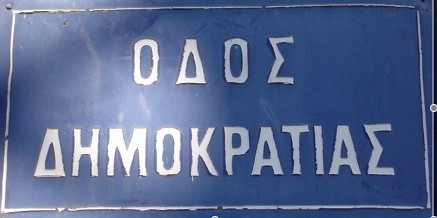 |
| Οδός Δημοκρατιας / Odos Demokratias : "Democracy Street" sign in Greece |
Αn alley is called Πάροδος / parodos, the street pavement is called Οδόστρωμα / odostroma, the road roller used to compact asphalt is called Οδοστρωτήρας / οdostroteras, the road block is called Odofragma / Οδόφραγμα, road buildings is called Oδοποιεία / οdopoieia, a hiker is called Οδοιπόρος / odoiporos and street fighting is called Oδομαχία / Odomachia.
This uninterrupted 3000 plus years of continuous documented history in using this word (ὁδός – hodos - odos) is not enough for Mr. Belchevski. According to him, the Greek language borrowed this term (plus approximately 2000 other words according to his calculations) from a Slavonic dialect spoken in southern Yugoslavia which appeared in the lower Balkans not earlier than the 7th century AD (about 1500 years after Homer) a dialect that acquired its own alphabet, was written down and books started being published in it only after WWII! While the bible was written in Koine Greek, the first bible translation was not published in Slavomakedonski until 1996, and while Hodos is clearly mentioned in the bible, Mr. Odisej Belchevski claims that it was a loanword from Skopjan dialects all along!
Let us hear Odisej Belchevski rumbling away his bogus thesis once again:
"...we can see that the Greek language has borrowed from this large family / concept the word -"Odos "- street and "odeo" to travel, mainly found in the Homeric poems. However this concept of movement simply does not exist in Greek, English or many other European languages..."
Emboldened, Odisej goes into attack mode, determined to change the rotten status quo of Classical scholarship and linguistic ignorance world-wide, and especially in "the West":
"Unfortunately, the Oxford and Webster authorities have referred to many of these words as "Greek" without any convincing proof as to their roots or families."
I am most assured that a brief note by such a noted Skopjan pseudo-scholar as Odisej Belchevski is, along with a copy of his "musings" research to the aforementioned "authorities" will cause distress and panic into the classics and linguistics community worldwide. After that initial panic for such a centuries-old blunder perpetuated against the Slavomakedonskata dialect in favor of the hated Grci (who obviously bribed their way into Oxford and Webster dictionaries), the authorities will make their confession and will soon tow the party line and correct this problem. Isn´t this how Papa Stalin and Marshall Tito would have demanded of their own puppet "authorities" to do? Indeed, I am sure that following Odisej´s letter "the Oxford and Webster authorities", who have so foolishly to date "referred to many of these words as "Greek" without any convincing proof as to their roots or families" will change course immédiatement!
Till that moment arrives, we continue:
"Here is a brief explanation of the remaining English words mentioned here:
Vardi, Varde - to watch or guard in Macedonian (Warden,Guard in English)"
The words "vardi" and "varde" are loanwords into Slavomacedonian through Byzantine Greek "vardia/Bάρδια which the Greeks borrowed from Venetian Italian "vardia". The Venetian Italians in turn borrowed this term from medieval German "warda", which also gave us the English "guard", and the German "warte", meaning "guard" in German.
"Trk (trka trcha, trkalo) – Trek"
Trek, according to Oxford dictionaries is "a long arduous journey, especially one made on foot". The surprising part is the word´s origin:
"Origin: mid 19th century: from South African Dutch trek (noun), trekken (verb) 'pull, travel"
(http://oxforddictionaries.com/definition/trek)
The Dutch word "trekken" is defined by Wiktionary as "to pull", "to draw" or "to migrate".
 |
| South Africa's "Great Trek" |
The "migrate by ox wagon", "pull" and "draw´ give us the hint we need. This is how people until very recently and the invention or railroad and automobiles used to move around: "migrating" in ox wagons where they helped "push" and "pull" and "turn" the wheels whenever the wagon got stuck in the mud.
We therefore look for the meaning and origin of the word "turn":
"Middle English; partly from Old English tyrnan & amp; amp; turnian to turn, from Medieval Latin tornare, from Latin, to turn on a lathe, from tornus lathe, from Greek tornos; partly from Anglo-French turner, tourner to turn, from Medieval Latin tornare; akin to Latin terere to rub"
(http://www.merriam-webster.com/dictionary/turn)
In the "Encyclopedia of Indo-European culture", J. P. Mallory gives us the original Indo-European root for "turn":
"*trep- "turn", Latin trepit, "turns", Greek τρέπω "turn, τροπή, "change", τρωπάω "turn", "change", perhaps Hittite teripp "plow" (if *turn the earth)..."
The Indo-European root trep- "to turn" appears in several words originating from Greek such trope, entropy, tropic (the place where the sun "turns back" to the south after the summer solstice), possibly tornado (through Spanish), tornillo "screw" in Spanish, "tour" as in Tour de Franch, etc.
Related words are also torque, torment (from torquere, to twist), tournament, and others, all of them "turn" related.
The Greek τόρνος/tornos (turning lathe) and τροπή/trope have etymological cognates in the Tocharian B words tark "rotate", tetarku "twist" and terk "move". (A dictionary of Tocharian B, By Douglas Q. Adams, p.294). In Iranian the word tark means "spindle", and this might be the key to putting all this together. I may be wrong, but if indeed *trep- was originally derived from the PIE word for "spindle", this would all make easy sense.
The spindle: a. "turns", b. is "fast", c. it operates in a "round, cyclical movement" and finally d. it does all this by "rubbing". This means that any word derived from it can go in any of these directions.
In dialectical Bulgarian there is an older word, търкало / trkalo, meaning "something that can turn", "a wheel", "a circle" but it is also translated as "rubbing" and търкалям/trkaljam means "to roll". Tъ̀ркам/trkam means "to rub" but there is also въртя /vrtya – gate (something that turns around its hinge), Tръст/trst which in Bulgarian means "horse riding" (fast moving) and Tърча/trcha "to run"(fast moving). Tърча/trcha is definately related to Tжrжk/tzhrzhk in Osetian/ Oсетински which means "swift", "fast one". The Osetians are the only living descendants of the ancient Scythians, and the territory of the Skythians was in contact with the territory of the early Slavs.
Now that we made a full turn, let us go back to Odisej´s:
"Trk (trka trcha, trkalo)", which are supposedly, according to him, the sources of the English "Trek"
In Serbo-Croatian there is the word Trkaci meaning "runners", Trča "to run", Trka "race" and trčati-running, all indicating a fast movement, as in the Osetian Tжrжk/tzhrzhk and in the Bulgarian Tърча/trcha. It is a long way from it, but it is most definitely relater to "*trep- meaning "to turn". In a twisted way, Trk is linguistically also related to the English word "trek", a loanword as we show earlier from the Dutch, although it means the exact opposite: trekking indicates "slow movement by foot", slower than even an oxen wagon, and far slower than a fast turning spindle!
As I was finishing this chapter I stumbled across a Russian linguistics site that confirms what we already suspected about the relationship of words relating to "turning" and "swiftness" with the PIE word for "spindle":
 |
| Byzantine stone spindles from Stobi, FYROM |
Proto-IE *(a)trēkʷ- Query method Match substring
Proto-IE: *(a)tor[e]kʷ-, *(a)trēkʷ-
Meaning: to twist; spindle
Old Indian: tarku- m. n. `spindle'
Old Greek: átrakto-s m. (/f.) `Spindel; Pfeil'
Slavic: *torkъ
Baltic: *tark=
Germanic: *ɵrēx-s=, *ɵrēxs-t-[ō]- vb.
Latin: torqueō, -ēre, torsī, tortum `drehen, winden; verdrehen; martern'; torquēs, -is f. `Halskette; Blumenkete', tortus, -a `gedrehet; verfänglich'; tortor, -ōris m. `Folterknecht, Schinder, Bedränger'; tormentum, -ī n. `Seil zum Aufwinden; Fesel; Wurfmaschine; Folter; Folterwerkzeug; Marter, Plage'; pl. tormina n. `Leibschmerz, bes. Ruhr', torculum, -ī n. `Presse, Kelter'
Albanian: tjerr `spinnen'
Russ. meaning: крутить; веретено
(http://starling.rinet.ru/cgi-bin/query.cgi?basename=dataiepiet&root=config&morpho=0)
Time now to move to something much easier:
"Shirina, shirinka – Shire"
Ширѝна/Shirina in both Serbo-Croatian and Russian means "width". Ширинка/Shirinka in old Russian meant towel. Ширинка/Shirinka now also means "little siren" and it is the name of a Russian porno site which I stumbled across looking for sources for "Shirinka". Now here is a "Homeric" connection that Odisej B. failed to mention, though the Sirens tortured Odysseus´ ears with their melodic calls!
Shire, according to Webster´s Dictionary is derived from a Germanic word meaning "office" and is derived from the word for "care", so is not in any way related to width:
"Origin of SHIRE
Middle English, from Old English scīr office, shire; akin to Old High German scīra care"
"Pat – Path"
The same word appears in Russian and Ukranian as Путь/put, in Bulgarian as Пьт, where also a "small, narrow path" is Пьтка/ptka. The Slavomakedonski "pat", like other Slavonic "paths" is directly derived from OCS "poti", meaning "way". Poti and the English (unpaved) "path" and "ford" (way), the Latin "pons" (bridge) and the Greek "Πόντος/pontos" (sea way) and "πάτος/patos" (way), the Nordic "fjord" and the Old Brussian "pintis" (way) as well as the Indo-Iranian panthas (path) are all derived from the same Indo-European root: *pontoh2s. According to J.P Mallory and D.Q. Adams in The Oxford introduction to Ptoto-Indo Europeans and the Proto-Indo-European World, "an Iranian form" (I would personally think possibly between an early contact between Scyths and Germans) "was borrowed into Germanic to give us NE path" p.250.
"Mek, Meko – Meek"
Merriam Webster dictionary, totally unaware of Mr. Belchevski´s research on English terms borrowed from Slavomakedonski, somehow thinks that Meek is an Old Norse word brought into English by the Normans:
"Origin of Meek: Middle English, of Scandinavian origin; akin to Old Norse mjūkr gentle; akin to Welsh esmwyth soft
First Known Use: 13th century"
Further down Mr. Belchevski mentions
"Divina, Divovi – Divine"
 |
| Pro Salve Domus DIVINAE Sacrum... |
"Alphabet, Learning, Writing and Science
Booka (buka) - In Macedonian this is a type of birch tree the bark of which is used to make paper tablets for writing*
Bookvar - elementary learning book
Azbooka = (J)azik (Tongue or Language) + Bukva (Alphabetic Character) - used for reading and writing.
Bukva, Bukvi - the letters of the alphabet
In SlavoMacedonian "bookvar" is the very first "book" for learning to read and write. The word bookvar is related to a large family of words. This represents the larger concepts of learning and writing."
Far from being a mother tongue to any others, Slavomacedonian is simply one language or dialect within the Slavic family of dialects and languages. For once Odisej got it right in his etymology, since indeed the word for book comes "from Old English "bōc" which in turn comes from the Germanic root "*bōko", which also doubled as a word for "beech staff for carving runes on", which the early Germans used to scribe their language in runes, a Latin-derived early Germanic alphabet. The early Germanic word "*bōko" is derived from the PIE root word for beech tree, *bhago- .
The word for beech is a word common to most Indo-European languages. It has in fact been used as a proof to locate the original home of the Indo-European language. That being said, and knowing that both the Germanic and the Slavonic branches of languages use the word for a beech (tablet) for book, it is more probable that it was the Slavs who borrowed it from the Germanic peoples rather than the opposite (unless we agree that it was a common invention) since the Germans knew writing since at least five centuries before the Slavs (4th cAD vs 9th cAD). Speaking of the South Slavs in particular now, it seems like once the Slavic tribes that gave rise later on to the Serbs, Bulgarians, Croatians etc came into the Balkans, they were already aware of this magical Germanic beech tablet, simply because once they arrived into the Balkans they had no chance to associate with Germans. They came in contact with and under the cultural influence of the Greek language and the Byzantine Empire. The Books they would read now were not written on Nordic forest beech tablets but on Byzantine paper and parchment.
The Poles who came under the influence of the Latin Church adopted the word Litera for letter, while the Russians, Bulgarians and Ukranians kept Буква/Bukva. Slavomakedonski being a Bulgarian dialect until the middle part of the 20th century kept the Bulgarian Bukva too. The Baltic Latvians also have a similar word: Burts. The last time I checked nobody in Skopje had claimed the Latvians as being a lost "Makedonskata" tribe as of yet!
"Nauka, uka - Science of learning"
Nauchnik – Scientist
Uchi - to learn"
Nauchi"
The Slavomakedonskata Nauka is actually spelled Наука in Cyrillic and it is spelled exactly the same, Наука, in Bulgarian as well as in UkranianNaukovets in Ukranian while Scientist in Russian is Учёный/Utsenii.Научаване/Nautsavane means "learning" in Bulgarian and Навчання/Navchania is also "learning" in Ukranian. Nauczanie means "teaching" in Polish and it becomes Nastavne in Croatian. We also find Обучение/Obutsenie, "education", in Russian, Učenie in Slovenian, Učenje in Croatian, Učení in Czech, Uczenie się "learning" in Polish and Учене/Utsene in Bulgarian.
Then we see the Slavomakedonski words:
"Uchi - to learn
Uchilishte – school
Uchitel – teacher"
The words for school and teacher, are, again, to all Slavs. Uchitel / Учител for "teacher" seems to be identical in Bulgarian, Učitelj, is"professor" in Serbo-Croatian, Učitel "teacher" in Czech and Учитель/Uchitel in both Russian & Ukranian. All of the above are derived from the common Učiti, "to teach" in OCS (Old Church Slavonic) the Slavonic language understood by all Slavs of the middle ages and closest to their common tongue before they split.
"In 1992 in Stobi, an ancient archaeological site near Veles, FYROM**, a wood-paged book was discovered along with a bottle for ink and a writing pen."
 |
| Part of a diptych written in Byzantine Greek cursive script. |
Why should this come to us as a surprise? All ancient Greek children had such a wax-covered wood tablet when they went to school, on which they scribed their letters, then erased and started again. They were out of Beech or fir or box wood (hence πυξίον/pyxion, from which "box" is derived), and for wealthy persons silver, bronze or ivory was used. The tablets themselves were not called Slavonic "Bukvars" or Germanic "Books" since the Macedonians in Stoboi had other words for them. In Greek these tablets were called Πίνακες/pinakes, Δέλτοι/deltoi, Πυξία/pyxia, Πινάκια/pinakia Γραμματεία and when they were more than one folded together then they were called Δίπτυχα/diptych or Τρίπτυχα/triptycha, Τετράπτυχα/tetraptych, Πενταπτυχα/pentaptycha or just Πολύπτυχα/polyptycha, accordingly. The stylus was called Γραφίς/graphis and the soft composite wax used on the tablets was called Μάλθη/malthe. Below the wax and to create contrast so that the letters would be easily readable for more permanent documents, they would apply white gypsum and then it was called Γραμματείον λευκωμένον/grammateion leucomenon (whitish) or Λεύκωμα/leucoma, a word still used in modern Greek when we speak of an "album", a blank, empty (white) book to keep photographs. (ref: A dictionary of Greek and Roman antiquities, Volume 2, edited by Sir William Smith, William Wayte, George Eden Marindin, p. 753) Album, incidentally is the equivalent Latin word for the same thing as the Greek leucoma: Latin album ("blank white writing tablet") from albus ("white"). For letters sent to others, paper was used with a feather graphis and Μελάνη/melani,(meaning "Black" f.) ink. In other words, why should Mr. Belchevski be so surprised to hear that in ancient Στώβοι/Stoboi "a wood-paged book was discovered along with a bottle for ink and a writing pen"?
 |
| Stobi, FYROM. Can Odisej B. read: "Baccheios Presbyteros" on it? |
Stoboi was originally a Paionian city that after its capture by the Macedonians soon became completely Hellenized with baths, gymnasion and a Greek theater, all three (especially the Theater!) clear indications that the city was Greek. After all, every inscription found in Stoboi is in Greek with some percentage written in Latin, after it was incorporated into the Roman empire. All Mr. Belchevski has to do is visit the Museum of Makedonija in Skopje and the Greek statues and inscriptions will await him. No wonder he speaks further down of "unknown inscriptions", "identified as possibly Greek"! He obviously has no clue what these ancient MACEDONIAN inscriptions say, yet any child from Beroia, Edessa, Florina, Serres or Thessaloniki not only can read but substantially also understand their content!
"Also in the Homeric Poems of approximately 1500 BC (PS: he is really stuck on that 1500BC date for the Homeric poems!) there is mention of the Ancient (Magic) wooden tablets that contained the letters /symbols that "spoke". The writing was done on the wooden surface prepared with natural bees wax and scratched with a solid /metal pen like tool."
While the Greeks of the "dark ages" had forgotten how to read and write in the Linear B script of their Achaean speaking dialect Mycenaean predecessors, which disappeared in every part of Greece but Cyprus during the early part of the 1100´s the memory of writing persisted and came down to us in the following quote of Homer in Iliad, when the Homeric poems were still transmitted orally:
"πέμπε δέ μιν Λυκίην δέ, πόρεν δ᾽ ὅ γε σήματα λυγρὰ γράψας ἐν πίνακι πτυκτῷ θυμοφθόρα πολλά, 170δεῖξαι δ᾽ ἠνώγειν ᾧ πενθερῷ ὄφρ᾽ ἀπόλοιτο."
"but he sent him to Lycia, and gave him baneful tokens,
graving in a folded tablet many signs and deadly,
and bade him show these to his own wife's father, that he might be slain."
Homer Iliad 6.168-170 (English Translation by A.T. Murray)
"These examples only "scratch the surface" of what I have found, but indicate the Macedonian language may have had an influence on other European languages from early times."
I am sure we are now all convinced…
"In the past many unknown inscriptions were dubiously identified as possibly Greek or unknown but, as I mentioned, they can easily be translated with the use of Macedonian and other Slavonic languages."
We all wonder to what specific "unknown inscriptions" is Mr. Belchevski referring to that "were dubiously identified as possibly Greek…" and which as he mentioned "can easily be translated with the use of Slavomakedonski…". First of all, if some inscription is written in Greek, all you have to do is bring any high school graduate from Greece and they will be able to immediately identify if it is indeed written in Greek, no matter how ancient it is. You do not need a Classics scholar for this task. If the inscription is in Greek letters but completely indecipherable by that high school student, most probably it is in another language (Phrygian, Latin, Slavonic, Coptic, Albanian, Turkish etc) and that is the end of the story. Nobody is going to "dubiously identify it as possibly Greek"! If on the other hand you take a pseudo-scientist, like for example the Skopjan restauranteur-turned paleography scam-"expert" Vasil Iliov, author among other lunacies of the treatise "UNRESTRAINABLE MACEDONIAN CIVILIZATION" (http://www.unet.com.mk/ancient-macedonians-part2/nezapirliva1-e.htm), then you can easily "translate" anything!
Even rock carvings of five thousand years BC using the Cyrillic Alphabet that was not invented until six thousand years later (I just found and I am uploading this video above, where Vasil Ilion is pushing "Slavomakedonski" inscriptions in Cyrillic writen on rocks back in 77,000 BC, and there is even another one where he makes a claim for 102,000 years BC Slavomakedonski inscriptions...and this is on national television in Skopje!), or you can follow the example of the professortal duo of Tendov and Boshevski and invent your own syllabic alphabet and then use it to "decipher" the demotic Egyptian inscription on the Rosetta Stone, of all things! (http://macedonianissues.blogspot.com/2010/01/blog-post.html)
"Scholars will have to consider this influence if they want to get a better understanding of the languages in Europe."
Thus spoke:
"Odisej Belchevsky,
(Slavo)Macedonian Language Researcher"
AS AN EPILOGUE:
I wrote earlier that "it becomes embarrassing trying to defend the obvious and self evident truth against such moronic attacks of falsification, which unfortunately become a never ending battle."
The Americans have a great expression:
"You can never win against an idiot, because he is fighting on his own terrain!"
This is true, but in our situation, while it fully applies to any reader who believes in pseudo-theories, it is not always as clear cut when applied to the writer. Anyone who can organize and write a paper cannot be an utterly complete moron, so the explanation needs to go beyond minimum standards of basic intellectual capacity.
The writer of the "musings" may have made some childish blunders such as the 1500 BC Homeric poems, and he may have come up with some pretty wacky stuff along the way, but the issue is not him, personally, nor his rather sub-inferior, pseudo-scholarly linguistics. The issue is in the political ramifications of the ideology he is serving: "Antiquization", as they call it in Skopje, "pseudo-Makedonism" as Greeks name it. The Slavomacedonians as a nation are a product of the 20th century. They are not the only nation to have reached national consciousness in the last 100 or so years, and the process is not complete by any stretch of imagination. Large percentages of the population is not convinced to tow the official line. The most obvious failure lies with the Muslim minorities, and especially with the Albanians and the Torbeshi (Muslim Slavs). There are also several other, albeit less vocal, ethnic groups, like Greeks, Bulgarians and Serbs, some bilingual, some not, who never accepted being forced to dilute their particular ethno-cultural identity into Slavomacedonism´s melting pot.
For any nation to move forward, it is necessary to have a good footing on its past as a springboard to succeed on its present and to prepare for its future.
The crime of the pseudo-Makedonists in Skopje is that instead of accepting the obvious multicultural essence of the Former Yugoslav Republic of Makedonija, and working towards making that state formation work, like the Swiss, the Canadians and other successful nations have done, some for centuries now, they attempt to make it appear and act as a mono-national state, which is obviously not.
FYROM is not and cannot ever be the exclusive feud of a rather small minority which is becoming more and more emboldened lately, after the ascent into power of the Gruevski clique which claims that the Slavomacedonians are the direct descendants of the Ancient Macedonians. The obvious linguistic dichotomy between the Greek inscriptions found in their land and the obviously Slavonic language they speak, a dialect intermediary between Bulgarian and Serbo-Croatian has never been explained away in a rational and scientifically serious way.
What we see instead is the dominance of all kinds of quassi-lunatic theories like Proto-Slavic speaking Macedonians in Egypt, or Homer copying his epics by translating into Greek what Slavomacedonian bards were singing in Macedonia or Bosnia around 1500 BC and Slavomacedonian – inscribed Cyrillic inscriptions of 6000BC!
Rivers of ink and thousands of internet pages are daily being wasted into belittling the Greeks, and making them seem like they were always the "unwanted other" in Macedonia, repulsive "sub-Saharan African invaders" into a Macedonia that they claim was always inhabited by Slavonic-speaking "Makedontsi", since the beginning of earth.
It is not a crime for the Mexicans to claim that the descendants of the Azteks, the Olmeks and the Mayans are now, in the 21st century constituting one and inseparable nation with the descendants of the Spanish colonists who dominated the original inhabitants after 1520 or so. But from there to go as far as to invent a bogus history about Proto-Latins who were supposedly always living in Mexico, building pyramids in Chichen Itza and Tulum, then migrated into Spain, France, Romania and Italy, establishing the Roman Empire, there is a chasm. A chasm of history, language, basic intelligence and basic human decency and I am saying this because I cannot possibly believe that any of the history falsifiers are not away of the fact that they are lying through their teeth when they attempt such a vulgar violation of history: they do it for money, they do it for political power, they do it for a rotten cause of ethnic hatred, intolerance and irredentism.
What is the cost of this racist and intolerant theory? FYROM is being torn apart by ethnic hatred and just about everyone there feels that they are oppressed and pushed on the sidelines of society. The external policy ramifications of Skopje´s rabid anti-Hellenism and anti-Bulgarism has only gained it the friendship of external destabilizing forces like the military cast of Ankara that has its own irredentist plans on the Balkans while at the same time pseudo-Makedonist Skopians have won for themselves the open contempt and derision of just about everyone else, both inside FYROM and the neighboring people in the rest of the Balkans.
FYROM has already lost the train of European integration, for years to come. The gates of EU entry have now shut closed and the responsibility for missing the opportunity of years past lies squarely on the shoulders of the "Antiquizists" and the Nikola Gruevski administration. Unemployment is rampant, at a word record of 33%, poverty stands at African levels and the only ones who are happy are the Cazino owners, the pimps, the drug dealers and the well connected ВМРО ДПМНЕ / VMRO-DPNE governing party apparatchiks, the ones who siphon any money left in the country, much of it in the form of Greek and other foreign investment that still keeps that moribund economy alive.
The exposing of the hoax in all the assorted "Musings" and their related nonsense on which we have wasted precious time finding the documentation to prove the moronic fallacy in them, must be clearly viewed in this context. The Balkans will never find a moment of peace and prosperity for as long as national irredentism, ethnic hatred and intolerance are being exploited internally by corrupt ultra-nationalist regimes and externally by self serving foreign powers (and their front men: the Soros – funded NGO´s are notorious in Skopje for this) all of whom use them for perpetuating artificial divisions and through them perpetual control of that perennial powder keg, the Balkans and its numerous weak links, Bosnia, Kosovo and FYROM, among others.
PS:
With all due respect, wherever Odisej Belchevski mentions "Macedonian", intentionally creating an un-historical confusing on his reader´s mind between the Northwest Greek dialect of the ancient Macedonians and the Serbo-bulgarian dialect of the Slavonic speaking inhabitants of Southern Yugoslavia – FYROM, we replaced it with the more descriptive and historically correct "Slavomakedonski" (Cлавомакедонски), since the southernmost areas of the former Yugoslav Republic of Makedonija the areas adjacent to Greece (Monastir-Stromnitsa-Prilep, gevgeli, etc) were indeed part of historic Macedonia in the past. Likewise, whenever he mentions "Macedonia" and by that he means the Southern Yugoslav state that has usurped the name of the Ancient Macedonians, disregarding the fact that Macedonia already has its name and it is the largest province of Greece, and it corresponds geographically with historic Macedonia, then I have to use the UN approved name for that state, namely: FYROM.