A blog dedicated exclusively to issues concerning historic Macedonia and the fight against Skopian pseudo-makedonism.
Ιστοσελίδα αφιερωμένη σε θέματα που αφορούν στην ιστορική Μακεδονία και στον αγώνα εναντίον του Σκοπιανού ψευδομακεδονισμού.
"Lincoln’s enemies paid dearly for their resistance: When the South revolted against his rule in 1861, Lincoln sacked and destroyed several Confederate cities, Atlanta being one of them" but "It should be remembered that Lincoln, technically, was not American, but Yankee. Indeed, the Confederates looked down on the North, however much they were powerless to stop Yankee dominance."*
Now that we put things in perspective, let me add a couple points, most of which have been said time and again, yet some people who had a D- in their high school History and never repeated the course in college seem to pass by:
The Macedonians proclaimed their Hellenism in every opportunity. Herodotus tells us that none other that Alexander I, 150 years before Alexander the Great tells the world that he is a Temenides Greek from Argos from old. Herodotus also tells us that the Macedonians were accepted as participants in the exclusively Pan-Hellenic Olympic. We know that Philip participated won several times in the Olympic and Delphic games and the Macedonian king won a seat in the Delphic council. Olympic and Delphic games were NOT Greco-barbarian affairs. We have the names of tens of Macedonians that competed and won fame in the Olympic, Nemean, Delphic and other exclusively Hellenic Games. You will not find the names of any Illyrians, Persians or Thracians competing there. This in itself is argument enough to close the case of how the Macedonians were viewed by other Greeks.
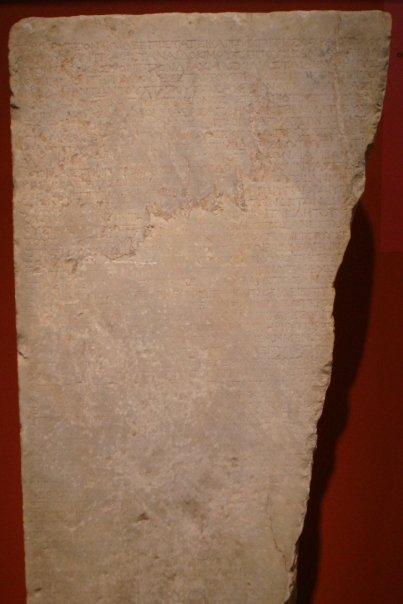
The recruitment inscription of Cassandreia
Another issue to consider. The language of the army was Greek. How do we know it? We have Arrian tell us that when Alexander recruited the first 10,000 Persian youth, he had them crush trained in the Greek language and in the Macedonian arms. This was in Persia, after all, not in Greece. If the Macedonians spoke a different language, how would they understand the commands so well as to crush every army they encountered? Would the American army make its commands in Spanish, just to accommodate its Spanish speaking recruits? It is true that Attic Greek, the dialect spoken in Athens was not the colloquial Macedonian dialect, and we know this from, among others, the dialect on "Pella Katadesmos". Some say that the Russians also spoke French in the Czarist high society circles, which is not related to Russian. Very true, but the Czars' army did not speak French, the commands were given in Russian. When the Russians pushed into Siberia, and reached what is now Vladivostok, we find people now who speak Russian there, not French. The language of the army is the language the common people can understand, even when it is gets more technical and sterile, it is still understood by a high school drop out recruit who speaks his own dialect, urban, prairie or mountain, at home. We also have Epigraphical confirmation in the Cassandreia and other stelae where recruits are being asked to show up and bring what is necessary to join the army. This are in Macedonia, for the Macedonian farmer boys to read and join up.
Once the Macedonians conquered the known world, it was the Greek language that they spread around the world. It was due to Alexander's Macedonians that the Greek language became the Lingua Franca of the ancient world, from North Africa to India, not because of Athens or Sparta. It is due to his conquests that the Christian Bible was written in Greek, and this is because everyone, Jews, Persians, Egyptians and many others, had to use Greek to communicate in the vast Hellenistic kingdoms. The language we now find inscribed in the Macedonian outpost cities in Batria / Afghanistan is Greek, and the culture of those cities that outlasted every single Hellenistic kingdom after Alexander, including Cleopatra in Ptolemaic Egypt, is unmistakably Greek. We know that it is the trait of every empire to promote the use of its own language, the Americans and the British spread English, the Soviets Russian, the French in Africa and Canada French, the Spaniards and Portuguese Spanish and Portuguese (not Latin, for example), the Arabs spread Arabic along with Islam and the Romans who were fascinated with Greek culture and spoke Greek in educated circles, spread Latin. The Macedonians, who dominated half of the known world for some 300 years spread their language too, which was Greek. They did not spread their own colloquial dialect, nor the Attic Greek either, but a new dialect of Greek which arose because of them, a common Greek dialect, a creative amalgam of Attic, Macedonian and other Greek dialects, Common Greek - Coene or Koine Greek was formed, the dialect in which the Christian Bible is written.
If you wonder why Greeks are so sensitive about this issue, maybe you could read up on the issue of the Slavomacedonians of ex-Yugoslavia (Skopje-FYROM), who attempt to claim the name and the historic legacy of Alexander's Macedonians. They also call their language "Macedonian" creating confusion to the Historically challenged, though it is a Serbo-Bulgarian dialect which appeared along with their Slavic progenitors into the Balkans in the 7th c AD, fully a thousand years AFTER Alexander's Greek Macedonians.
Future unification of Baja & Alta California for the "Californians" who speak "Californian"?!
An average American might think this is much ado about nothing, until some split off former "Estado" from Mexico appears in the scene at some point in the unforeseeable future, that that will call itself FMRC, as in the Former Mexican Republic of California, who will claim to speak "Californian" and demand annexation of "Upper California" into the "Motherland" state of "Baja California" and create a "United California"!
Balkan ultra-nationalist irredentism, is the main cause of war in the Balkans. Slavomacedonian irredentism is hiding behind such un-historical statements about a non-Greek (indeed Slavic speaking!) Alexander, as well as Philip and even Aristotle, to support their land-grabbing claims against Greek Makedonia, for a "United Macedonia" or Obetineta Makedonija, in the Slavonic dialect (a mix of mainly Serbian glossary and Bulgarian syntax and grammar) that Alexander's Macedonians, the Greek-speaking MAKEDONES would have never understood.
* "Alexander’s enemies paid dearly for their resistance: When Thebes revolted against his rule in 335 BC, Alexander sacked and destroyed the city." and also:
"It should be remembered that Alexander, technically, was not Greek, but Macedonian. Indeed, the Greeks looked down on Macedonia, however much they were powerless to stop the kingdom’s expansion"
Documentary. Year of production - 1984
Taken from the You Tube channel of DocumentaryMacedonia
http://www.youtube.com/watch?v=er8JWfyStuc
Macedonia( [ˌmæsəˈdoʊniə], Greek: Μακεδονία, Makedonía, IPA: [makʲe̞ðo̞ˈnia]) is a geographical and historical region of Greece in southeastern Europe. Macedonia is the largest and second most populous Greek region. The region and that of Thrace are often together referred to informally as northern Greece.
This northern Greek region incorporates most of the territories of ancient Macedon, the kingdom ruled by the Argeads whose most celebrated members were Alexander the Great and his father Philip II. The name Macedonia was later applied to identify various administrative areas in the Roman and Byzantine Empires with widely differing borders. Under the Ottomans, the name disappeared altogether.
Even before the establishment of the Modern Greek state in 1830, it was identified as a Greek province, even though Macedonia had no geographical borders [1][2][3] By the mid 19th century, the name was becoming consolidated informally, defining more of a a distinct geographical, rather than political, region in the southern Balkans. At the end of the Ottoman Empire most of the region known as Rumelia or "Turkey in Europe" was divided by the Treaty of Bucharest of 1913, following the Ottoman defeat in the Balkan Wars of 1912-1913. Greece, Serbia, Bulgaria and Albania each took control of portions of the territory, with Greece obtaining the largest portion.
Macedonia was an administrative subdivision of Greece until the administrative reform of 1987, when the region was subdivided into the peripheries of West Macedonia and Central Macedonia and part of the periphery of East Macedonia and Thrace, the latter containing also the whole of the region of Thrace.