
Miltiades Elia Bolaris Βalkan Illusion - phantasia archaica: "...it is very interesting to note that many of the authentic ancient Macedonian words, according to their etymology and pronunciation, have a striking resemblance to the appropriate words used in the modern Macedonian language (and other so called "Slav" languages)[sic]"..."Kopria. This name has possible connections to the noun "kopra" (a dill). It is a well-known practice to derive personal names from those of the plant world. In 16th century Macedonia one finds the female name Kopra." From: "Similarities between ancient Macedonian and today's' Macedonian Culture (Linguistics and Onomastics)" by Aleksandar Donski, celebrity propagandist and self proclaimed "historian" from Skopje, FYROM. Kopria / Copria / Κοπρία: In the early 1970's, a clay "pithos" type jar was found in Egypt in an illegal excavation. It quickly found its way to the Louvre Museum. Inside it there was a lead sheet insrcibed in Greek and a tiny clay statuette of a female figure in a kneeling, submissive position. Her hands were tied to her back with thirteen bronze pins piercing through her clay body. In "The ethnic origins of a Roman-Era Philtrokatadesmos (PGM IV 296-434)", Christopher Faraone, professor of Classics at the University of Chicago, describes how this find corresponded closely in text and in the clay doll treatment to another find, inscribed in (PGM IV. 335-406): "Marvelous love binding spell (philtrokatadesmos): Take wax (or clay) from a potter's wheel and make two figurines, a male and a female. Make the male in the form of Ares fully armed, holding a sword in his left hand, and threatening to plunge it into the right side of her neck. And make her with her arms behind her and down on her knees...". Then we hear of several other jars with clay or wax figurines with the thirteen bronze needles pinched in them and the accompanying lead katadesmoi that have been found and are being circulated among museums and legal or (mostly) underground art and antiquities dealers. The (PGM IV 296-434) is unique among them for its length and complexity. It demands from chthonian deities like Pluton, Kore Persephone, Hermes-Thoth and Adonis to bind a girl and "deliver" her - bound through infatuation and erotic passion - to the man who lustfully desires her. The full text of this Philtrokatadesmos can be found in the public domain, but here I will bring the middle part of it, that is of particular interest to us:  "...I adjure you (ἐξορκίζω / exorkizo ), all spirits (δαίμονες / demones ) in this place, to assist this ghost (δαιμων / demon). Rouse yourself for me, corpse spirit ( νεκυδαίμων / nekydemon ), whoever you are, whether male or female, and go into every place, into every quarter, into every house, and bind Κοπρία / Kopria, whom her mother Ταέσις / Taesis bore, the hair of whose head you have, for Αἰλουρίων / Ailourion, whom his mother named Κοπρία / Kopria bore, that she may not submit to vaginal nor anal intercourse, nor gratify another youth or another man except Αἰλουρίων / Ailourion only, whom his mother named Κοπρία / Kopria bore, and that she may not even be able to eat nor drink nor ever get sleep nor enjoy good health nor have peace in her soul or mind in her desire for Αἰλουρίων / Ailourion, whom his mother Κοπρία / Kopria bore, until Κοπρία / Kopria, whom her mother Ταέσις / Taesis bore, whose hair you have, will spring up from every place and every house, burning (with passion), and come to Αἰλουρίων / Ailourion, whom his mother named Κοπρία / Kopria bore, loving (and) adoring with all her soul, with all her spirit, with unceasing and unremitting and constant erotic binding, Αἰλουρίων / Ailourion, whom his mother named Κοπρία / Kopria bore, with a divine love, from this very day, from the present hour, for the rest of Κοπρία / Kopria's life...etc etc...Do not disobey my commands, ghost, whoever you are, whether male or female, but rouse yourself for me and go into every place, into every quarter, into every house, and bind Κοπρία / Kopria, whom her mother Ταέσις / Taesis bore, the hair of whose head you have, for Αἰλουρίων / Ailourion, whom his mother named Κοπρία / Kopria bore, that she may not submit to vaginal nor anal intercourse, nor gratify another youth or another man; and that she may not even be able to eat nor drink nor get sleep nor be at peace in her soul or mind in her desire, day and night, for Αἰλουρίων / Ailourion, whom his mother named Κοπρία / Kopria bore, loving (and) adoring him with all her heart, with all her spirit, like her own soul, Κοπρία / Kopria, whose hair you have, loving with a divine love, until death, Αἰλουρίων / Ailourion, whom his mother named Κοπρία / Kopria bore. Now now quickly quickly! ...and again....and bring Κοπρία / Kopria, her mother Ταέσις / Taesis bore, whose hair you have, to Αἰλουρίων / Ailourion, whom his mother named Κοπρία / Kopria bore, burning, blazing, melting away in her soul, her spirit, her feminine part, loving (and) adoring with a divine love, until death, Αἰλουρίων / Ailourion, whom his mother named Κοπρία / Kopria bore. Now now quickly quickly!..." and so on and so on, it continues... Bibl.: David G. Martinez, PMich 757: A Greek Love Charm from Egypt, Ann Arbor, 1991. This is an immensely powerful, deep and dark magical text, that is casting hair-raising spells of magic, witchcraft, desire, fear and curse, repeating itself again and again, pressing, hammering and pounding point after point, word after word, threatening, cursing, begging, exhorting, exorcising and adjuring. It was written sometime between the 2nd and the 4th century AD and it comes to us from Roman-occupied but Greek-speaking Egypt, still fully immersed in her Hellenistic and Ptolemaic legacy. The characters appearing on this Philtrokatadesmos (besides the Demons and Spirits, Gods and other divinities, named or implied) are four persons, whose names the katadesmos preserved for us in posterity: There is young maiden named Κοπρία / Kopria, her mother, Ταέσις / Taesis, a young man, Αἰλουρίων / Ailourion and Ailourion's mother also named Κοπρία / Kopria. At first sight, to any Greek speaking person Κοπρία / Kopria sounds like a very unusual choice for a name. Kopria as a noun means literally a pile of kopros, dung, the excrement of humans and (mostly) animals. To the modern mind this sounds like a most undesirable word, and just the thought that someone would want to use it as a name for their baby girl is unthinkable, to say the least! But then, I have not seen many modern religious processions where every pious parishioner is partaking in the religious reveling by carrying a huge phallus around the neighborhood either. Yet this was commonplace practice in Greek religion. 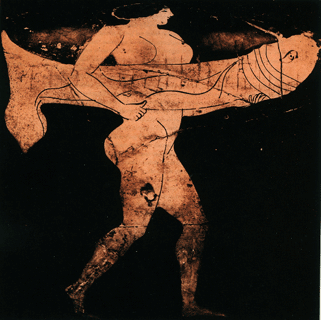 To the Greeks, dung was simply viewed as an integral part of the cycle of life. A natural byproduct of life, which only created a problem of handling. The myth of the fifth labor of Heracles is very telling. Having first killed with his bare hands the Nemea Lion, having eliminated through dagger and fire the Lernea Hydra, having caught unharmed the sacred Hind of Ceryneia and having captured alive the Erymanthean Boar, Heracles was now being asked by Eurystheus to do the humanly impossible: to clean the κόπρος / kopros the dunk out of the Augean Stables in one single day. It was such a huge task, that Heracles using brains and engineering as much as brute force to dig out channels to divert two rivers, was able to clean up years of accumulated cow excrement without even getting his hands dirty by it. Such was the effect this monumental task had on him, that having finished it, Heracles instituted the Olympic Games at the very site of his fifth labor (at Olympia, in the Peloponnese), as ancient legend tells us. The beginning of the first Olympiad marked for the Greeks the beginning of their collective calendar, in the same way Christians count everything from before BC and after AD today, or the founding of Rome was used for the Romans. The fact that such a task was tied to the most important religious festival of the Greeks should give us a powerful and clear hint that the Greeks did not seem to be bothered by this "kopros-related" beginning of this, their most important national religious festival. The photograph in the beginning of this article is from a metope of the temple of Zeus in Olympia, and it is showing Heracles working on his fifth labor, cleaning the kopros of Augeas, under the guidance of Athena. The existing epigraphical record of Hellenic inscriptions is full of mentions of females that were named Κοπρια / Kopria, and only one in its closest male equivalent, Κοπριανος / Koprianos. Here below are a few characteristic inscriptions: In the Macedonian city of Beroia we locate inscription I.Leukopetra 128, about a preteen girl named Kopria, that is being dedicated to the Great Mother of Gods: Μητρὶ Θεῶ<ν> κοράσιον ὀνόματι Κοπρίαν, ἐτῶν ∙ ιʹ ∙ ὃ λαβὼν ἐξ ἕμα- To the Mother of Gods a young girl named Kopria, years 10, which having taken from ema- A loving dedication by a husband to the memory of his deceased wife from Eordaia in Macedonia in on inscription EAM 131, which reads: Δάμαχος Κοπρίᾳ Ἀλεξάνδρου ἡρωίδι τῇ συνβίῳ ἐκ τῶν ἐκείνης μνήμης χάριν. Damachos to Kopria daughter of Alexandros, a hero lady, to his life's companion to the grace of the memories of her life From Thessaloniki, again in Macedonia, comes a simple inscription, IG X, 2 1 387: Κοπρία Πολυ- νείκης χαῖρε. Kopria, daughter of Poly nike Greetings Further west, in Sicily we find the funerary stela IG XIV 137 where in a very rare occurrence, as mentioned above) the name is being used in its masculine form, as a man's name, Koprianos: Κοπριανὸς ἐνθάδε κῖτε Koprianos lies here From Thebes, in Central Greece, comes inscription SEG 42:538 : Κοπρία Φιλήτῳ τῷ ἰδίῳ ἀνδρὶ μνίας χά- Kopria To Philitos her own husband in memory South of Thebes, in Athens, Attica we find inscription IG II² 12221 Μωμὼ Κοπρίᾳ τῇ θυγατρὶ μνήμης χάριν. Μomo to Kopria her daughter in memory's grace Having gone the full circle, we now return again to Hellenistic Egypt where in the museum of the city of Alexander, Aλεξανδρια / Alexandria / Al Iskendariya, we find inscription Breccia, Alexandria Mus. 359: Κοπρία (ἐτῶν) λ...ʹ Kopria (age) 3... To our amazement we see that the name Kopria, despite modern expectations to the opposite, was a rather wide spread name in the ancient Greek world. It was actually very popular in the fertile plains of Macedonia. To us, removed as we are from the ancient society by more than two thousand some years, this name sounds strange, to say the least, because of the connotation we ourselves bring onto it. The explanation, I think must lie elsewhere. Everything in life depends on how you decide to view things. In my opinion, the name Kopria, in the mind and the ears of the ancient Greeks did not as much bring the obviously undesirable connection of the foul smell and sight of kopros / dung, as the positive attributes of it. We need to forget, some of us, our city upbringing, and think for a moment as farmers, with cultivated fields, orchards and gardens, and this will bring us on the right track.  An expression exists in modern Greek "από την κοπριά το ρόδο / apo tin kopria to rodo" which translates into "from the manure comes the rose". The expression refers to a child that grew up to become a good person, despite a deficient upbringing, coming from a "bad" family. This expression, I believe, can become the key to understanding the usage of the name Kopria among all ancient Greeks, and the Macedonians in particular. It vividly and clearly expresses what we must understand the Greeks saw in manure, in kopros : not the pile of smelly dung, that the city person sees in it, but the promise of a fertile field that the farmer reads into it. The ancient Greek word κόπρος / kopros, which incidentally has exactly the same meaning in modern Greek, is a direct derivative of the Indo-European root word *kokwr, of the same meaning : dung / manure. An expression exists in modern Greek "από την κοπριά το ρόδο / apo tin kopria to rodo" which translates into "from the manure comes the rose". The expression refers to a child that grew up to become a good person, despite a deficient upbringing, coming from a "bad" family. This expression, I believe, can become the key to understanding the usage of the name Kopria among all ancient Greeks, and the Macedonians in particular. It vividly and clearly expresses what we must understand the Greeks saw in manure, in kopros : not the pile of smelly dung, that the city person sees in it, but the promise of a fertile field that the farmer reads into it. The ancient Greek word κόπρος / kopros, which incidentally has exactly the same meaning in modern Greek, is a direct derivative of the Indo-European root word *kokwr, of the same meaning : dung / manure.Like the huge erect phalluses at the religious processions of the ancient Greeks, kopros was also seen by them as a blessing to the fertility of the agricultural land. Until very recently, horse and cow dung was used not only as a source of excellent field and garden fertilizer (as it is still used today, despite its foul smell, even in the gardens of expensive homes, albeit now sold in colorful plastic bags that have photos of beautiful roses printed on them), but it was also saved and used in winter as a fuel to heat the home. It was even used as a very practical heat insulation, being spread on the exterior walls of the humble, unbaked-brick walls of the farmers' homes.  This is why the name Kopria, literary meaning "of the manure" despite the impossible odds to us, was in fact to them a very normal name. It is a well documented fact that this was an immensely popular name with the ancient Greeks, as attested in the epigraphical record from Macedonia to Athens and from Egypt to Sicily. This therefore, should make us think in this direction. Since the name Κοπρία / Kopria, was being given as a name almost exclusively to female babies ( with only one rare exception from Sicily, that we were able to find in the epigraphical record, in similar male equivalent as Κοπριανός / Koprianos and the also the names Kόπρις / Kopris and Κοπρίων / Koprion, found in the LPGN : http://www.lgpn.ox.ac.uk/publications/vol3a/vol3a_names/v3amk_u.html), I believe that it must be seen as a family investment towards the good will of the fertility deities; an assurance for agricultural fecundity, a hope for wealth through fruitfulness and finally as a promise for familial growth through health and fertility of the female body. In fact it not very unusual that the name Κοπρος / Kopros and Κοπρια / Kopria appear also as toponyms in several places of the Greek world. There is the ancient municipality of Κοπρος / Kopros in Λαυρεωτικη / Laureotike, near the modern village of Legrena, in Αττικη / Attica. There is a small Aegean island called Κοπρια / Kopria, in the Cyclades, between Naxos, Keros, Koufonesia, Amorgos and Donoysa (Greece, Cyclades, Eparhia Naxou [coordinates: 36.9875 25.63833] (http://www.geonames.org/maps/google_36.988_25.638.html). There is a town square called Kopria in the island of Alonissos and a cape Kopria in Pelion, in Thessaly. Strabo / Στραβων the Geographer in his description of Sicily and the terrible double monster of Scylla and Kharybdis, he also speaks of a beach shore by the straits of Messina, between the tip of the boot of Italy and Sicily. It is close to the Sicilian Greek city of Tauromenion / Ταυρομενιον which in Greek means the city of the bulls, and the Italians now call it Taormina. The beach was named by the Sicilian Greeks Kopria. Despite the explanation for the name of Kopria beach that Strabo passes to us, I think that considering that it was next to the city of the bulls, we can already start guessing quite accurately how the beach got its name:  "ἐντεῦθεν δὲ καὶ τὴν φυγὴν ἐποιήσατο ἐκπεσὼν ἐκ τῆς νήσου. δείκνυται δὲ καὶ ἡ Χάρυβδις μικρὸν πρὸ τῆς πόλεως ἐν τῶι πόρωι, βάθος ἐξαίσιον, εἰς ὃ αἱ παλίρροιαι τοῦ πορθμοῦ κατάγουσι φυσικῶς τὰ σκάφη τραχηλιζόμενα μετὰ συστροφῆς καὶ δίνης μεγάλης· καταποθέντων δὲ καὶ διαλυθέντων τὰ ναυάγια παρασύρεται πρὸς ἠιόνα τῆς Ταυρομενίας, ἣν καλοῦσιν ἀπὸ τοῦ συμπτώματος τούτου Κοπρίαν." "ἐντεῦθεν δὲ καὶ τὴν φυγὴν ἐποιήσατο ἐκπεσὼν ἐκ τῆς νήσου. δείκνυται δὲ καὶ ἡ Χάρυβδις μικρὸν πρὸ τῆς πόλεως ἐν τῶι πόρωι, βάθος ἐξαίσιον, εἰς ὃ αἱ παλίρροιαι τοῦ πορθμοῦ κατάγουσι φυσικῶς τὰ σκάφη τραχηλιζόμενα μετὰ συστροφῆς καὶ δίνης μεγάλης· καταποθέντων δὲ καὶ διαλυθέντων τὰ ναυάγια παρασύρεται πρὸς ἠιόνα τῆς Ταυρομενίας, ἣν καλοῦσιν ἀπὸ τοῦ συμπτώματος τούτου Κοπρίαν.""In the ship-channel, only a short distance off the city, is to be seen Kharybdis, a monstrous deep, into which the ships are easily drawn by the refluent currents of the strait and plunged prow-foremost along with a mighty eddying of the whirlpool; and when the ships are gulped down and broken to pieces, the wreckage is swept along to the Tauromenian shore, which, from this occurrence, is called Kopria." Στραβων Γεωγραφια 6.3.2 / Strabo, Geography 6.2.3 Finally there is a Κόπραινα / Kopraina beach by the city of Arta in 'Ηπειρος / Epeiros and a Kopria beach οn the island of Ρόδος / Rhodes. Beauty, someone could argue, is not just in the eye, but also in the ear of the beholder. Words are only vocalizations. They are meaningless sounds in themselves. It is for us to attach the meaning to them. Once a baby girl was born and the fertility-wishing name of Kopria was given to that girl, the girl was in turn giving new meaning to the word, like all babies bring new meaning to the name we sometimes randomly attach to them. The Artan boys and girls going with their parents to the "full of dung" beach shown above, might initially laugh at hearing the name, but they do love going to the beach and the name then becomes synonymous with the fun and play they enjoy and the beautiful childhood memories it brings to them later on. What´s in a name? that which we call a rose By any other name would smell as sweet; tells us William Shakespeare (1564–1616) in Romeo and Juliet Act II, Scene II, 47-48. Yet, despite Shakespeare, who wrote his play some eighteen centuries too late for her, on a tombstone inscription belonging to a girl from Macedonia, we find traces of a naïve grievance of this girl for the name given to her by her parents: Οὔνομα μὲν Μακέταις ἐπιχώριον. οὔνεκα μεμφθή μηδέ ενί. Κοπρίαν μ' ὠνόμασαν γενέται. Kaibel, Epigr. Graeca 313 (also mentioned by G. Babiniotis) "The name itself is local to the Maketais" (note: Μακέταις / Maketais was another name for the Macedonians) "because of it the blame should go to no one" (μηδέ ενί = μηδενί). "Kopria I was named by my parents". So then, we realize that this would not have been this Macedonian girl's first name of choice, had she been given a voice on the matter. Yet she accepts it because it is traditional and "local with the Maketais", the Macedonians (Μακέταις ἐπιχώριον). But personal names are never a matter of personal choice: they are always given to us, as children, as a matter of tradition. Parents have their own reasons (tradition based, ideological or religious) for choosing names for their offspring. Professor Donski from Skopje has (not unwittingly) confused the ancient Greek name Kopria, with the Slavonic word for dill, the aromatic plant whose seeds are used to give the anisette taste to ouzo and other similar anise drinks. We comprehend his agony in trying to try to find some phonetic excuses to hold on from, and try to create imaginary connections with the ancient Greek past of the Macedonians, but we cannot allow him to get away with such an unscientific trick in support of Skopje's Slavomacedonian nationalism. The aromatic plant dill, which the Greeks call Anethos / Ἄνηθος or Aneson / Ἄνησον, appears in most Slavonic languages in a word that is similar sounding to Kopria, yet it comes from a completely different linguistic root. Dill in Bulgarian is kopur [копър], in Ukrainian krip [кріп], in Russian ukrop [укроп], in Slavomacedonian kopra [Копра] in Slovak kôpor, in Polish koper and in Czech kopr. Through association with the Slavs, it was also taken on by the Albanians [Kopër, Kopra] and the Yiddish speaking Jews of Eastern Europe [קאָפּער, קראָפּ, קריפּ, אוקראָפּ Koper, Krop, Krip, Ukrop ]. The Slavonic names for dill are all derived from a common Slavonic root *kapr´ = dill, which in turn is related to the Baltic-Lithuanian kvapas = smell, aroma and kvepia = fragrant. There is absolutely no relation that can be credibly established between the (attested 1500 years later) Slavonic name for dill, therefore, and the ancient Macedonian Greek name Kopria/Κοπρία. Note: My thanks to Soteria Tsimoura / Σωτηρία Τσιμούρα a graduate student of Media and Communications in Germany, for her invaluable assistance in the creation of this article and her tireless suggestions and corrections of this and many other manuscripts. M.B. | ||||


