 Miltiades Bolaris
Το παρόν άρθρο πρωτοεμφανίστηκε στα "Αμερικανικά Χρονικά", στις 27 Μαίου 2009
This article was originally appeared in the American Chronicle, on May 27, 2009
http://www.americanchronicle.com/articles/view/103991
Balkan Illusion - phantasia archaica:
"...it is very interesting to note that many of the authentic ancient Macedonian words, according to their etymology and pronunciation, have a striking resemblance to the appropriate words used in the modern Macedonian language (and other so called "Slav" languages)."
"Crater(us). The root of this name contains the word "krater" (crater) which exsists [sic] in the present day Macedonian and other "Slavic" [sic] languages. In todays' Macedonian onomasticon is present the name "Krate"."
From: Similarities between ancient Macedonian and today's' Macedonian Culture (Linguistics and Onomastics), by professor Aleksandar Donski, celebrity "historian" from FYROM.
Crateros/Craterus/Κρατερός
Atticus Finch, a character in Harper Lee's novel To Kill a Mockingbird is based on a real life Roman gentleman called Titus Pomponius Atticus, who was born about 110 BC and died around 35 BC. He divided his life between Rome and Athens, and he took the prosonym Atticus (Attica is the province of Athens, and Pomronius had also named Attica his own daughter) to show his affection for Athens and his love for Greek culture and letters. He was of an equestrian family, wealthy, politically conservative, and of refined taste. He is best remembered by his friendship to the orator and philosopher Cicero. Cicero's "Epistulae ad Atticum" are a testimony to their friendship and their frequent exchange of ideas. In one of these letters, written by Cicero from Thesalonike on July 17, 58BC, Cicero, speaking of Pompronius Atticus' daughter, Attica and her deteriorating health, he also mentions a man called Craterus, a Greek physician practicing medicine in Rome in the 1st c BC:
de Attica doleo, credo tamen Cratero.
I feel for Attica, but I have trust in Crateros.
Cicero, Ad Atticus. Xii. 14.4
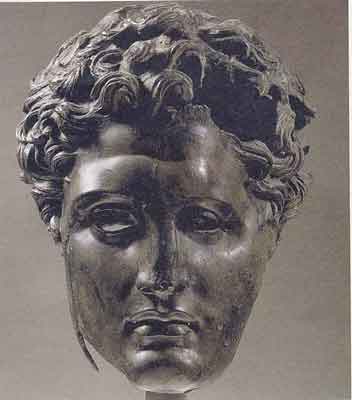
A more famous Crateros was the one who lived in Macedonia three centuries earlier. Krateros/Crateros/Κρατερός was a childhood friend of Alexandros III of Macedonia, Alexander the Great. The photograph accompanying this text, shows Crateros hunting a lion with Alexander. It is only a detail from the much larger and famous "Lion Hunt" scene where Alexander is shown on the left, spearing a lion, in the center, with Crateros, on the right, raising his sword ready to strike the lion. It is taken from a floor mosaic in Pella, the ancient capital of Macedonia, Greece. Crateros was from the mountainous Upper Macedonian provinces of Orestis/Ορέστις (meaning "Mountainous" in Greek), close to the modern city of Kastoria in NW Greece. He was considered Alexander's best army commander, after Parmenion/Παρμενίων and his best friend along with Hephestion. He proved his worth by being the Phalanx commander at the battles of Issus and Gaugamela, where Parmenion had commanded the left flank and Alexander himself the right flank of the army. Crateros was the commander of the left flank of the navy and half the Macedonian ships (Alexander commanding the right flank) attacking the island (made into peninsula) Phoenician city of Tyre/Syr. He took active part as the main general entrusted to find and defeat the rebel Spitamenes, which task he completed successfully, and Alexander switched him from infantry (phalanx pezhetairoi) into a cavalry (hetairoi) commander. He was also the commander to whom Alexander entrusted the main body of the army to hold down to position and then attack through the river Hydaspis the Indian king Porus/Πώρος/Rai Por at the Hydaspes river crossing the river from the east, after the battle had started with Alexander's attack from the north, on the west side of the river.
http://www.facebook.com/#!/album.php?aid=27827&id=100000145744130
He was entrusted by Alexander to not only capture but also to build several cities and his fortification and organizational skills became appreciated by Alexander. He then led the Macedonian and allied army column east towards Babylon, while Alexander took the rest of the army through the Indus river to the Indian Ocean, and then through what is now southern Pakistan and Iran to Babylon close by where is now the city of Baghdad. In 324 BC, in accordance with Alexander's cultural fusion policy there was a massive wedding organized at Susa where ten thousand Macedonian soldiers married Persian women. The only ones who married Persian princesses (versus commoners) were Alexander, Hephestion and Crateros. Marrying into the Achemenid family also meant that you acquired royal pretensions to the Persian throne. For Alexander, allowing Hephestion and Crateros to marry an Achaemenid princesses meant, in practical terms, that he considered either one of them as a possible successor to the throne if something happened to him. Crateros chose Amestris, whose name means "Friend" in Old Persian, an Achaemenid niece of Darius II. Crateros and Hephestion were the generals closest to Alexander and was given the prosonym Philobasileus/Φιλοβασιλεύς, meaning "friend of the king" or "the one who loves his king", while Hephaestion was called Philalexandros/Φιλαλέξανδρος.
 Following the untimely death of Hephestion/Ηφαιστίων later that same year, Krateros was given an army of eleven thousand veterans to return to lead them back to Macedonia and take over the regency of Macedonia from Antipatros/Ἄντίπατρος who was to be replaced (and probably disposed of too, on orders of Alexander). While still in Cilicia, in what is now southern Turkey, news of Alexander's death (June 11, 323 BC) reached him. Arriving in Macedonia he actually mended fences with Antipatros, marrying his daughter Phila and helping him defeat a coalition of city states in the Lamian war. He joined Lysimachos/Λυσίμαχος, governor of Thrace and Ptolemaios/Πτολεμαίος, governor of Egypt in their support of Antipatros in the coalition he organized against Perdicas/Περδίκας, the designated regent of the whole empire after the death of Alexander. In the spring of 321BC he led the coalition army into Cappadocia to face the army of Perdicas led by the inexperienced secretary of Alexander Eumenes of Cardia/Ευμένης Καρδιανός. To the amazement of everyone, the "pencil pusher" Eumenes defeated in battle the greatest of Alexander's generals, Krateros, who was slain in the battlefield at the age of 45.
Another, less famous Krateros was a historian by the same name, who lived during the 3rd cBC. He was the son of the king of Macedonia Antogonos II Gonatas/Αντίγονος Β' Γονατάς, both being sons of Phila/ Φίλα and a father who was also named Krateros. He had understood the importance of the epigraphical record to the study of history, so he compiled a list of chronologically cataloged inscriptions which he named Synagoge psephismaton/Συναγωγή ψηφισμάτων/Collection of decrees.
Centuries later we hear of a Byzantine army general named Krateros. He had been sent
 by Constantinople to recover the island of Crete from the Spanish Arabs. The Arabs had occupied Crete only a couple years earlier (822-824), so in 826 AD, the Byzantine army general Krateros attempted a campaign against them, which proved unsuccessful. The area where the battle was fought and the Byzantine Army under Crateros was soundly defeated preserves down to our day the memory of that defeat and bears his name. It is only few kilometers east of the modern city of Herakleion/Ηράκλειον, and it is called (slightly modified over the centuries) Karteros/Kαρτερός.
ΚΡΑΤΕΡΟΣ μάρτυρας, ο στρατηγός, εν Άμορίω ΜΑΡΤ. 6
The name Krateros comes from the noun kratos.
In Richard Cunliffe's "A Lexicon of the Homeric Dialect" (University of Oklahoma Press, 1963, first published in London, 1924), we find the noun kratos/κράτος defined mainly as: physical strength, might, stoutness, prowess and also as power, authority, influence. In the same dictionary, we find also the verb krateo/κρατέω, which means to hold sway, to rule, to have power and also to be ruler over, to exercise power among, to be lord of. As an adjective krateros/κρατερώς (written with omega) means with or by the exercise of strength or force, violently, with violence, stoutly, staunchly.
Krataios/κραταιός as an adjective means strong, mighty, powerful, compelling, relentless. Kraterophron/κρατερόφρων (krateros+phren) means Stout hearted, and Krateros/κρατερός means strong, mighty, powerful, stout, staunch, restraining, taking strong hold of one, overpowering, overmastering, etc.
On an inscription from Southern Italy we find the word "craterophron", describing Heracles.
Regions : Sicily, Italy, and the West (IG XIV) :
Sicily, Sardinia, and neighboring Islands
IG XIV 3
Sikelia — Syrakousai (Siracusa) — bef. 215 BC
1.1 [βασιλέος Γέλωνος]. of king Gelon
2.1 βασιλίσσας Νηρηίδος. of queen Nereis
3.1 βασιλίσσας Φιλιστίδος. of queen Philistis
4.1 [β]ασιλ[έος Ἱέρω]νος. of king Hieron
5.1 Διὸς Ὀλυμπίου. of Zeus the Olympian
6.1 Β․Σ̣[— — — —]. B.S.
[Ἡρ]ακλέο[ς κ]ρατε[ρό]φρονο[ς]. oh Heracles craterophron (the stouthearted, strong hearted=the brave)
Autenrieth's Homeric Dictionary (University of Oklahoma Press, 1958. First published in German and translated into English in 1876) we find kratos/κράτος (occasionally appearing also as kartos/κάρτος) similarly defined as superior strength, might, power, then mastery, victory, and krateros (also karteros) is defined as strong, powerful, mighty, of persons and things.
Kratos, in Greek also means the state power, the state. The Roi Soleille's - Louis XIV's statement "L' etat c' est Moi!", in Greek is rendered as Το Κράτος είμαι Εγώ/To Kratos eimai Ego!=The State is Me! "Statism" In Greek is translated as Kratikismos/Κρατικισμὀς.
Krateros, starting from Homeric Greek to Classic and Attic Greek and into modern Greek has retained its original meaning unaltered. Karteros on the other hand, which originally was its synonym having the same meaning as crateros, changed over the centuries and while it is still daily used, in Modern Greek, it now means "being patient", "having endurance", "having a passive, a defensive kind of strength".
In "The shield of Heracles", Hesiod contrasts Heracles with his twin (but wimpy) brother:
οὐ καθ᾽ ὁμὰ φρονέοντε· κασιγνήτω γε μὲν ἤστην· [50
τὸν μὲν χειρότερον, τὸν δ᾽ αὖ μέγ᾽ ἀμείνονα φῶτα,
δεινόν τε κρατερόν τε, βίην Ἡρακληείην·
Ἠσιόδου, Ἀσπὶς Ἡρακλέους / Aspis Hērakleous
Though they were brothers, these were not of one spirit;
for one was weaker but the other a far better man,
one terrible and strong, the mighty Heracles.
Hesiod, The Shield of Heracles
I take the last sentence, which has the word we are looking for:
δεινόν τε κρατερόν τε, βίην Ἡρακληείην
deinon te krateron te, bien Herkleeien
terrible and strong, the mighty Heracles.
Krateros is here translated as: "strong".
The word meaning "strong" in this text is the word "krateron", which is the accusative case of "krateros".
The cases of this name in Greek would be as follows:
Nominative: ho Krateros ὁ Κρατερός
Possesive: tou Kraterou τοῦ Κρατερού
Dotive: toi Krateroi τώ Κρατερώ
Acusative: ton Krateron τόν Κρατερόν
Vocative: oh Kratere ᾧ Κρατερέ
From Hesiod we will move to Homer and the epic poem Iliad, where we hear Thetis talk of her powerful son Achilles:
ὤ μοι ἐγὼ δειλή͵ ὤ μοι δυσαριστοτόκεια͵
ἥ τ΄ ἐπεὶ ἂρ τέκον υἱὸν ἀμύμονά τε κρατερόν
τε ἔξοχον ἡρώων·...Ὁμήρου Ἰλιάς Ῥαψωδία Σ 52-55
ah, woe is me unhappy, woe is me that bare to my sorrow
the best of men, for after I had borne a son peerless and stalwart,
pre-eminent among warriors,... Homer, Iliad 18.52-55
υἱὸν ἀμύμονά τε κρατερόν
uion amyntora te krateron
a son peerless and stalwart
Krateros is here translated as: "stalwart".
In Rhapsody 21, Homer continues:
αὐτὰρ ὅ γ' ὡς ἐνόησεν Ἀχιλλῆα πτολίπορθον
ἔστη, πολλὰ δέ οἱ κραδίη πόρφυρε μένοντι·
ὀχθήσας δ' ἄρα εἶπε πρὸς ὃν μεγαλήτορα θυμόν·
ὤ μοι ἐγών· εἰ μέν κεν ὑπὸ κρατεροῦ Ἀχιλῆος
φεύγω, τῇ περ οἱ ἄλλοι ἀτυζόμενοι κλονέονται,
Ἰλιάς Ῥαψωδία Φ 550-555
So when Agenor was ware of Achilles, sacker of cities,
he halted, and many things did his heart darkly ponder as he abode;
and mightily moved he spake unto his own great-hearted spirit:
Ah, woe is me; if I flee before mighty Achilles,
there where the rest are being driven in rout,
Homer, Iliad 21.550-555
We follow the fourth line, where we read kraterou, the genitive form of karteros:
εἰ μέν κεν ὑπὸ κρατεροῦ Ἀχιλῆος
ei men ken upo kraterou Achileos
if I flee before mighty Achilles
Krateros is here translated as: "mighty".
The Homeric Hymn to Apollo of Delos, "To Delian Apollon/Εἲς Ἀπόλλωνα Δήλιον",
Leto's son is twice mentioned as "carteros", stong and mighty:
χαίρει δέ τε πότνια Λητώ,
οὕνεκα τοξοφόρον καὶ καρτερὸν υἱὸν ἔτικτε.
and queenly Leto rejoices
because she bare a mighty son and an archer.
καρτερὸν υἱὸν
karteron uion
mighty son
Karteros translated again as "mighty".
ἧστο γὰρ ἄκρῳ Ὀλύμπῳ ὑπὸ χρυσέοισι νέφεσσιν,
Ἥρης φραδμοσύνης λευκωλένου, ἥ μιν ἔρυκε
ζηλοσύνῃ, ὅτ᾽ ἄρ᾽ υἱὸν ἀμύμονά τε κρατερόν τε
Εἲς Ἀπόλλωνα [Δήλιον]
for she sat on the top of Olympus beneath golden clouds
by white-armed Hera's contriving, who kept her close
through envy, because Leto with the lovely tresses was soon to bear a son faultless and strong.
Homeric Hymns: To Delian Apollo
ἀμύμονά τε κρατερόν τε
amymona te crateron te
faultless and strong
Crateros (in accusative: crateron) is here again translated as: "strong".
In the Homeric Hymn to Pan, we note the invocation to the god Pan being called the "strong", the "mighty" one:
Πάνα καλώ κρατερόν, νόμιον, κόσμοιο τό Σύμπαν,
ουρανόν ηδέ θάλασσαν ιδέ χθόνα παμβασίλειαν
καί πύρ αθάνατον, τάδε γάρ μέλη εστί τά Πανός.
Ορφικός Υμνος, αρ. 11, πρός Πάνα
I call mighty Pan, the pastoral, regulator of the Universe,
Etherial, marine, earthly, general soul,
Immortal fire; for all the world's parts are Pan's,
Homeric Hymns: To Pan
Πάνα καλώ κρατερόν,
Pana callo crateron
I call mighty Pan
Crateros is translated here also as "mighty".
In yet another religious hymn, this one to goddess Demetra, written by the poet Callimachos who lived half a millennium after Homer (born 305Bc and died 240BC, in Cyrene, a Greek city in Africa, now the Lybian city of Shahhat) the adjective carteros is used to describe a terrible hunger:
ἃ μὲν τόσς᾽ εἰποῖς᾽ Ἐρυσίχθονι τεῦχε πονηρά.
αὐτίκα οἱ χαλεπόν τε καὶ ἄγριον ἔμβαλε λιμόν
αἴθωνα κρατερόν, μεγάλαι δ᾽ ἐστρεύγετο νούσωι.
Callimachus, Hymn to Demeter 65-67
So much she said and devised evil things for Erysichthon.
Straightway she sent on him a cruel and evil hunger
a burning hunger and a strong and he was tormented by a grievous disease.
αἴθωνα κρατερόν
aithona crateron
burning (hunger and a) strong
Crateros is translated here again as "strong"
Aeschylus in his Eumenides makes the chorus of the play, which re the dreaded furies/ερινύες speak of how they can make a feeble one out of a strong man, one who has angered the gods through his impiety and homicidal crimes against friends or family:
Χορός
(line missing)
ἀνατροπάς, ὅταν ̓́Αρης
τιθασὸς ὢν φίλον ἕλῃ.
ἐπὶ τὸν ὡ̂δ' ἱέμεναι
κρατερὸν ὄνθ' ὅμως ἀμαυ-
ρου̂μεν ὑφ' αἵματος νέου.
Chorus
(I have taken for myself the overturning)
of houses; whenever Warfare (Ares) reared tamely at home
kills family or friend,
we go in pursuit of the man-On! On!
however strong he is, and enfeeble him
draining youth's blood.
κρατερὸν ὄνθ' ὅμως
crateron onth' omos
however strong he is
Crateros (used as in the previous example being in the accusative form as "crateron") is translated here as: "strong".
We now move seven centuries ahead, to the early Byzantine era and we find an Orthodox ascetic from the Black Sea, the Euxine Pontus, writing a treatice called Antirrhetikos/Aντιρητικός. It is St. Evagrius Ponticus/Αγιος Ευάγριος ο Ποντικός (345-399AD) who writes in a feverish way on what a Christian needs to overcome his temptations:
Εν τουτωι δε τωι
πολεμωι επιζητειται ημιν
οπλον πνευματικον ητοι
πιστις εδραια και διδασκαλια
τουτεστιν τελεια νηστεια
και κρατερα κατορθωματα
και ταπεινοτης και ησυχια
[γαληνην] μολις κινουμενη η
παντως ακινητος και
προσευχη αδιαλειπτος.
In this
battle we need [the]
spiritual weapons, (cf. 2 Cor 10:4)
of steadfast faith (Col 1:23) and teaching,
which imply: perfect fasting;
mighty victories;
humility; [calm] stillness;
slowness to react
or utter imperturbability;
and prayer without ceasing. (cf. 1Th 5:17)
On the sixth line we read:
και κρατερα κατορθωματα
kai kratera katorthomata
(and) mighty victories
(Cratera is in neuter plural here).
Finally we fly into the modern age in the end of October 1940, and we go to the mountains of Epirus in northwest Greece. Mussolini's fascist army, using their protectorate in Albania has just invaded Greek territory and the Greek army is putting up its resistance. A resistance that led to its victory and the pushing back of the fascist army into the Adriatic sea months later. But in the second day of the invasion, the situation in the Greek front looked very gloomy. It was Lieutenant General Charalambos Katsimetros who in his daily communique' to the troupes tried to raise the morale of the Greek soldier fighting against all odds to stop Mussolini's "eight million bayonets" invading a country of seven million people. This is a part of his daily communique of October 30, 1940:
 "Λήξαντος του προκαλυπτικού αγώνος από σήμερον η Μεραρχία κατέχει την τοποθεσίαν δι' όλων των δυνάμεων της.`Επί της τοποθεσίας ταύτης θα δοθεί ο αποφασιστικός αγών προς τον εχθρόν. Ο αγών θα διεξαχθεί μετά πείσματος και επιμονής ακαταβλήτου. Άμυνα κρατερά επί των θέσεων μας μέχρις εσχάτων. Ουδεμία ιδέα εις ουδένα να υπάρχει περί υποχωρήσεως."
Having ended the frontier covering defensive struggle, starting today, the Division is holding on to the position with all its forces. On this position there will be fought a decisive struggle against the enemy. The struggle will be conducted with stubbornness and unbeatable determination. Mighty defense (Amyna cratera: amyna=defense, cratera=mighty) on our positions until the end. No idea should get into anyone's mind about a retreat."
Απόσπασμα από την Ημερήσια Διαταγή της 30-10-40 του Υπ/γου Χαράλαμπου Κατσιμήτρου, Διοικητού της της VIII Μεραρχίας / Daily Army communique', 10-30-40, Lieutenant General Charalambos Katsimetros, Division commander of the VIII Division.
Krateros, as we established fairly solidly with the examples above means someone strong, powerful and mighty. Liddell and Scott's Greek English Lexicon, Oxford, 1951, first published in 1843) gives us the same definitions of strong, mighty, stout, etc, but offers a lot more words, like krateaichmes/κρατεραίχμης meaning mighty with the spear, kraterophoros/κρατεροφόρος meaning brave, krataiocher/κραταιόχειρ mighty with of hand, krataiopedos/κραταιόπεδος meaning hard soiled, and also of animals: krataionyx/κραταιόνυξ meaning hard hoofed of horses or strong clawed of wolves and lions. Kratimachos/κρατίμαχος is conquering in the fight, kratesippos/κρατήσιππος is the one who wins a horse or chariot race, while kratisteia/κρατιστεία is a rank of excellence and the verb kratisteuo/κρατιστεύω means to be the mightiest, the best the most excellent. All these words, as we understand start from cratos/kratos/κράτος. Kratos in the same lexicon is defined as Strength, might, power, authority, control over, etc. Let us make a list of several words used in the English language that are derived from the word cratos, and are therefore directly related to the meaning of Crateros, the name. Here is a partial list:
Androcracy,androcratic/Ανδροκρατία. Ανδροκρατικός: male supremacy.
Angelocracy/Αγγελοκρατία: A government by angels.
Aristocracy/Αριστοκρατία: the government of a state by its "best" citizens, distinguished by birth, fortune, or privilege.
Aristocrat/Αριστοκράτης: a member of an aristocracy, a noble.
Arithmocracy,arithmocratic/Αριθμοκρατία: when power is held by the group that holds the numerical majority.
Autocracy/Αυτοκρατία: an absolute government.
Autocrat/Αυτοκράτης, Aυτοκράτωρ: an absolute ruler, an Emperor: "Autocrat of all the Russias", Tsar of Russia.
Autocratic/Αυτοκρατικός, Αυτοκρατoρικός: absolute in authority, despotic, imperial.
Autocratism/Αυτοκρατισμός: pertaining to an autocrat, despotic rule.
Barbarocracy/Βαρβαροκρατία: rule of the barbarians.
Bureaucracy/Γραφειοκρατία: management characterized by hierarchical levels with numerous offices and with strictly enforced procedures, or the administrative structure of a complex organization.
Bureaucratic, bureaucratism/Γραφειοκρατικός, γραφειοκρατισμός: Rule by "desks" or government officials who "govern the desks".
Cheirocracy/Χειροκρατία: rule by a "strong hand", rule by force.
Christocracy,Christocratic/Χριστοκρατία, Χριστοκρατικός: rule of Christ or a government allegedly based on Christ's teachings.
Chrysocracy/Χρυσοκρατία: rule of the wealthy, of gold, plutocracy.
Cosmocracy/Κοσμοκρατία: governing the whole world.
Cosmocrat,cosmocratic/Κοσμοκράτης, Κοσμοκρατικός: ruler of the world.
democracy/Δημοκρατία: government by the people, or a country with a democratically elected government.
Democrat/Δημοκράτης: he who believes in democracy and the democratic system of government. A member of the Democratic party.
Democratic/Δημοκρατικός: advocating or upholding democracy. Also referring to the Democratic party.
Demonocracy/Δαιμονοκρατία: control and rule of demons.
Despotocracy/Δεσποτοκρατία: a despotic, authoritarian government, the rule of a despot.
Diabolocracy/Διαβολοκρατία: ruled of the devil.
Doulocracy/Δουλοκρατία: rule of slaves.
Ergatocracy/Εργατοκρατία: a government controlled by the working class.
Ergatocratic/Εργατοκρατικός: referring to a government controlled by workers.
Ethnarch/Εθνοκράτης: ruler of a nation or people.
Ethnocracy/Εθνοκρατία: government by a sole ethnic group.
Geocratic/Γαιοκρατία: Applied to earth-movements that reduce the area of the earth´s surface covered by water (opposite of hydrocratic).
Gerontocracy, gerontocrat, gerontocratic /Γεροντοκρατία, Γεροντοκράτης, Γεροντοκρατικός:
governing by a group of elders.
Gynecocracy,gynecocratic/Γυναικοκρατία, Γυναικοκρατική: a government, or political rule, of women.
Hagiocracy/Αγιοκρατία: the rule of persons supposedly holy.
Hierocracy, hierocratic/Ιεροκρατία, Ιεροκρατικός: ecclesiastical rule, government by or influenced by church officials.
Ideocracy/Ιδεοκρατία: A government founded on theory or abstract ideas.
Idiocracy/Ιδιοκρατία: the rule or government for personal gain.
Isocracy, isocratic/Ισοκρατία, Ισοκρατικός: a system of government in where all people have equal political power.
Κakistocracy/Κακιστοκρατία: a state, government or society run by its worst citizens.
Kleptocracy,cleptocracy/Κλεπτοκρατία: a government of thieves or a government characterized by rampant greed and corruption.
Kritocracy/Κριτοκρατία: a government ruled by judges. Judgments in a kritocracy are arrived at by the personal opinions of the judges.
Logocracy/Λογοκρατία : where words are power.
Mediocracy/Μεσοκρατία: a society by the mediocre.
Meritocracy,meritocratic/Αξιοκρατία: a system where advancement is based on individual ability.
Mesocracy/Μεσοκρατία: a government representing the middle classes.
Metrocracy/Μητροκρατία: a society where women are in charge as heads of families.
Monocracy,monocratic/Μονοκρατορία: a government by a single person, an autocracy.
Neocracy/Νεοκρατία: a place or government run by amateurs.
Nomocracy/Νομοκρατία: government based on a legal code; the rule of law in a community.
Ochlocracy/Οχλοκρατία: mob-rule.
Ochlocratic/Οχλοκρατικός: pertaining mob rule.
Oligocracy/Ολιγοκρατία: a form of government where power is exercised by a small elite.
Papyrocracy/Παπυροκρατία: a place where power is held or influenced by the printed media.
Pedocracy/Παιδοκρατία: a place governed by children.
Phallocracy/Φαλλοκρατία: a society of absolute male domination.
Phallocrat/Φαλλοκράτης: a person who believes in a society of absolute male domination, a male chauvinist.
Physiocracy/Φυσιοκρατία: a government which governs according to natural laws or principles.
Plutocracy/Πλουτοκρατία: the rule of those who are wealthy.
Plutocratic/Πλουτοκρατικός: the rule of the wealthy.
Plutodemocracy/Πλουτοδημοκρατορία: a ploutocratic government pretending to be a democracy.
Plutodemocratic/Πλουτοκρατικός: a state or government that claims to be a democracy but where the real power lies with those who are wealthy. A party by that name would not do very well in the public relations political arena: I suppose that calling a party simply Democratic or Republican (taking away the word "plouto-" meaning wealth, πλούτος in Greek) makes a lot more sense, after all...
Polycracy/Πολυκρατία: polyarchy.
Polycratism/Πολυκρατισμός: refering to a government by many rulers.
Pornocracy/Πορνοκρατία: a place or a government dominated by the influence of prostitutes
Psephocracy /Ψηφοκρατία: A representative government that results from a ballot.
Ptochocracy/Πτωχοκρατία: the rule of paupers.
Sociocracy/Κοινωνιοκρατία: government by society as a whole.
Statocracy/Στρατοκρατoρίa: military government or rule.
Stratocratic/Στρατοκρατικός: reference to a government by the army; military rule
Technocracy/Τεχνοκρατία: where scientists, engineers, and technicians have high social standing and political power.
Technocratic/Τεχνοκρατικός: pertaining to a bureaucrat or ruler who trained in engineering or some other form of technology.
Technocratism/Τεχνοκρατισμός: rule by technical experts.
Teleocracy,teleocratic/Τελειοκρατία, τελειοκρατικός: An organization designed to fulfill a specific purpose.
Thalassocracy, thalattocracy,thalattocraty /Θαλασσοκρατορία, Θαλαττοκρατορία: Mastery, supremacy or command of the seas.
Theocracy, theocratic/Θεοκρατία, Θεοκρατικός: government of people (priests or other clergy) who claim to represent God.
Theocrat/Θεοκράτης: he who rules in a theocracy as the representative of the deity.
Theodemocracy/Θεοδημοκρατία: democracy with religious undertones or religious rule.
Timocracy/Τιμοκρατία: In Plato, a state where love of honor is the ruling principle.
In Aristotele, a state where the ownership of property is the sole qualification for holding a public office.
Xenocracy/ξενοκρατία: rule of foreigners.
Etc, etc.
This is a virtually unending list, it can go on and on...despite taking four pages out of this paper, this is actually only a small and partial list of kratos-derived words attested in the English language. While I take most of the blame for boring the reader beyond limit by bringing forward this list of names that are linguistically and semantically related to the Greek name Krateros/Crateros, the pseudomakedonists from FYROM should bear some of this blame, for bringing up Crateros as a Yugoslav - Slavomakedonski name. Pehaps next time they should be more careful with the names they choose to falsify.
Having by now established the connection of the name Krateros/Crateros/Κρατερός to the noun cratos/κράτος, we now proceed to search for the roots of kratos. We look at Pokorny's list of lemmata and we find the proto-Indo-European (PIE) lemma *kar- (3), meaning hard.
I copy below from Julius Pokorny (writer of the Indogermanisches etymologisches Wörterbuch (Indo-European Etymological Dictionary, 1959) Ref: http://dnghu.org/indoeuropean.html
Root / lemma: kar-3, redupl. karkar-
English meaning: hard
German meaning: u. dgl. `hart'
Material: Ai. karkara- `rauh, hart' = gr. κάρκαροι τραχεῖς Hes. , ai. karkaśa- `rauh, hart' (auch karaka- m. , `Hagel'?); vermutlich gr. κρανα[F]ός `hart, rauh, felsig'. Dazu wohl die Wörter für `Krebs': ai. karkaṭa- m. `Krebs' (karkin- `Krebs als Sternbild', Lw. aus gr. καρκίνος), karka-ḥ m. `Krabbe'; gr. καρκίνος ds. , lat. cancer, -crī ds. (dissim. aus *carcro-, vielleicht schon idg. , vgl. ai. kaŋkaṭa- m. `Panzer' aus *kaŋkr̥ta-); daß aksl. rakъ `Krebs' aus *krakъ dissim. sei, ist möglich; die Ähnlichkeit mit norw. (usw. ) ræke `cапcег squilla, Garnele' setzt Entlehnung des norw. Wortes voraus; ferner Worte für harte Schale, Nuß: gr. κάρυον `Nuß', καρύα f. `Nußbaum'; lat. carīna f. `Nußschale, Schiffskiel, Schiff' (vielleicht aus dem Gr. nach Keller Volkset. 279, in welchem Falle καρύινος die Quelle ist); cymr. ceri (*carīso-) `Obstkern'.
We see above that kar-3 produces various words that are strength related. From the hard-shelled sea creature krebs/καρκίνος/cancer/crab, to the hard shelled nut κάρυον (wallnut, in Greek) and the Latin carina,, holding together the under-water structure of the ship. To the Greek κάρκαροι/karkaroi, the rough ones I will also note its Armenian karcr for "hard".
Through kar-3 with t-suffix we start arriving to many more familiar words:
Mit t-Suffixen: got. hardus `hart, streng', anord. harðr `hart', ags. heard `hart, stark, tapfer', as. hard, ahd. hart, herti `hart, fest, schwer', Adv. anord. harða, ags. hearde, ahd. harto, mnd. harde `sehr, besonders' (vgl. gr. κάρτα), urgerm. *harðú- aus idg. *kar-tú-; auf Grund einer idg. Erweiterung *kre-t-, *kr̥t- äol. (Gramm. ) κρέτος, woneben mit dem Vokalismus des Adj. att. κράτος, ep. ion. κάρτος `Stärke, Kraft', hom. κρατύς `stark' Komparat. ion. κρέσσων, att. κρείττων, Superl. κράτιστος, ep. κάρτιστος, Adv. κάρτα `stark', κρατερός, καρτερός `stark, kräftig, fest, heftig' (usw. ); fern bleibt ai. krátu-, av. xratuš `geistige Kraft'. Ai. kaṭhiná-, káṭhora- `hart, fest, steif' kann auch mit idg. l zu cymr. caled, mir. calad `hart', gall. -caletos gehören (s. kal- `hart').Besides words like the gothic "hardus" and the modern English "hard" to the Greek Superlative κράτιστος/kratistos, which we should not and we will come back to it, towards the end we also encounter our -familiar by now- κρατερός/krateros!
To the above I would add "carton", meaning "hard, stiff" paper product used to make paint preliminary paintings on, from which the "cartoons" eventually got their name, and also carton the stiff, hard paper product is also used to make "cartons" for packaging. Then there is also the word "crate", from wood or other "hard" product, even "carton". We "crating something to "stiffen" it up and make a package "strong" for shipping. Cartilege from Latin cartilago is a related word, for the "hard" and unchewable part of the meat.
Then, one comes to wonder, why does professor Aleksandar Donski of FYROM tell us that "The root of this name contains the word "krater" (crater) which exists in the present day Macedonian and other "Slavic" [sic] languages"?
The south Slavic word Krater/Кратер meaning crater, as in the opening of the volcano, is not original Slavic at all. It was taken as a loan word either from the Greek or from the Latin. This takes a minute to prove. We open our Lewis and Short Latin Dictionary (first edition 1879, this impression Oxford University Press, 1993) and we look for crater:
Crater, eris, m. = κρατήρ. Ion. Κρητήρ, a vessel in which wine was mingled with water, a mixing vessel, a bucket, a water basin, a volcanic opening, a constellation the bowl, etc.
Crater, therefore, the Latin scholars tell us, is a Greek loanword into Latin after all. In order to find the original meaning of the word crater we now go back to our Liddell and Scott Greek lexicon and we read:
κρατἠρ, Ion. And Ep. Κρητήρ, -ήρος, (κεράννυμι) mixing vessel, esp. bowl, in which wine was mixed with water, etc etc, many examples are given and then also: II any cup-shaped hollow, basin in a rock, ...2. mouth of a volcano, crater.
Since the word krater/κρατἠρ is derived from the verb keranymi/κεράννυμι, shown in the parenthesis above, we look it up a few pages earlier in the same dictionary and we read: 1. mostly of diluting wine with water,...2. Temper, cool my mixing...3.generally mix, blend....including mixing of liquids, mixing of metals to create alloys, mixing of voices of different dialects etc.
Krater/crater/κρατήρ, therefore has nothing to do with strength and power and might. Obviously it also not a word originating from the Slavic dialect spoken in FYROM, as professor Donski deceptively tries to imply. It is simply a loan word, as it is the case with this same word in all the modern European languages, including English.
Slavo-makedonski (if it is to be considered a language and not simply a transitional dialect between Bulgarian and Serbian) far from being a mother language to any other language, it was only declared as being a separate language by state decree and it was first codified and written down in 1944. This was part of a political maneuver by Tito's regime in Yugoslavia as a means of placing a linguistic and ethnic identity wedge between the inhabitants of what was then considered south Serbia (Vardar province/Vardarska banovina)on one hand and their Slavic cousins in Bulgaria and Serbia on the other hand.
Crater, as shown above, originally meant a bowl for mixing wine (which the Greeks always diluted with water, and the modern Greek word "krasi/κρασί, meaning "wine" is derived from this wine-mixing action). Additionally it acquired a meaning for any bowl-shaped items, including the volcano crater. The original meaning though, as attested in the verb keranymi/κεράννυμι, is "to mix". We go back to our Indo-European roots and we find the original PIE word: *ḱerh₂.
From a zero grade of PIE *ḱerh₂, comes κεράννυμι (kerannumi) / "´to mix´, but also the English word: hrēr/ "rare", the German hruoren/ "rühren", the Old Nordic hrǿra, the Sanskrit श्रायति / śrāyati, the Avestani sar, and, once again, the Greek word: kratēr/ "κρατήρ".
One of the most exquisite crater bowls for mixing wine is the Derveni CraterΚρατήρας τού Δερβενίου, found during excavations at the ancient Macedonian city of Lete/Λητή, close to the capital of Macedonia in Greece, Thessaloniki, and exhibited at the Archaeological Museum of Thessalonike:
http://www.culture.gr/h/4/eh431.jsp?obj_id=4502&mm_id=3547
To be fair to professor Donski, we need to address the issue of the example he brought forward:
"In todays' Macedonian onomasticon is present the name "Krate".
This is actually true. In a totally clueless way, he is actually correct in associating Krateros with Krate. There is a connection, but not the one he claims. Using the example of some Slavomacedonians who had the Greek name Christos (the "Annointed" one, Greek for the Aramaic name: Jesus) and changed it to the phonetically easier "Risto", to sound more proper in Bulgarian/Slavomacedonian, so it was for Greek and Slavomacedonian partisans who crossed into Yugoslavia after the Greek civil war in the 40's. Some, whose name was Socrates/Σωκράτης changed Socrates to Krate, to better assimilate themselves into the Slavic speaking mainstream of Tito's Hellenophobic and openly anti-Greek "People's Socialist Republic of Macedonia", now the Former Yugoslav Republic of Macedonia-FYROM. While Aristotle who was a native of Macedonia has long ago been claimed as a Slav-Macedonian by Skopje's propaganda machine (but so was Homer who was born in the island of Chios or Smyrna, today's Izmir, in Turkey), the Athenian Socrates has to date escaped his post mortem Slavization, despite his name's shortening from Socrates to Krate. Maybe not for long: A famous Greek (and others) can never be too far from the loving reach of either the Mormon church or the pseudomakedonists of Skopje: They can always be baptized as either Mormons or Slavomacedonians, even after death: The nightmarish thought of Aristotle in particular is haunting me lately: Aristotle as a Mormon Slav, instructing his famous student, another (posthumously baptized) Makedonski Mormon Slav, Alexander the Great, in the Serbo-Bulgarian dialect spoken in FYROM, the so called Makedonski/Македонски language.
Having now come full circle from heaven to earth, let us again return to Crateros. He was, as the biographical note at the beginning of this paper reminded us, on his way to Macedonia, leading more than eleven thousand war veterans back home, and having been appointed by Alexander his regent in Pella/Πέλλα, replacing Antipatros/Αντίπατρος. On his way there, while in Cilicia, news came to him from Babylon that Alexander had died. He now realized that had he been there at the time of his death, Alexander would have surely appointed him as his Epitropos, until Alexander's children would grow up and become of age. It is life's irony that men who create destiny like Krateros and Alexandros III, the Great, are her victims too.
Now let us remember a word we found earlier in Julius Pokorny's Indo-European Etymological Dictionary earlier, the Greek superlative word "κράτιστος/kratistos", which we promised to remember and come back to it later.
As it happens, as Krateros was on his way to Macedonia, Alexander was on his death bed, In Babylon. His closest associates (minus Crateros) congregate around his bed and realizing that the young king is dying, they desperately ask for guidance, they ask him who should lead them from now on. Alexander, gathered his strength and took his ring in his hand. He raised it, and in a faint voice he exclaimed:
Τῷ κρατίστῳ! To cratistoi!
And his ring dropped on the floor: Alexander had passed from life to immortality, into legend.
These were Alexander the Great's last words:
Τῷ κρατίστῳ!/To cratistoi! : To the mightiest one!
If only Crateros had been there, in Babylon...with Hephestion dead only a few months earlier, he would have been, unquestionably, Alexander's chosen Cratistos!


