Tuesday, March 22, 2011

Papasynadinos: The Chronicle of Serres


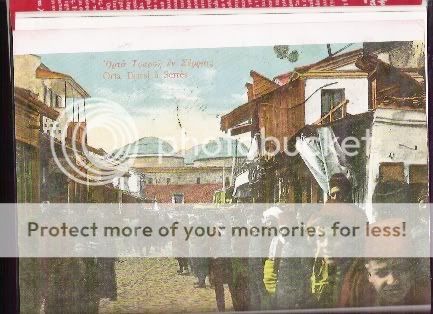
Orta Carsi street in Ottoman-occupied Serres
http://history-of-macedonia.com/wordpress/2008/12/01/the-chronicle-of-serres/
The Chronicle of Serres was written by the priest Synadinos (Papasynadinos / Παπασυναδινός) who lived in Serres, a city of Macedonia, in Northern Greece, during the first half of 17th century. We know very few things about Papasynadinos. He was born in the village Melenikitsi, ten kilometers north of Serres, where he settled in 1615. He became a priest in 1622 and he started to write his chronicle in 1642,when he sought refuge in his village due to the deadly plague that had hit the whole Ottoman empire since 1641. We do not know the exact date of his death, but it was for sure not prior to 1646, since his name is mentioned in a document of the monastery of St John the Baptist near Serres dating from that year. 
The chronicle covers the years 1598-1642 and it resembles the Byzantine chronicles. It is written in the vernacular Greek of the era. Papasynadinos uses many Turkish loanwords that were in the vernacular of the regional dialect of Serres at that time and many dialectical peculiarities as well. It’s considered as a source of valuable informations for the life of the enslaved Greeks during the Ottoman time, their relations with the Ottomans and all the oppresion and acts of violence they suffered by the later. We can find also informations for the function of the institutions of the local self-government in Greece under Ottoman rule and the organization of the Orthodox church. The author uses the Byzantine calendar that was introduced by the Sixth Ecumenical Council of Constantinople and numbers the years from the beginning of the world (date of creation) or 5508 BC. The chronicle was discovered by Spyridon Lambros in the monastery of Koutloumousion in Mt. Athos in the last years of 19th century.
papasyn20 The chronicle of Serres
A copied page from Papasynadinos’ original manuscript
which is kept today in the Athonite monastery of Koutloumousion
It starts with a (lament) for the capture of Constantinople by the Ottomans, a very popular topic for Greek folk poetry in the first years of post-Byzantine era.Some scholars doubt whether Papasynadinos was the real author of this ,due to the many differences between it and the main text of the chronicle.There is also a close morphological affinity between this and the one that wrote in 1618 the bishop of Myres (in Asia Minor) Mathaeus (it was published in 1672).
We can see in this that the ethnic names and were used interchangeably by Papasynadinos(or the real author) while the Greeks never applied the name to the other Christian nations of the Balkans:
papasyn1 1 The chronicle of Serres
papasyn2 The chronicle of Serres
papasynfroncov The chronicle of Serres
The chronicle has also been studied by Turkish historians,since it is a good first hand account of the Ottoman administration in the Balkans.The pages below are from by Fikret Adanır and Suraiya Faroqhi,2002:
papasyn196 The chronicle of Serres
The Turks applied the ethnic name (Roman-Byzantine) only to Greeks.
papasyn198 The chronicle of Serres
papasyn199 The chronicle of Serres
And here we see that the Greeks never called the Bulgarians, Serbs and other Christian nations of the Balkans,instead they had their own ethnic names. Below is the Greek text:
papasyn17 The chronicle of Serres
papasyn18 The chronicle of Serres
Some other pages of the chronicle:
A Greek named Patrulas was burnt alive due to the false accusation of a Turk whom he had saved from death in Romania some years ago:
papasyn3 The chronicle of Serres
papasyn4 The chronicle of Serres
The execution of another Greek, Manolis Bostantzoglis,  by impaling is described below. 
The Turks offered him the option to save his life if he converted to Islam but he refused.
papasyn5 The chronicle of Serres
papasyn6 The chronicle of Serres
papasyn7 The chronicle of Serres
A forceful conversion to Islam:

papasyn8 The chronicle of Serres
papasyn9 The chronicle of Serres
Another Greek murdered by a Turk:
papasyn10 The chronicle of Serres
The infamous (the recruiting of Christian children as Janissaries) :
papasyn11 The chronicle of Serres
A Greek was hanged due to false accusations:
papasyn12 The chronicle of Serres
papasyn13 The chronicle of Serres
Another Greek, Alexandrts Tatarchanis, was hanged refusing to convert to Islam to save himself:
papasyn14 The chronicle of Serres
papasyn15 The chronicle of Serres
The term Macedonia was not unknown to the Greeks of Macedonia at that time: 
"...Macedonia, Thessaly and Bulgaria..."
papasyn16 The chronicle of Serres
papasyn19 The chronicle of Serres
It’s also remarkable that Papasynadinos’ native village was in early 20th century 
Slavophone as some other villages in the vicinity that are mentioned in his 
chronicle. It seems that at Papasynadinos time the inhabitants were still 
Hellenophones,since he mentions the Greek surnames of their inhabitants, like 
Skarlatos, Dimos and furthermore some of them were accomodated in the 
regional Greek dialect, like Gerakoudis, Mavroudis. So the question is when and how 
these people lost their Greek language.

Monday, March 7, 2011

The ghosts of ancient Afghanistan

Cavorting nymphs, headless nudes, lost cities in strange locations . . . a new show about Afghanistan's ancient wonders thrills Jonathan Jones

  • guardian.co.uk,
  • A gargoyle water spout from Lady Moon city
     
    A gargoyle water spout from Lady Moon city. Photograph: Linda Nylind for the Guardian
    In 1971, a team of French archaeologists discovered a sculpture in fragments at a site by the river Oxus in northern Afghanistan. It was restored and placed in the National Museum in Kabul. Then, a decade ago, it was smashed all over again, this time deliberately – by the Taliban, who were also demolishing the colossal Buddhas at Bamiyan, in the centre of the country. Those vast masterpieces of religious art are gone for ever, but this wonder of nudity was luckier. Afghan experts have now pieced it together again – and sent it around the world, to show off the richness of a country the world thinks of only as a vast alien battleground; or, in the subtle words of our defence secretary Liam Fox, "a broken 13th-century country". The twice-rescued young man greets you at the start of Afghanistan: Crossroads of the Ancient World, the British Museum's compelling new show. There's no mistaking the beauty of this alabaster nude, who would be arresting even without his story of survival. The history of Afghanistan, this exhibition hints, is vast, complex and astounding. Its epic nature is shown by the fact that this show covers just a few ancient centuries, ending in the first century AD. But what centuries they were. One of the most remarkable things about the youth carved in alabaster is the fact that he's an ancient Greek. How did he end up in Afghanistan? Well, he was found at an ancient Greek city discovered near the Oxus by French archaeologists in the 1960s. They partially excavated the city, clearly Hellenic in its art and architecture, until the Soviet invasion drove them away in 1979, leaving the site to be torn apart by looters. Locals called the city Ai Khamun, Lady Moon, from a legend about a princess who lived in a fortress on the site. The remains of Lady Moon city, on show in this exhibition, are as stupendous as they are delicate. The huge flowery bloom of a Corinthian capital (the decorated top of a column) stands next to leaf-like terracotta ornaments overlooking a sundial shaped into a hollow sphere. A bronze Heracles, musclebound and fierce, is powerful proof that the Greek gods and heroes penetrated this far into Asia. And only one man could have got them there: Alexander the Great. Consequently, although the original name for this city is not known, it can be guessed – some variant of Alexandria, perhaps. Ai Khamun is physical proof of the hold Alexander the Great has on history. Was he a monster or a genius, a visionary or just a talented general? Whatever, he tore through the borders separating east and west. In the fourth century BC, this Macedonian king led a Greek army into Asia to conquer the mighty Persian empire, then kept going, getting as far as India. He also got to the river Oxus, which is towards the border with China; and, in his mighty wake, this city grew up, a Greek colony with Greek art in the heart of central Asia.   A very saucy sofa Afghanistan, says the country's president Hamid Karzai in the exhibition catalogue, "stands at the crossroads of many civilisations". You can't get more spectacular proof of this than a Greek city within a camel journey of China. In fact, camel journeys to and from China were the business of Afghanistan for centuries. Ai Khamun could not last: so far from the Hellenic heartland, this and other cities left by Alexander – which had made their money from trading on, or controlling trade along, the fabled Silk Road – were eventually overrun and wrecked by nomads. In the archaeological museum of Naples in Italy, you can visit the Secret Cabinet: a collection of dirty pictures from the ancient Roman city of Pompeii. Surprisingly, the collection also includes an ivory carving of a cavorting love goddess from India. How did it find its way to Pompeii? This exhibition solves the mystery, placing a photograph of this carving next to identical ones found in Afghanistan, all with big round breasts, dancing, riding magical beasts, and generally displaying themselves. These sensual Indian figures – most of them decorations for a sofa, not hard to guess its purpose – come from a hoard found at Begram, a little to the north of Kabul, near the route of the Silk Road. It is rare to find evidence of this fragile epic artery connecting ancient east and ancient west; rarer still to find evidence that's both beautiful and erotically animated. This dizzying collection of traded intercontinental treasures proves the Silk Road to be no fable: beautiful, expensive things really did journey between worlds, at a time when Romans knew nothing of the places they were connected to. In between worlds, dominating the tough landscape of central Asia, ruling over poor farmers and moving in tented courts on horseback, lived the nomads, who hunted, kept pasture animals and fought fearsomely. Little survives of the world the nomads made: they were movers and shakers, not builders. Yet in 1978, Russian archaeologists in northern Afghanistan dug into a mound known as Tillya Tepe, "the hill of gold", and found it really was full of gold, nomad gold. It was the burial mound of a powerful nomad prince and five princesses: all were buried at the same time. The women were sacrificial victims, apparently, doomed to die with their master. Stand by your man – and get buried with him, too.         Something doesn't add up So, rich and splendid as these nomads were, you wouldn't call them civilised. It is the gold of Tillya Tepe that features on the show's catalogue cover. Even without knowing why the princesses died, there is something savage and coarse about this gold. Compared with the Indian and Greek works, these are primitive, if still brilliant, objects. And yet the people who made them draw on ancient Greek and even Chinese art for inspiration. This gold hoard is, literally, a melting pot of cultures. Yet the mixing of Greek cupids and Chinese pastoral ornaments results in a strange and tasteless art, a bizarre, barbaric melange. Yes, it is magnificent, but it's not a magical synthesis of cultures, more like a visual no man's land. Among the nomad gold, the exhibition's portrayal of Afghanistan as a "crossroads" becomes questionable. Goods were traded, but was any deep learning shared? Somehow it doesn't add up. Some Indian stuff went west. Some Roman glass went east. Yet the only people creating a postmodern bricolage of east and west were the nomads, scavengers on the borders of both east and west. If east and west really had met in ancient times, the world would look very different. But that would have needed a deeper encounter: a true visionary, able to cross continents and join them. Now if Alexander had lived . . . Jonathan Jones Jonathan Jones • Afghanistan: Crossroads of the Ancient World is at the British Museum, London WC1, from Thursday. Box office: 020-7323 8181.

Friday, March 4, 2011

Slavic Elements in...Homer? - Part 2

Miltiades Elia Bolaris

SLAVIC HOMER IN SKOPJE and assorted Balkan fables

 
HOCUS POCUS SLAVOMAKEDONIENSIS:
Bogus scholarly witchcraft in the age of Antikvizatsiyja


The man known in the internet as Petrus Invictus, a.k.a. Perica Sardzoski, a.k.a. Pero, a.k.a. Petro, a.k.a. John Donne has come up with a "theory" which claims there are certain words in Homer that men like Tashko Belchev, Odisej Belchevski, Risto Stefov, Aleksandar Donski and himself have found in the Iliad and Odyssey that are obviously…Slavic, therefore…Slavomacedonian! This, they claim, is what "proves" that Homer must have copied some Slavic bards who, of course, lived in Macedonia before the "African" / "Egyptosemitic" Greeks ever showed up in history.

This was the original theory, but since nobody sat down to expose their lunacy about Homer being a copycat of the imaginary Slavonic bards more than 1500 years before Slavic ethne ever made their appearance in history, they decided they had a few rein to move a step further: Homer was not a Greek copycat of prehistoric Slavic poetry, after all. Now that Petrus Invictus had time to reflect on this issue a bit longer, he decided that Homer was actually a Slav himself, after all. What was his proof? No proof is necessary, just pure hot air hallucinations: "another view", "new theories" and (obviously!) zero documentation.

"This promotes yet another view in reading history regarding Homer and his Slavic character. New theories arise:

Homer spoke a form of pre-Slavic language."1

Undisciplined lunacy ran amok, is the only way we could describe it.

As we said earlier, a word here and a word there do not in themselves constitute a language. Language is structured sentences, grammar and syntax, not simply independent words floating around. It has been estimated that approximately 60% of the English vocabulary is made up of Latin and Greek words injected into the Germanic language of the Saxons via French. This does not in any way make a case for English being a Latin or a Greek dialect though. It is still very much a Germanic language.

It is inevitable that neighboring languages share several common words or even whole expressions. In border lands bilingualism becomes a normal way of life. Trade, tourism and intermarriages enhance this process of lexical borrowing and lending. Beyond this commonality of shared words between different languages there are also groups of closely related extended language families. It would be a deaf person the one who will not recognize that German and Dutch, Serbian and Bulgarian, or French and Italian, share a lot more among themselves than just a few random words.

If we narrow our scope in the Balkans, we notice that there are border populations on both sides of the national frontiers of Serbia and Bulgaria where the native people can understand both standard languages equally well while conversely, native speakers of standard Bulgarian and Serbian have a hard time understanding the native spoken transitional dialects. The largest of these groups of dialects are to be found among the speakers of Shopi / Шопи, Torlatchki / Торлашки, and Gorani / Горани dialects. Under different historical and geopolitical circumstances all the above could have either developed into separate languages or become absorbed into one of the neighboring "mother" standard languages. The various Slavomacedonian dialects are one such case where history worked in their favor.

During the resistance against the Nazis and their puppet governments in occupied Yugoslavia, and following the disaster of the Wehrmacht in Stalingrad in 1943, Marshal Tito saw that the balance had now turned against Germany and it was a matter of time before Yugoslavia would be liberated. It was now time to start thinking big. Italy was split in two, and the allies were marching north. Mussolini and his Salò Republic (Repubblica di Salò) was a shadow puppet of the Germans. Bulgaria, that had joined the Axis, gaining substantial land concessions from Hitler against both Greece and Yugoslavia, was going to be, like Italy in the postwar dog house. Greece had fought against the Nazis and had suffered, like Yugoslavia, but this was not a huge issue if the Yugoslav cards were played right. He asked the Greek and Albanian communists to sign a memorandum of cooperation between the separate national partisan organizations for establishment of a headquarters to coordinate the antifascist struggle in the Balkans. But Tito had only a small detail that he asked them to take care of, demanding, in 1943, for the "creation of a free Macedonia"2. A year later on August 2, 1944 a new nation was proclaimed out of the mainly Bugarski-speaking inhabitants of southern Serbia. Initially everyone living in the People´s Republic, including Greeks, Torbeshi Muslim Slavs and even Albanians were all told they are included in the new nation, consequently everyone had to conform by changing their names to more "Makedonski" (some would also say Polish or Russian) sounding endings like –ski, –vski, -nski and -oski. Serbovic became Serbovski, Bulgarov Bulgarovski and Ellenas Jelenovski. This was the land the Serbs had won with their blood from the Turks in 1912, any longer, but a new Yugoslav People´s republic, the Socialist people´s republic of Makedonija, whose people did not speak a confusing assortment of Serbo-Bulgarian transitional dialects, along with Turkish, Greek, Aromunian, etc, but a new language, which they had to learn as they went along, before it was even codified: Slavo-Makedonski!

At the the "First Plenum Session of ASNOM, the antifascist Assembly for the National Liberation of Macedonia", held on August 2, 1944, Slavo-Makedonski was proclaimed the official language of the Демократска Федерална Македонија / Demokratska Federalna Makedonija / Democratic Federal Makedonija, which soon after changed to People´s Republic of Makedonika and later to Socialist People´s Republic of Makedonija.

A committee of linguists and philologists under Blaze Koneski was assigned to work on the local dialects and to create what became known as the "standard (Slavo-)Macedonian language", a language formed out of the westernmost dialects of Slavonic, spoken in what was till then known as South Serbia or Vardarska Banovina. The western dialects were intentionally chosen because they were most distinct and distant from either Serbian or Bulgarian, while the closer you go to Serbia or Bulgaria the dialects start fusing into the respective standard Serbian or standard Bulgarian. Soon after, the new "standard Slavo-Macedonian language" made its appeared, in articles that were published in the first issue of the Nova Makedonija newspaper in 1944. They say that the difference between a language and a dialect is that a language is a dialect with an army and a navy. Tito, the catholic Croatian Stalinist leader of Yugoslavia, took things a step further: on July of 1967 Marshal Tito´s regime became the first "communist" government ever to initiate the establishment of an official state church, the so called Macedonian Orthodox Church, which was of course immediately proclaimed schismatic by all other Orthodox Churches. But the Makedonci now had not only a state and a language but a state church too, separate from Serbian and Bulgarian influences. The first translation of the Bible in the newly established official language (Archbishop Gavril´s translation) was published in 1990 and a second one (translated by Dushko Konstantinov) was printed in 1996.

Yet, if we are to believe the unsupported assumptions of the Slavic ultranationalists from Skopje, Blaze Koneski´s Slavonic idiom was indigenous to the Balkans since time immemorial. Vasil Iliov goes as far as to claim that Makedonski has been spoken since the Paleolithic era, and he is about to claim that the Neanderthals of Europe spoke Makedonski too:

"...in the entire evolutionary process the ancient Macedonian tribes had during the Paleolithic a common mythology…; they had a common language and common territory of speech; they had the earliest social organization in forms of ´zeting´ (sic); they had common name, a common Macedonian phonetic alphabet, common Macedonian ´zets´ – writers and high level of Macedonian culture in the framework of the evolutionary process of the oldest phase of Macedonian culture from Magdalen to Mamontovoy Kuryi at Urals…"3

This was not printed by some obscure occult magazine that only some nuts will read. This is from an article published in Nova Makedonija, Skopje´s largest daily!4 Such articles gives us a good indication of the daily misinformation that proliferates through every level of Slavomacedonian society from schools to the press and to political and cultural associations.

"The theory of the so-called "Indo-European languages", Vasil Iliov, whom Petrus Invictus freely quotes and accepts, tells us, "will have to go through revision. The continuity of the Macedonian linguistic tradition confirms that the oldest language i.e. protolanguage, which was spoken in the greater or the Great Zeta Macedonia was the Paleolithic, Mesolithic, Neolithic and the Eneolithic Macedonian language."!

Professor Victor Friedman, throw your worthless University of Chicago Linguistics books away and rush once again to Skopje to learn the new dictum: You thought Slavomacedonian was a Slavonic language, related to but separate from Bulgarian yet Vasil Iliov just found out that Makedonski is "the oldest language i.e. protolanguage, which was spoken in the greater or the Great Zeta Macedonia". All we need now is to define what on earth "Zeta Makedonija" is and Vasil Iliov will soon "prove" than everyone from Patagonia to the Chinese and to the Australian Aborigines spoke Makedonski, "the oldest language i.e. protolanguage"! And if "Great Zeta Macedonia" is not enough, we will have to include the Great Eta Slavomakedonija, the Great Theta Slavomakedonija and even the Great Iota and Kapa Slavomakedonijas will be kicked in, just to make sure the adjacent planets in our solar system and beyond are covered linguistically by the Slavomakedonskata protolanguage…

Petrus Ivictus follows right behind Vasil Iliov:

"…we might assume that Homer, or better say the original singer of the epics, must have used a language that was of proto-Slavic origin!

This language has been altered due to the influence of other languages mostly the Doric and Ionic dialects, who cam later after Homer's time, and new words entered the epic, however, some of the words from the first languages, that you so well assume might have been the one spoken in Mycenae might be of proto-Slavic substratum!"

Rarely has so much nonsense has dressed up in such pompous fashion. We are regressing from the comitatzi Goce Delchev to the Byzantine emperor Basil the II, the Bulgarslayer, back to the Slavic Czar Aleksandar Velikiot (Alexander the Great) and then to the proto-Slavic Makedonskiot Czar, Agamemnon of Mycenae, pardon me, Agamemnovski of Mykinovgrad, along with Patroklovski and Achilevski from Central Hellas-Heladovo.

If this all sounds so awkwardly embarrassing and utterly ridiculous, it is because it is!

"To this we add the discovery of Slavic language in the Demotic text of the Rosetta stone and that makes the story complete!"

Well said: Two professors of Electrical Engineering from Skopje shattered the world of Egyptology a few years earlier "proving" the ancient Egyptian language of the Hellenistic government during the Ptolemaic era was proto-slavic "Makedonski" too 5. This discovery, sanctified by the official state Makedonskata Church in Ochrid6 led to a great distress among the modern Egyptian population, who just realized that they were fed ethnic lies hitherto, never being told of their proto-Slavic nature, which electro-mathematically that led to popular riots and the toppling of the Mubarak regime. Hosni Mubarak´s original name, as we all probably already know is derived from Bosni Mubarakdoni, which of course proves that he was a Bosniac Makedonski Czar after all. The circus Skopjanska keeps on marching:

"Homer was of Slavic speaking group however created a poem that was orally transmitted through generations, until it reached the Athenian Greeks who recorded it as they received it from those before them with vocabulary from various dialects or languages, however, preserved some of the words that were used in the original ages before!"7

Are we surprised wondering where this man found the imaginary sources for all these extraordinary claims? I hope not, since more surprises follow:

"The term for GO in Macedonian is surprisingly "ODI"!!!"

ODI SI means GO AWAY!

Now I am surprised what ODYSSEY means at all!!!"(sic)

"Let us check: (Merriam Webster Dictionary)

Odyssey

Etymology: the Odyssey, epic poem attributed to Homer recounting the long wanderings of Odysseus

1 : a long wandering or voyage usually marked by many changes of fortune
2 : an intellectual or spiritual wandering or quest

So my question is the following: if "ODI SI" means GO AWAY even today in Macedonian, and the form of GONE comes from an older proto-German word "ēode" which is not in use in English as such today, however has transformed into GONE, then if we have "Odyssey" in Homer that means a "journey" or "GOING AWAY", isn't it logical to say that the word is of Slavic or proto-Slavic origin that has entered the Greek, German and other languages since the Slavic linguistic element is one of the primary in the Indo-European linguistic substratum, and has been best preserved into modern day Macedonian language! This curiously makes Macedonian language one of the oldest languages in Europe, a language that supposedly the first authors of the epic Odyssey were using! Maybe the one used with Linear B in the Mycenaean epoch!?!

In other words, Homer's Odyssey which means a JOURNEY means the same in modern day Macedonian!

While say JOURNEY in modern Greek is:
journey = ταξίδι (taxidi)
and TO GO is:
go = πηγαίνω (pigaino)
while to WALK is:
walk = περπατώ, περίπατος (perpato, peripatos)

No trace of ODISI or ODYSSEY or EODE or any Indo-European form of the word in the Modern Greek! While everyone knows that Odyssey meant JOURNEY in Homer's time!

However, Macedonian language has preserved the original form in its true meaning!

ODI SI - GO AWAY"

We will suggest another route to this argument. We want to find out why Petrus Invictus wants to make a Proto-Slavic Czardom out of the Achaean kingdom of Mycenae. Czardom is of course derived from the Slavonic word for king of the Mycenae, Czar Agamemn-ovski, as we saw earlier.

We will go back to the same lexical source as Petrus Invictus used, The Webster dictionary. 8 A search for Czardom brings us to Czar:

"Definition of CZAR

1: emperor; specifically : the ruler of Russia until the 1917 revolution
2: one having great power or authority
— czar•dom also tsar•dom or tzar•dom tzär-dəm, (t)sär- noun

Variants of CZAR
czar also tsar or tzar

Examples of CZAR

1.Origin of CZAR
New Latin czar, from Russian tsar', from Old Russian tsĭsarĭ, from Gothic kaisar, from Greek or Latin; Greek, from Latin Caesar — more at caesar

First Known Use: 1555
Related to CZAR

Synonyms: baron, captain, magnate (also tsar or tzar), king, lion, lord, mogul, monarch, Napoleon, prince, tycoon".

Czar, therefore is an English word that can mean baron, captain, magnate (also tsar or tzar), king, lion, lord, mogul, monarch, Napoleon, prince, and tycoon, among other things. It is a word that was borrowed from Russian which borrowed it from Byzantine Greek which borrowed it from Latin and Latin borrowed it from the family name of a person, Julius Caesar.

The last name of Julius Cesar, in other words, became synonymous with what Websters defines as:

"Definition of CAESAR

1: any of the Roman emperors succeeding Augustus Caesar —used as a title
2: a powerful ruler: (1): emperor (2): autocrat, dictator"

Caesar, in simple words is a biographical name, that through power and prestige acquired a meaning embodied in the qualities that person exemplified.

The same thing happened to the name of Charlemagne. His name became a synonym of "king" in several Slavic languages, though he hardly ruled over them, just by linguistic association: Charles the great, lent his name to the meaning of "king" and became Králin in Czech, Król in Polish, Краљ/Kralj in Serbocroatian, etc.

The cunning Skopjan propagandist who was very eager to give us earlier the English definition of the word Odyssey, told us that according to Webster´s dictionary, Odyssey is defined as follows:

"Definition of ODYSSEY

1: a long wandering or voyage usually marked by many changes of fortune
2: an intellectual or spiritual wandering or quest"

Pero conveniently failed to go a few lines down and give us the whole story. Webster´s gives us examples of how the word Odyssey is used in English:

"Examples of ODYSSEY

1. The story is about the emotional odyssey experienced by a teenage girl.
2. the spiritual odyssey of the deeply religious"

Then right below that, it also gives us the:
"Origin of ODYSSEY

the Odyssey, epic poem attributed to Homer recounting the long wanderings of Odysseus"

Webster´s also gives us the first time the word "Odyssey" ever appeared in its current usage (i.e. as : "a long wandering or voyage", or as "an intellectual or spiritual wandering or quest")

"First Known Use: 1889".

This means that, according to the source that Petrus Invictus gave us, until 1889, when Odyssey acquired a new meaning intot he English language, when someone spoke of Odyssey, everyone understood only one thing: "the epic poem attributed to Homer recounting the long wanderings of Odysseus".

Even Petrus Invictus cannot deny the fact though that Odyssey is not English but a Greek word. Odyssey is merely a translation in English of the original Greek Odysseia / Οδύσσεια. While it would be very interesting indeed to know what Odysseia means in Swahili, German, Urdu or Japanese, in order to find the true meaning of Odyssey we need to go to the original language and look into the etymology of Odysseia.

Odysseia / Οδύσσεια means "something pertaining to Odysseus", in this case his journeys. The endings "-eios"(m), "-eia"(f) and "-eion"(n) as well as "-ios"(m), "-ia"(f) and "-ion"(n) in Greek all indicate a close identification and relationship pertaining to the noun that precedes them.

Basileus / Βασιλεύς is "king" and basil-eios / Βασίλ-ειος (m) is someone pertaining to the king, i.e. "regal", "royal".
Basil-eia / βασίλ-εια (f) could mean many things royal like queen, crown, royal dominion, reign, etc, all pertaining to royalty and related to king.
Alexandros is a Greek name meaning "defender against (enemy) men", and Alexandr-eia was a city that was founded by Alexandros.
Lyceios means "illuminating" and it is an adjective to Apollon, and Lyc-eion (Lyceum) was originally the name of a temple dedicated to Lyceios Apollon and the area around it.
Heracles is a name and when Phillip II built a city where is now Monastiri – Bitola, he named the city dedicated to Heracles: Heracl-eia.

If Homers was writing about Alexander (Alexandros/ Αλέξανδρος in the original Greek), that epic would be called Alexandreia, if he was writing about Achileus that epic would be called Achileia. If he had written about Telemachos, Odysseus´ son by Penelope, that epic would be called Telemacheia. If Homer or anyone else written an epic about Telegonos, Odysseus's son born of Circe, that epic would be called Telegoneia. Now, as a matter of fact, there was indeed a lost epic called just that: The Telegony. The Telegony (Telegoneia / Τηλεγόνεια in the original) is a long lost epic Greek poem, considered the last poem of the Greek epic cycle. It was attributed to the poet Mousaios/Μουσαῖος, among others.

It is obvious that Odyssey and Telegony or, better yet, Odysseia / Οδύσσεια and Telegoneia /Τηλεγόνεια have no connection with Petrus Invictus´ infantile pseudo-linguistics of "Odi si", "go away". Otherwise he would be at a loss to find an "etymology" for "Telego Ni"!...

"Odi si", pronounced harshly and with a loud stump of the foot on the pavement, might be enough to scare off an alley cat in Skopje (http://www.flickr.com/photos/berghaus/452238951/in/set-72157600099269011/), even if the cat has no clue that ODI SI means go away. Cats are smart, she will get the message. We would bet that if Pero would stamp his foot and screams at the next cat "TELEGO-NI" or "TELE GO" for short, the cat will run as fast as the "ODI SI" cat will. It will be a long way before Petrus Invictus´ "ODI SI" can explain the etymology of Odyssey, the Odysseia, in other words.

We will offer some examples where the Slavonic Odi cannot be used:

Bodies and Crocodiles and Kodiak bears all have odi in them, but not because crocODIles and bODIes and KODIak bears walk and "go". PODIatrists tend to feet (pODIa /πόδια, in Greek) which do GO and walk, yet any pODIatrist in Skopje will assure Pero that his profession is not named after the south Slavonic ODI, "to go" but the Greek "podia" (podes). GODIva chocolates have ODI too, and so does rODItis wine and sODIum and iODIne, yet none of them "go" anywhere. "Functional Etymology", like all modern pseudo-scientific witchcraft emonating from Skopje, has its dire limitations, as I am sure ODIsej Belchevski, its initial proponent already found out.

Basic common sense, reason and historical bounds will not deter a determined Skopjan propagandist from making grandiose mental leaps over and beyond time, truth and logic, into the abyss of the obscure:

"So my question is the following: if "ODI SI" means GO AWAY even today in Macedonian, and the form of GONE comes from an older proto-German word "ēode" which is not in use in English as such today, however has transformed into GONE, then if we have "Odyssey" in Homer that means a "journey" or "GOING AWAY", isn't it logical to say that the word is of Slavic or proto-Slavic origin that has entered the Greek, German and other languages since the Slavic linguistic element is one of the primary in the Indo-European linguistic substratum, and has been best preserved into modern day Macedonian language! This curiously makes Macedonian language one of the oldest languages in Europe, a language that supposedly the first authors of the epic Odyssey were using! Maybe the one used with Linear B in the Mycenaean epoch!?!(sic)
In other words, Homer's Odyssey which means a JOURNEY means the same in modern day Macedonian!

While say JOURNEY in modern Greek is:
journey = ταξίδι (taxidi)"

That is curiously curious indeed!...we would add.

Un-curiously enough, our suggestion to Pero would now be to simply hire a taxi ("ταξί / taxi" being a word most definitely derived from ταξίδι / taxidi), and take a long hike into the paranormal time travel (chrono-taxidi!) where Proto-Slavic Mycenaean bards will chat in Slavomakedonski and write pre-Homeric poems on pre-Cyrilic Linear B tablets, which the Skopje restauranteur cum pseudo-epigraphist Vasil Iliov will not even have to "translate"!

We urgently need some fresh air! Exiting the Skopje time-travel machine, and leaving the imaginary Homeric Proto-Slavs behind us, we are back to reality:

We already said that Odysseia / Οδύσσεια means "something pertaining to Odysseus", but we need to explain the etymology of Odysseus / Οδυσσεύς, whose name is Ulysses in Latin.

There is word in Modern Greek called odyne / οδύνη. Odyne means psychological distress, grief and pain but in some cases it can also mean pain in the physical sense.

You console someone on his "odyne" for the loss of a beloved person. When you sue someone for causing mental anguish to you, mental anguish in Greek is translated as psychike odyne/ψυχικη οδυνη. On the other hand, a woman can attest that her childbirth was un-odynous, an-odyne / ανώδυνη and she felt no pain due to an epidural shot.

This word has also entered the English language and in an internet dictionary we find the following:

"English-Word Information", word Info about English Vocabulary

odyn-, odyno-, -odynia, -odynic,-odyne, -odyn, -dyne, -dynia +

(Greek: οδυνη, pain)"

Several medical terms follow which include derivatives of the word odyne:

"phrenodynia - Pain in the diaphragm.
pleurodynia - Pain in the chest
pneumonodynia - Pain in the lungs.
pododynia - Pain in the foot
proctodynia - Pain at the anus, or in the rectum.
prostatalgia, prostatodynia - Pain in the prostate
rachiodynia - A pain in the vertebral column.
rhinodynia - Pain in the nose.
sacrodynia - Pain in the sacral region
scapulodynia - Pain in the shoulder blades.
splenodynia - Pain over the region of the spleen
spondylodynia - Pain in a vertebra of the back.
sternodynia - Pain in the sternum or the sternal region.
stomatodynia - Pain in the mouth.
tenodynia - Pain in a tendon" 11

Odyne is also attested in the Bible (not Petrus Invictus´ Slavomakedonskata "bible" unfortunately):

ὅτι λύπη μοί ἐστι μεγάλη καὶ ἀδιάλειπτος ὀδύνη τῇ καρδίᾳ μου.»
Πρός Ρωμαίους 9:2

"oti lype moi esti megale kai adialeiptos odyne tei kardia mou",
in transliteration with Latin letters.

"that I have great grief and uninterrupted pain in my heart", according to the
Darby Bible Translation

"that I have great sorrow and unceasing pain in my heart", according to the
American Standard Version

"that I have great sorrow and unceasing grief in my heart" according to the
New American Standard Bible (©1995)
Romans, 9.2

In the Vulgata Latin translation we wead:

quoniam tristitia est mihi magna et continuus dolor cordi meo»

(ὀδύνη /odyne was translated into Latin as «dolor»).

The word odyne / ὀδύνη, appears also in Homeric Greek, in the same form and with the same exact meaning (pain, sorrow, distress of body or mind) as it is used in the Alexandreian Coene Greek of the Bible and in colloquial Modern Greek. Despite Petrus Invictus, a.k.a. Perica Sardzoski, a.k.a. Pero, a.k.a. Petro, a.k.a. John Donne´s incoherent rumblings, the continuity of the Greek language is unparalleled. From the Linear B attested Achaean Greek of the Mycenaean Greeks to the Greek of Homer's epics and from Thucydides and Aeschylus to the Alexandreian Greek of the Bible through Byzantium and into Modern Greek, the Greek language follows an unbroken line. This is an unbroken line of a written Greek word that has a DOCUMENTED written history of 3500 years. Not one other single language can claim this, not Latin, nor Chinese, Hebrew, or Sanskrit. Here is a proof:

"οδύνη δε δια χροός ήλθ' άλεγεινή
and pain through his flesh became excruciating"

tells us Homer in the Iliad. 11.398

"...σφαδᾳσμῶν τε καὶ ὀδυνῶν πλήρης, εἴπερ τῇ τῆς πόλεως
"...and he is full of convulsions and pains, if in fact he resembles the condition of the city"

tells us Plato, centuries later, in the 5th cBC, in the Republic/Πολιτεία 579e.

Plato's and Homer's odyne, having also entered the Bible, has kept the same meaning, three thousand years later.

Following the murder of two young policemen by armed robbers in the Renti municipality of Athens, a Greek blog on March 2, 2011 speaks of ΑΠΟΤΡΟΠΙΑΣΜΟΣ, ΟΡΓΗ ΚΑΙ ΟΔΥΝΗ ΓΙΑ ΤΗΝ ΔΟΛΟΦΟΝΙΑ ΤΩΝ ΔΥΟ ΑΣΤΥΝΟΜΙΚΩΝ / Apotropiasmos, Orge kai Odyne gia tin Dolophonia ton Astynomikon / Repulsion, Rage and Pain for the Murder of the Policemen" http://topsecret2010.blogspot.com/2011/03/blog-post_6128.html

Incidentally, EVERY SINGLE WORD in this Blog's title can be traced back to Plato and to Homer! How is that for a DOCUMENTED continuity of a language, especially when attacked by someone whose language has a documented existence of a post -1944 date!

A word which I believe is closely related to odyne / οδύνη, in both linguistic root and etymology, is the noun odyrmos / οδυρμός. It means "loud cry, lamentation, expressing grief openly, wailing in pain". The verb odyromai / ὀδύρομαι, is its derivative and it means "to grieve, to wail, to lament".

" ὁ δ᾽ ὀδύρετο πατρίδα γαῖαν"
"O d´ odyreto patrida gaian"
"and he was lamenting for his father land"

says Homer in Odyssey 13.219.

In the New Testament, in Mathew 2.13 we read:

"θρηνος και κλαυθμος και οδυρμος πολυς"
"lamentation , and weeping , and great mourning"

The same meaning is still apparent in the modern Greek usage of Odyromai and Odyrmos. A News Blog in Athens was deriding on October 25, 2009 a minister of the C. Caramanlis government because he was:

"Lamenting for not becoming transitional":
ΟΔΥΡΕΤΑΙ ΓΙΑΤΙ ΔΕΝ ΕΓΙΝΕ ΜΕΤΑΒΑΤΙΚΟΣ...
Odyretai Giati Den Egine Metavatikos...

http://www.inews.gr/89/odyretai-giati-den-egine-metavatikos.htm

Another word distantly but most probably (though some could dissagree) related to both odyne and to odyrmos as well as to odyromai is odyssomai/οδύσσομαι. Like them, odyssomai/οδύσσομαι is a word incorporating in its meaning powerful antithetical emotions, and (potentially) much pain.

Hesechios in his LEXICON gives us several words derived from it:

Οδύσασθαι, χολωθήναι / Odysasthai. to be wroth against

Οδυσθήναι, οδύσασθαι, χολωθήναι, θυμωθείναι, οργισθήναι / Odysasthenai. Odysasthai, to be wroth against, angry, enraged.

Οδυσσάμενος, οργισθείς / Odyssamenos. enraged.

These last three words are all derived from the verb Odyssomai / Οδύσσομαι which means to be wroth against, to hate, according to Liddell & Scott, but also to be angry, wroth, incensed, to rage, according to R.J. Cunliffe´s Lexicon of the Homeric Dialect.

As for the etymology of Odysseus, Liddell & Scott´s Greek-English Lexicon tells us that the meaning of Οδυσσεύς is the one "hated by gods and men":

"τί νύ οἱ τόσον ὠδύσαο, Ζεῦ;"
tin y oi toson odysao Zeu?
Where then did you conceive such wrath against him, O Zeus?" 12
Homer Odyssey, 1.62

One thing we need to remember is that Odysseus in Latin becomes Ulysses. More complicated is the question as to why the Greek "D" in Odysseus appears to transform itself into Latin "L" in Ulysses. This might seem to complicate or even demolish part of the etymology we have worked so hard to unfold. Odysseus´ O can be easily explained changing into the Latin U. When we search for the source of the Latin name Ulysses we discover that it is in fact derived from one of the multiple Greek variations to Οδυσσεύς / Odysseus. Odysseus´ name appears in Greek sources alternatively also as Ολυσσεύς/Olysseus, Ολυσεύς/Olyseus, Ολισευς / Olyseus, Ολυτευς / Olyteus, Ολλυτευς / Ollyteus, Ολυττευς/Olytteus, Ολυτές /Olytes, Ουλιξεύς/Oulixeus, Ουλίξης /Oulixees, Ουλιξες /Oulixes, so it is no wonder that in Latin ended up as Ulysses.

Do we have any cases where the dental Greek D appears also as L in the same word? We find the name of the laurel tree daphne / δάφνη which according to Hesechios appears in once dialect at least, in the city of Perge into Laphne:

Λάφνη, δάφνη. Περγαίοι
Laphne, daphne. Pergaioi
Hesechios, Lexicon

We keep in mind that dental d can change into L in other Indo-european languages, since we have dacruma interchange with lacruma, odor with olor, etc 13

Lest we forget, we need to remind ourselves what Petrus Invictus, a.k.a. Perica Sardzoski, a.k.a. Pero, a.k.a. Petro, a.k.a. John Donne said:

"ODI SI means GO AWAY!

Now I am surprised what ODYSSEY means at all!!!"(sic)…"

We look into the "American Heritage dictionary of Indo-EuropeanR" for odi- and we find od-2 which meant "to hate". English derivatives are: annoy, noisome, odium, from Latin odi, hate and Odium, hatred. [Pokorny od-773].

But Petrus Invictus continues:

"So my question is the following: if "ODI SI" means GO AWAY even today in Macedonian, and the form of GONE comes from an older proto-German word "ēode" which is not in use in English as such today, however has transformed into GONE, then if we have "Odyssey" in Homer that means a "journey" or "GOING AWAY", isn't it logical to say that the word is of Slavic or proto-Slavic origin that has entered the Greek, German and other languages since the Slavic linguistic element is one of the primary in the Indo-European linguistic substratum, and has been best preserved into modern day Macedonian language! This curiously makes Macedonian language one of the oldest languages in Europe, a language that supposedly the first authors of the epic Odyssey were using! Maybe the one used with Linear B in the Mycenaean epoch!?!"

The Greek words odyne (pain, suffering) and odyromai (lament) share the same root as the Latin doleo (lament), the Hittite Idalu (evil) and Old Irish Idu (pains), all of which are derived from proto-Indo-European *h1ed- and *h1edwol which seem to indicate affliction and pain or bite. According to J.P. Mallory and D.Q. Adams, in the Oxford Introduction to Proto-Indo-European and the Proto-Indo-European World, the word for hatred comes from a slightly different *h3ed- indicating hate which gives us the Latin Odi, hate(verb) and Odium, hatred (noun). Old English Atol, meaning atrocious, Greek Odysasthai "be angry at", "hate", Hittite Hatikzi "is terrible" and it underlies the name of the Greek Hero Odysseus. In the Lewis and Short Latin Dictionary, we find the word Odiosus, an adjective, derived from Odium, which means hateful, odious, unpleasant, and offensive and the adverb Odiose, in a hateful maner, odiously.

The Latin adjective Odiosus, as it becomes apparent, is not only linguistically but also etymologically connected to Odysseus.

Despite the overwhelming odds, Perica Sardzoski, a.k.a. Pero, a.k.a Petro etc insists:

"In other words, Homer's Odyssey which means a JOURNEY means the same in modern day Macedonian!

While say JOURNEY in modern Greek is:
journey = ταξίδι (taxidi)
and TO GO is:
go = πηγαίνω (pigaino)
while to WALK is:
walk = περπατώ, περίπατος (perpato, peripatos)

No trace of ODISI or ODYSSEY or EODE or any Indo-European form of the word in the Modern Greek! While everyone knows that Odyssey meant JOURNEY in Homer's time!"

I think we just about had enough of this joke. If we want to know what Homer thought of what Odysseia, Odyssey, Oddyseus´s journey meant to him, he would have explained why he chose this name for his main character, and what that name meant to him. We go to Odyssey 19.408 to hear it from Homer himself, in the speech of Autolykos:

"τὴν δ᾽ αὖτ᾽ Αὐτόλυκος ἀπαμείβετο φώνησέν τε:
"γαμβρὸς ἐμὸς θυγάτηρ τε, τίθεσθ᾽ ὄνομ᾽ ὅττι κεν εἴπω:
πολλοῖσιν γὰρ ἐγώ γε ὀδυσσάμενος τόδ᾽ ἱκάνω,
ἀνδράσιν ἠδὲ γυναιξὶν ἀνὰ χθόνα πουλυβότειραν:
τῷ δ᾽ Ὀδυσεὺς ὄνομ᾽ ἔστω ἐπώνυμον"

Which translates as:

To this Autolykos replied: "the name
I now declare must be the name that you
My son-in-law and daughter are to use:
BECAUSE I COME AS ONE WHO, on his ways,
Across the fertile earth HAS BEEN ENRAGED
BY MANY MEN AND WOMEN, let his name
Now be Odysseus, "son of wreath and pain"

The Odyssey of Homer: a new verse translation
By Homer, Allen Mandelbaum, Maria Luisa De Romans, page 401

Having heard Homer, now the last word goes to Pero:

"However, Macedonian language has preserved the original form in its true meaning!

ODI SI - GO AWAY"

We are leaving, but before we leave, we need to give Petrus Invictus, a.k.a. Perica Sardzoski, a.k.a. Pero, a.k.a. Petro, a.k.a. John Donne a gift, with Cassandra´s warning:

Timeo Danaos et dona ferentes »,
as Virgil said, speaking of Odysseus´ Trojan horse:

"Beware of Greeks bearing gifts!"

Petrus invictus had prepared us in the beginning with a poetic forewarning about truth, something he did not seem to follow himself, unfortunately:

"Hateful to me as the gates of Hades is that man
who hides one thing in his heart and speaks another."

I found the original quote in Homer (Iliad 9.312-313). Here is the first of the two lines, and right below is the transliterated text:

ἐχθρὸς γάρ μοι κεῖνος ὁμῶς Ἀΐδαο πύλῃσιν
echthros gar moi keinos, omos Aidao pylesin

We sat down and made a translation just for Pero. The catch is, we did not try to make it poetic, but only used words of Modern Greek that are already found in the Homeric text, words spoken almost three thousand (3000) years ago. Here is our translation of the first line, followed by the transliterated text:

εχθρός μου είναι κείνος, όμοιος με Άδου πύλες
echthros mou ein´ keinos, omoios me Adou pyles

It is actually very easy, even for someone who has no idea of Greek to make the comparison. Here below follows the second line:

ὅς χ´ ἕτερον μὲν κεύθῃ ἐνὶ φρεσίν, ἄλλο δὲ εἴπῃ
οs ch´ eteron keuthe eni phresin, allo de eipe

όποιος αλλότερο κρύβει στο νού του, κι´ άλλο θα ειπεί
opoios allotero kryvei sto myalo, ki´allo tha eipe

Homer/Iliad 9.312-313

Then we put our word-to-word, indeed utterly un-poetic, Modern Greek translation of the Homeric text using Homeric Greek words to the Google translator test. Here is what "the machine" came out with:

"my enemy is him, similar to Hades Gates
allotero which hides in his mind, and else it will say"
"translation" by "Google Translator"

This is not how a native speaker would translated it, but the Google translator did what was asked: it translated all the words, using the Modern Greek words in its linguistic arsenal.

With the exception of "allotero" (a mix of "allo" and "eteron") all other words passed the Google translator test and the meaning is more or less understood. Had we used the Pontian or another, equally conservative dialect, "eteron" could have used unaltered. Now we want to see Pero translate the same text, using only Slavomakedonski words allegedly found in Homer, then have Google translate whatever he comes up with into English...and make sense too!

If Pero can´t do this, we will gracefully ask him to "Odi Si" and to leave the Greek language and the Classics alone...
If he cannot, we will have to do it for him!

END OF PART TWO - To be continued.

NOTES AND REFERENCES:

1. Homer's Slavic Character, http://www.facebook.com/topic.php?uid=2204957887&topic=4435

2. Λεηλασία φρονημάτων, Ιωάννου Κολιόπουλου, Thessalonike 1995.

3. http://www.macedonians.com.au/forum/showthread.php?2926-Vasil-Iljov-in-quot-Nova-Makedonija-quot-daily-16-III-2009-%28excerpts%29

4. Vasil Iljov,"Najstari svedoštva za makedonskata pismena tradicija" ("Oldest Testimonies About the Tradition of Macedonian Literacy"), "Nova Makedonija" daily, No 21639 , 16.03.2009

5. http://issuu.com/eismakedon/docs/boshevski_and_tendov_s_egyptian_illusions

6. http://maktruth.blogspot.com/2008/03/macedonian-orthodox-church-promotes.html

7. http://www.allempires.net/the-slavic-element-in-homers-epics_topic24650.html Posted: 14-Jun-2008 at 11:32

8. http://www.merriam-webster.com/dictionary/czardom

9. http://www.merriam-webster.com/dictionary/odyssey

10. http://en.wiktionary.org/wiki/%CE%BF%CE%B4%CF%8D%CE%BD%CE%B7

11. http://wordinfo.info/units/view/1452/page:6/ip:2/il:O

12. ὠδύσαο. A play upon the name "Ὀδυσσεύς", which, according to this etymology, might be translated ´a man of wrath´; with the double signification of enduring the wrath of the gods, or dealing wrath to his enemies. Cp. Od.19. 275; 407 foll. Roscher (Curt. Stud. 4. 196 foll.), referring to the forms "Ὀδύξης", Ulixes, supposes the stem to be "δυκ", Lat. dux. Homer's Odyssey. W. Walter Merry. James Riddell. D. B. Monro. Oxford. Clarendon Press. 1886-1901

13. http://campus.usal.es/~revistas_trabajo/index.php/0544-3733/article/view/2658/2701
Tuesday, March 1, 2011

Slavic Elements in...Homer?

Miltiades Elia Bolaris

(This article has also been submitted for publication to the American Chronicle: http://www.americanchronicle.com/articles/view/219771)

SLAVIC HOMER IN SKOPJE 
and 
assorted Balkan fables
Fake "Rockefeller"
HOCUS POCUS SLAVOMAKEDONIENSIS:
Bogus scholarly witchcraft in the age of Antikvizatsiyja

"Hateful to me as the gates of Hades is that man who hides one thing in his heart and speaks another."

This is the quote from Homer (Iliad 9.312-313) with which the person that used to go under the pseudonym Petrus Invictus chose to start his work "Slavic Elements in Homer"1 with. We are poetically forewarned right away, through this Homeric quote, that the writer is dead serious about speaking the truth.

From the first line of this text we humbly recognize that this is no ordinary literary work. This text, he tells us, is nothing else than the beginning of the Bible. To be exact, while not related to the well known Christian Bible, this one is "A living Bible of Light" also known as "The House of Macedon". Its divine Apostle is no mere fisherman in Palestine. "I am a linguist", he assures us, and he is none other than Petrus Invictus, a.k.a. Perica Sardzoski, a.k.a. Pero, a.k.a. Petro, a.k.a. John Donne ("my new identity as John Donne is my own trust me!"2)

In the beginning of his "Bible" Petrus Invictus asks us to "take a look at the following study", so we do:

"More evidence that gives credence to the existence of an ancient prehistoric Macedonian civilization comes to us from ancient literature. One such source that greatly influenced our impression of the ancients and inspired Alexander the Great to seek adventure was Homer´s epic poems. About five hundred years after the Trojan Wars, Homer wrote the Iliad and the Odyssey. Homer´s work captivated his audience with events that, according to Tashko Belchev, began and ended in Macedonia. Homer was born in the 8th century B.C. and created true literary masterpieces that are enjoyed as much today, as they were in the days of Alexander the Great. Originally, Homer´s stories were folktales told and retold for millenniums until they were immortalized in print in the 6th century B.C."

Somehow this sounded familiar. First of all, Tashko Belchev sounded like a name I had seen before. It is not every day, after all, that you come across a nut of a man who makes a living by selling books with extraordinarily unsupported claims such as that "the Trojan war began and ended in Macedonia". Tashko Belchev is an author from Skopje known in the internet for such pseudo-scholarly presentations as: "Greeks has (sic) stolen the (Slavo)macedonian Mythology!3" or "The root of Greek language is stolen from the (Slavo)macedonian language!4" Even someone who is not familiar with the Slavomacedonian idiom, or any other Slavic language for that matter, can roughly follow what Belchev says in these videos, as long they have previously read these arguments in print. The names Troy, Macedonia, Greeks, etc are well understood in most language, regardless. Tashko Belchev is an animated and persuasive speaker after all, who speaks slowly and with good intonation, and he pronounces the Greek words convincingly enough to be understood. If only the content of his speeches was a fraction as good as his presentation!...

Knowing what oddities Tashko Belchev wrote, we now wonder who on this good earth would quote such a"peculiar" source. We take a closer "look at the following study", as Petrus Invictus' "Bible" suggested and a quick internet search brings us back to the original crime source. Not surprisingly, the referenced "study" is the "History of the Macedonian People from Ancient times to the Present"5, the brain child of a pseudo-"historian", someone who has only glimpsed the gates of a University from the outer side.

We can already asses that this paper does not look to be standing on a solid footing from the onset. Petrus Invictus, a.k.a Perica Sardzoski, a.k.a. Petro, a.k.a. Pero, a.k.a. John Donne foretold us that he hates liars like hell ("Hateful to me as the gates of Hades"), yet the first quote he brought forward for consideration is from such an unreliably chauvinistic trash of a source that doubts are already swarming us. Once we consider that Tashko Belchev is also included as a primary "source" in Stefov´s garbage-bin-worthy pseudo-historical "study", then the situation becomes ever more bleak.

How much more bleak? I would say it becomes plainly pitiful, when the next two paragraphs from the infamous aforementioned pseudo-"History", immediately following what we were just quoted, are added for consideration:

"What is most interesting about Homer´s stories, especially the Iliad, is that they were originally written in the prehistoric Macedonian language. The first paleolinguist to openly proclaim the similarities between the words of the Iliad and those of the modern Slavic languages was the German Homerologist Pasov. Inspired by Pasov and others, researcher Odisej Belchevsky has furthered the study by clearly illustrating the fundamental relationship between the modern Macedonian language and the language of Homer."

We need to repeat this, just to make sure our brain registers it, before it shuts down from Toronto garbage overload:

"What is most interesting about Homer´s stories, especially the Iliad, is that they were originally written in the prehistoric Macedonian language."

We take a deep breath and then we take one item at a time:

To begin with, Homer, who describes the topography of even the most obscure islands throughout the Mediterranean, does not even seem to know Macedonia, and he never mentions it, though he does mentions people and town in Macedonia. He only knows of a place called "Ematheia" and there is a simple explanation for it. In Homer's time the Macedonians, the people who in later centuries came down and captured the plains of Macedonia, giving their own tribal name to it, were still tending sheep and goats on the highlands of western Macedonia by the Pindus mountains. They were still called Maketes/Μακέτες, or Makednoi/Μακεδνοί, i.e. the mountaineers, the highlanders, as Nicholas G.L.Hammond explains to us in page 12 of "The Macedonian State". Macedonia in Homer's time was still inhabited by Phrygians, Thracians and Paionians; Greek cities, if any at that early age, were only to be found along the coastal areas of Macedonia and Thrace.

Homer speaks of Paionia, the Paionians, and the river Axios, the largest river of Macedonia and even Pelagonia, a province of western Macedonia, indirectly, yet there is no mention of Macedonia itself in Homer:

"εἴμ᾽ ἐκ Παιονίης ἐριβώλου τηλόθ᾽ ἐούσης
155Παίονας ἄνδρας ἄγων δολιχεγχέας: ἥδε δέ μοι νῦν
ἠὼς ἑνδεκάτη ὅτε Ἴλιον εἰλήλουθα.
αὐτὰρ ἐμοὶ γενεὴ ἐξ Ἀξιοῦ εὐρὺ ῥέοντος
Ἀξιοῦ, ὃς κάλλιστον ὕδωρ ἐπὶ γαῖαν ἵησιν,
ὃς τέκε Πηλεγόνα κλυτὸν ἔγχεϊ: τὸν δ᾽ ἐμέ φασι
160γείνασθαι..."
Homer Iliad 21.154-160

"I come from deep-soiled Paeonia, a land afar,
155] leading the Paeonians with their long spears,
and this is now my eleventh morn, since I came to Ilios.
But my lineage is from wide-flowing Axius—Axius,
the water whereof flows the fairest over the face of the earth
—who begat Pelegon famed for his spear, and he, men say,
160] was my father..."

In the Iliad, 2.848-850, Homer mentions Amydon/Ἀμυδών the capital city of the Paionians, by the Axios river, in what is now Central Macedonia:

"αὐτὰρ Πυραίχμης ἄγε Παίονας ἀγκυλοτόξους
τηλόθεν ἐξ Ἀμυδῶνος ἀπ᾽ Ἀξιοῦ εὐρὺ ῥέοντος,
850Ἀξιοῦ οὗ κάλλιστον ὕδωρ ἐπικίδναται αἶαν."

"But Pyraechmes led the Paeonians, with curved bows,
from afar, out of Amydon from the wide-flowing Axius—
850] Axius the water whereof flows the fairest over the face of the earth."

Besides Paionia by the sea and Pelagonia Homer also mentions other parts of what much later became known as Macedonia, places such as Pieria and "lovely Emathia" where Thracian horsemen still rode the mountains:
 
"Ἥρη δ ΐξασα λίπεν ίον Ολύμποιο,
Πιερίην δ πιβσα κα μαθίην ρατεινν
σεύατ φ πποπόλων Θρκν ρεα νιφόεντα
κροτάτας κορυφάς: οδ χθόνα μάρπτε ποδοιν"
Homer, Iliad 14.226 
[225] but Hera darted down and left the peak of Olympus; 
on Pieria she stepped and lovely Emathia, and sped over the snowy mountains of the Thracian horsemen, even over their topmost peaks, nor grazed she the ground with her feet;


To the disappointment of Skopjan history falsifiers who find an imaginary and unattested Macedonian "nation", unrelated to Greeks and speaking a proto-Slavic language, living since time immemorial in historic Macedonia, history and geography is against them. The Macedonians were a Greek speaking tribe that came down from the mountains around the mid 8th cBC, defeating and pushing away the native Thracians, of Pieria, the Paionians of Amphaxitis and the Phrygians, whomever was left of them.

The Geographer Strabo, centuries later, corroborates with this apparent lack of knowledge about the toponym "Macedonia" by Homer, and he explains:

"Ότι Ημαθία εκαλείτοι πρότερον η νυν Μακεδονία. Ελαβε δε τούνομα τούτο απ αρχαίου τινός των ηγεμόνων Μακεδόνος. Ην δε και πόλις Ημαθία προς θαλάσση"
Στράβων Γεωγραφικά Ζ-11
"Since Emathia was called earlier what is now Macedonia. And she received this name from one of the ancient leaders, Macedon. There was also a city named Emathia, by the sea."
Strabo, Geographica, 6.11

The Greek Macedonians, who eventually lent their own tribal name to the land they conquered from the earlier, non-Greek inhabitants, and Re-named it Macedonia, had to wait for the 8th cBC before they descended down the plains of Thracian Pieria and the Paionian Amphaxites.

The Slavs, in turn, did not even show up in Macedonia until one no less that a thousand and six hundred years (1600 years) AFTER the Greek Macedonians had established themselves there. To put this into a historical perspective, the Slavs were as removed from Homer's time as our own 21st century age is removed from the age of emperor Constantine and the Roman empire. In the 4th cAD, during Constantine'e reign, there were still no French, English, Spanish, Portuguese, Belgian, Dutch, Hungarian or any Slavic nation we know now off. All of the above nations were still unformed, being integral parts of larger ethnic and linguistic units. Most French, Spaniards and English for example, could easily communicate with each other speaking either Latin or their own Celtic. To offer another example, for someone to claim at this early date that the Mayans of Mesoamerica copied the Mayan calendar from the Spanish, would be as anachronistic, historically speaking, as saying that the Greeks of Homer's age copied their epics from the Slavs: Pure Reductio ad absurdum!

Yet what this autodidact pseudo-scholar from Toronto whom Perica is using as if he was some serious historical source, tells us is that there was, somehow, somewhere, a "prehistoric Macedonian language", not related to Thracian, Phrygian, Paeonian or Greek, whom nobody else knew about, nobody ever noticed, a language that left no documetnts or other trace behind it!

For a third time:

"What is most interesting about Homer´s stories, especially the Iliad, is that they were originally written in the" historically unattested "prehistoric Macedonian language"!

Though unattested, we are all to act like imbeciles here and assume that is was, of course, a Proto-Slavic Slavomacedonian language! This, at a time when the Slavs were still frolicking in the forest lands of Poland and Belorusia, not even being Slavs at that early date, still being an integral part of the yet un-divided Baltoslavic family of people!

Then the next paragraph follows:

"In the Iliad and Odyssey, attributed to Homer, the great multitude of non-Greek people living around Olympus and further north in Europe were described as being as, ´Numerous as the leaves in the forests...with chariots and weapons decorated with gleaming gold and silver...like gods."

We have seen this quote before. It was used by none other than the other pseudo-scholar, the one mentioned in the paragraph above, Odisej Belchevski. This is what he had written:

""As Homer puts it (describing the Slav barbarian tribes) in his epic:

"They are numerous like leafs in the forest...with chariots and weapons decorated with gleaming gold and silver... like gods."

We notice the escalation of falsification. One pseudologist is saying that Homer is speaking of "non-Greek peoples", in Macedonia, while the other one takes his Big Lie a step ahead and makes Homer speak of them as "Slav barbarian tribes".

We will have to repeat what we already wrote about this fake quote: The reader is advised to not even bother tracing this quote down in Homer...We already wasted precious amount of our time looking for it. It simply does not exist! Yet another great day in the toiling routine of forgery, fraud, deception and History falsification by the good folks of MakNews.com! Four out of four fabricated quotes, all in the same paper! If they were forging checks, under the "third strike and you are out" law of California, most of these pseudo-macedonians would be facing life in the slammer with no parole!

The most amusing part of this lousy joke is that these pathetic frauds did not even have to invent a fake quote to prove that Homer speaks of "non-Greek" people in Macedonia at that early stage in history: he simply never did! Homer never mentioned any Greeks in Macedonia, and the explanation is simple: there were no Greeks in lower Macedonia, in the plains, during the 12thcBC. The Macedonian Greeks, as we said, did not descent into lower Macedonia until five centuries AFTER the Trojan war and the colonization that brought Ionian and Dorian Greeks to every corner of the Mediterranean and the Black Sea, making these immense water lakes into their own cozy ponds, had not started yet. Greek colonization started after the 9th cBC. The only linguistic relatives of the Macedonians in what was to be called Macedonia, at that time, were first of all the Brygians-Phrygians. The Phrygians left immediately afterward and by the middle of the 12thcBC we find them marching western ward towards the center of Asia Minor, establishing themselves in the land of the (by then destroyed) kingdom of the Hittites.8 The only other linguistic relatives of the Greeks in the area, the Paionians, remained there only to be pushed back by the ever growing Macedonians, first during the 5th cBC and still further north during the 4th and 3rdcBC.

After being told that "What is most interesting about Homer´s stories, especially the Iliad, is that they were originally written in the prehistoric Macedonian language.", and before we faint, a source is quickly offered as a back up:

"The first paleolinguist to openly proclaim the similarities between the words of the Iliad and those of the modern Slavic languages was the German Homerologist Pasov."

The name is of course grossly misspelled, but he is obviously speaking of Franz Ludwig Carl Friedrich Passow (1786-1833), a classics scholar and lexicographer, most famous for this his "Handworterbuch der griechischen Sprache" / "Dictionary of the Greek Language"(1819-1824) , which formed the basis for the venerable Liddell and Scott's Greek-English Lexicon. I happen to have three different editions of the Liddell and Scott lexicon and there is nothing written or implied anywhere, even in the extensive preface of the largest one of them about such absurd notion as a Slavonic connection to Homer. If there is it would only be referenced as a common Indo-European word, common not only to Greeks and Slavs but also to the Iranians, Germans, Latins, Hindus, Tocharians and others. But this is not what is being alleged, far from it. I do not speak any German and I have no access to Passow´s immense literary work, but I am ready to say that I would put my head on the chopping block being certain that he would have never written any such utterly preposterous nonsense. Petro has no such qualms, so he charges ahead, repeating (or plagiarizing) Belchevski:

"Not knowing the Macedonian language, Passoff concentrated on the most contrasting preserved words, unknown in Greek and Latin with the Czech and Slovak languages of that time. So these words were identified, in fact, as Slavic words. Hence, in my opinion the golden rule for analyzing a language is the aforementioned Functional Etymology. Since the functional relations of words are the fundamental building blocks of word forms, I name this rule the "GOLDEN RULE OF FUNCTIONAL ETYMOLOGY"™10

We pretend we did not notice the trade mark (™) sign on the "Functional Etymology"™ Golden Rule. It seems to indicate that this is some sort of a valuable theory that if infringed upon, its author will clamp down on the "trespassers", being such valuable property and such. Lacking any outside acceptance for their loony theories and preposterous claims, all these frauds can do is puff themselves and each other up, pretending to be a group of serious "researchers", one quoting the other as normal people would quote the greatest minds of Humanity: "this is what (pseudo-)historian Aleksandar Donski said", this is what (pseudo-)historian Gandeto a.k.a. Grizlov(-ski) claims", "as contemporary scholar Odisej Belchevski wrote", and "according to the research of paleowriter Vasil Iliov" (the "paleographer" runs a restaurant in Skopje: this is the kind of bogus "scholars" Skopje is relying on to "prove their Macedonism"), or as professors and academics "Tendov and Boshevski found out reading Slavic into the demotic language of the ancient Egyptians" etc.

There is a modern Greek word for their pitifully sorry predicament:

Tragelaphiko / Τραγελαφικό - Tragicolaughable, if it were to be translated.

At the same time we cannot help but scratch our head hearing the rest: How could Carl Friedrich Passow possibly know, in the 1820´s, "Slavomakedonski", a language that did not even exist at the time? It would be an anachronism, like saying that someone spoke "Belorussian", another language that did not even exist back then. Many people in Macedonia proper (now Northern Greek Makedonia) as well as in the areas of what later became southern Yugoslavia (now FYROM) spoke jumble of Slavonic idioms, plus Greek and Turkish, not to mention Armenian, Ladino, Aromunian and Albanian.

The Slavic spoken there was identified then by most people as Bulgarian, though it was unformed and dialectically diverse. Sometimes small groups of villages could not communicate with adjacent groups of other villages that spoke a completely different Slavic dialect. As for a Slavomakedonski or even "Makedonski" national consciousness, before the Balkan wars, while nonexistent among the mass of the people, who struggled between Hellenism and Bulgarism, it only began being formed as a hazy dream in the minds of a literally handful of mainly Bulgarian but also Serbian intellectuals close to the turn of the 20th century.

What is now called the Slavomacedonian language was established by a committee of linguists and philologists assembled by the Tito regime some 120 years later after C.F. Passow, out of the westernmost dialects of the Slavonic idiom spoken in what was then southern Yugoslavia, with a strong lexical infusion of Serbian and Russian terms. This is the historical truth, and obviously few ever heard of a thing called "Makedonski" or Slavomakedonski language, idiom or dialect before the dawn of the 20th century.

As for the claim that Passow, Pasov or...

"Passoff concentrated on the most contrasting preserved words, unknown in Greek and Latin with the Czech and Slovak languages of that time. So these words were identified, in fact, as Slavic words", it is simply preposterous and fraudulent. This is why they are not offering an exact quotation and and precise source. All they say is Pasov said this, Passoff said that...and we are left wondering if they mean the late 20th c. Bulgarian linguist Pasov who also wrote in German, or the early 19th c German Passow, they speak off. After all, it is not on the reader to look for a referenced quote, but for the writer to give it.

After all, when putting words in a man like Carl Friedrich Passow whose lifework work is counted in thousands of pages, without offering the precise reference is pitifully inadequate. If there is one thing that I have learned dealing with the distortion and falsification tactics of these petty propagandists is that they never give any precise references. It is always: my uncle (the crook) from Skopje said this, my friend (the fraud) from Toronto said that and my cousin (the liar) from Shtip told some neighbor such and such nonsense. If history and linguistics were regulated like the Banking sector is, these propaganda con-artists would be looking up the sky from a prison yard right now.

In fact, what they do is immensely more hideous and potentially more dangerous than the most hideous banking fraud:

They cheat the youth of a small and insecure nation out of their own true identity, their home-born true national consciousness, feeding them lies and Antikvizatsiyja / Anticquization raw garbage, instead, not to mention burning hatred towards any ethnic entity around them, be it Bulgarians, Greeks or Albanians. That is not all, they also promote division and hatred among their own, against the sensible ones who do not believe in the Antikvizatsiyja lunacy, branding them as "traitors"!

Obviously this is not the way to create stability in this volatile area. This is not the way to create the foundations of a long lasting existence for this tiny multi-ethnic and multi-cultural state in the center of Balkania, Europe's proverbial powder keg! Switcherland did not become the island of stability and wealth in the middle of Europe, avoiding two world wars during the 20th century that ravaged their neighbors, by harboring territorial ambitions against France, Germany or Italy and by claiming that they are the true descendants of the Roman people, and therefore the rightful inheritors of the Roman empire. They concentrated on making watches and high end machines and pharmaceuticals and in banking. Gruevski's administration has left the economy go to the dogs concentrating instead on drugs, prostitution, casino gambling, and any semi-legal or illegal scheming from which the Gruevski clique can siphon off protection money turning the other side.

I urge my friends from Slavomacedonia to give a thought to this Swiss analogy and to ponder on how Grouios' regime is moving their state towards the Swiss model of stability and prosperity through cooperation or towards the Bonsia-Herzegovina model of bloodshed and civil strife, instead.

We also need to keep in mind, that while being Swiss, the French-speaking, German-speaking or Italian-speaking citizens of Switzerland do not lose sight of their own personal ethnic affinity to the speakers of the neighboring fraternal nations. A Swiss Italian knows that he is both a Swiss as well as a person of Italian descent. But if you say you are a Bulgarian or a Greek national in FYROM hell will break on you and if you push your case then the state apparatus and the courts move in on you. You are branded as enemy of the state. Then there are cries of treason from withing your own social circle and family. You cannot be a Bulgar, or a Greek, you are a Makedonec!

This is the climate that has been created from the onset, when everyone who lived in southern Yugoslavia was branded an ethnic "Macedonian", part of a new nation that Marshal Tito was intend on creating out of a largely multinational population, comprised of Bulgarian, South Serb, Greek, Albanian, Torbeshi (Muslim Slav) and other smaller ethnic groups. The ideology of Makedonism continues on but now it has taken a sinister and lunatic twist into the paranormal pseudo-makedonism. It is almost certain that if Gruevski did not have the Greeks refusing to recognize his ludicrous parades into anti-history, and opposing his irredentist talk he would have to invent them. He would need them to continue his self serving ultra-nationalist paranoia, clinging on and pushing beyond its natural limits a system of compressed national uniformity on a multi-ethnic entity, a multicultural state like FYROM, a system that was proven inadequate and was shattered in Yugoslavia in the early 1990's. FYROM is a Yugoslav-model train wreck waiting to happen and whoever does not see it, is blind, to say the least.

I know many blind people in FYROM, but I also know of at least one who has sniffed the upcoming disastrous results of his own recklessness: It was in Switzerland, the model multi-lingual and multi-ethnic European country, convincingly enough, that Gruevski and his family took their money (robbed and plundered from his "beloved Makedonija" through greed and corruption) this past December, 2010. The rat can always sense a sinking ship. Especially, as in this case, when the rat doubles also as the ship's captain! An unfortunate confirmation of precisely what we are saying here, indeed.

With these thoughts we now move to the next issue: Homer as a plagiarist and shameless thief of cultural property originally belonging to the Slavomakedonci! Possibly the greatest theft of cultural property rights ever committed, if you ask me! Where are the lawyers when you need them!

"Homer may have borrowed from other bards, but he certainly made the piece his own when he performed".

Oh!...that is so nice to hear...! Homer may have been a copy cat but he was not that bad of a guy after all. He was a good artist "who made the piece his own"!

There was a young but pioneering American scholar, Millman Parry (1902-1935) who, as a 21 year old student in U.C. Berkeley, in 1923, and later in Sorbonne in the late 1920´s, started thinking about how Homer´s poems were organized and how was it possible that a single bard could memorize all these thousands of metric lines. He eventually came up with a theory that he called the "Oral Formulaic Hypothesis" through which he demonstrated that Homeric poetry is constructed in its core by fixed expressions which he called "formulas". These are standard expressions which the poet stores in his memory and are then recalled as needed. A " formula" according to Millman Parry is "an expression which is regularly used, under the same metrical conditions, to express a particular essential idea".9 The Oral Formulaic Theory, as it is now called, and it has been further advanced by others who continued Parry´s pioneering work, revolutionized the way we view oral poetry and the Homeric poems. It created for us an inside view into the mechanisms of oral memory and poetry mechanics in a society that has not invented the written word, or where it co-exists in a parallel way to it, though it takes a more specialized role: reciting during weddings, funerals etc. Millman Parry being a professor in Harvard by the early 1930´s, decided to do some studies in oral reciting to prove his "oral formulaic hypothesis". At the suggestion of a colleague, he chose to visit Bosnia, where he did extensive work among the Yugoslav Guslars, the traditional lyre-playing poet-singers.

John Chadwick speaking of Millman Parry in "The Mycenaean World" tells us that "he demonstrated how oral poetry works". He explained that " The creative singer is no mere record-player; he creates new poems as he recites. He is able to perform this feat because he has stored in his memory groups of lines, single lines, half lines and even smaller units suitable for all normal situations. He does not have to waste time wondering how to describe nightfall, he has ready to hand the line: "And so the sun went down and all the streets became darkened" and he continues: "There are numerous formulas of speech, such as: "Thus indeed he spoke and addressed him with words that went flying". Every hero has his stock epithet: "Akhilleus fleet of foot", Odysseus "much-devising", Agamemnon "King of men" Yet further down he also has a warning "The disadvantage of such poetry quickly becomes jejune and repeticious. The Yugoslav singers recorded by Parry and his successors may have sounded well enough around the campfire; studied in cold print they are largely devoid of poetic merit". Thus spoke John Chadwick, Cambridge University Homeric Scholar, the man who assisted Michael Ventris in translating the language of Homer´s Achaeans, from the Linear B tablets found in Pylos, Knossos, Mycenae and Thebes, among other of Homer´s places.

Now that we know what the scholars say, let us go back to the clowns:

"So over the ages, as Homer's epics were retold by many a poets, the language of the original author of the epics of Iliad and Odyssey must have been influenced by all those who have participated in the process of poetry singing! At that time it was customary for those who retold myths and legends in a form of poetry to prove their expertise by adding up to the contents of the original poem they learned from their predecessors! That is how we get folklore today! A conglomerate of authorships!"

In other words, what we being told here is that somehow, Homer was sitting with his Slavomakedonci buddies and both sides were singing, drinking slibovitsa; Homer singing in Greek, while the others, his mentors, in Slavomakedonci, and of course, the language of the original author of the epics of Iliad and Odyssey , Homeric Greek, "must have been influenced by all those" (i.e. his ancient Slavomakedonci drinking buddies, whose work he was stealing and translating) "who have participated in the process of poetry singing"!

"Moreover", we are assured, and we better pay close attention to the apocryphal revelation: "Homeric tradition of poetry reciting has survived in the Slavic cultures of today such as the Montenegrin "Guslari" or Macedonian "Mourners", who at funerals retell an old poem presenting the life of the deceased using the same old outline, but indenting the name and events from the deceased life! We call it "Zheljanje" - "Жељање"!"

We, in turn, call it something else. There is colloquially used, bovine-related phrase in English, appropriate to describe such loony theories, but, out of politeness, we shall avoid printing it at the moment.

Professor John Miles Foley of the University of Missouri, speaking of "Homer and South Slavic Epic" in his "The Performance of Homeric Epic" as if knowing that the proverbial idiot will eventually appear, the idiot to whom you show the moon (using the randomly picked Bosnian singers analogy [could have been African or Asian singers] to describe how the Homeric or other epics in history are structured and memorized) and the idiot is looking at the finger that is pointing to the moon (the Skopjan propagandists claiming that the Bosnian singers are descendants of a Proto-Slavic Homer!), wrote prophetically:

"It would be foolhardy--and prior scholarship has shown it to be dangerously misleading--to suppose that performances by guslar and aoidos can be simply equated, that observations can be transferred directly from the modern to the ancient event without translation. In short, any analogy has its limits. At best it is suggestive, heuristic, partially parallel, but as an analogy (rather than a mirror image) it also includes points of incongruity, places where the comparison just doesn't fit. Insistence on a one-to-one fit between the South Slavic bards and Homer has led both to inflated claims and to dismissive rebuttals, neither of which brings us closer to an understanding of either epic poetry."21

Little of what professor John Miles Foley knew or had seen in his academic career would have prepared him for this though, indeed using his own words "twisted by (Skopje Antiquitist) knaves to make a trap for (Slavomacedonian and international) fools", against precisely what he was saying:

"There are others who would also confirm that the original Homeric was a form of proto-Slavic language that has been fused with the Semitic Greek along the long process of oral transmission and has been recorded in Classical Greek times as we have it today."

Who are the "others"? The "others" is "Tomáš Spevák", an imaginary (literally: non-existing!) author with a fake "Czech" identity whose subzero intellectual caliber (if he were a real person) betrays "Tomáš Spevák" as being simply a nom de guerre of the infamous Toronto-based scatological pseudo-historian / propagandist / author mentioned earlier.11

"Now, if we assume that the Pelasgians"....(we can assume anythging we like, even that they were dropped off by a spaceship, but this is not history, it is charlatanism) ..."were the aborigines in the region where later the EgyptoSemitic(sic) Hellenes settled, and if we take into consideration the presence of the Paeonians in the Trojan War, who must have been akin to the Trojans since they claimed their origins from them, and if we take into consideration the Great Mother Goddess cult from Neolithic Macedonia that was venerated in Troy, which served as a bridge to pass it on to Rome as the Magna Mater cult, adding to this the fact that the oral tradition has never stopped in the South Slavic culture, with the evidence that there are many words in Homer´s epics that have remained in the same use in modern Macedonian7, and can be easily understood by the other Slavic languages, what conclusions can we make all together? I will let the readers decide upon their own reasoning."

EgyptoSemitic Greeks? Paeonians (whose names were as Hellenic as Agis, Ariston, Audoleon or Eupolemenos) were akin to the Trojans and passed the Great Mother Goddess cult to Rome, adding the "Fact" that "that the oral tradition has never stopped in the South Slavic culture", plus "the evidence that there are many words in Homer´s epics that have remained in the same use in modern Macedonian, and can be easily understood by the other Slavic languages"…"what conclusions can we make all together?"

I will let "The Bible" decide upon Perica Sardzoski´s (also known as Petrus Invictus, a.k.a. Petro, a.k.a. Petros, a.k.a. Pero, a.k.a. John Donne) reasoning.

"I am, what some would call, an innovative thinker, or a Metahistorian, whose quest is to present to his audiences the Truth as seen through his own eyes, through fact and fiction, just as this world has always seemed to all of us - real, yet intangible, except in our own perception of the realities we experience..."

"The House of Makedon - The Living Bible of Light", by Petrus Invictus, a.k.a. Perica Sardzoski, a.k.a. Petro, a.k.a. Pero, a.k.a. John Donne

Now, finally, we are talking: "a Metahistorian" presenting "the Truth as seen through his own eyes, through fact and fiction, just as this world has always seemed …" The problem is that some of us have 20/20 vision and some of us have glaucoma or cataracts. When you speak of history, there are rules you have to abide by. Introducing "fiction" into historical narrative is not one of them, and you do not simply write what "seemed" to you to be true, but what you checked through various, well documented sources, to be true.

Before someone comes out in print with such pompous nonsensical pronouncements as "EgyptoSemitic Hellenes", for example, they better have some solid proof of the "EgyptoSemitic" nature of the Greeks, in historical documentation, in archaeology, in linguistics, somewhere! When we know is that the Greek language has given more lemmata in Indo-European linguistic studies than either Germanic, Latin or Sanskrit, and the only words used in Greek derived of a Semitic source are Hebrew words like Amen, Sabbato/Saturday, or Pascha/Easter as well as Christian/Biblical names like Ioannes or Anna, among many others, making such a moronic claim only makes the claimant sound ludicrous. Making a reference to Martin Bernal´s book on Black Athena, will simply not do. A book that has won for itself the disgraceful position #8 in the Intercollegiate Review´s list of "The 50 worse books of the Century" among millions if not billions of books published around the world in the 20th century, is a pathetically laughable source, to say the least. You might as well site the Book of Mormon as a source of Macedonian history, which is almost as bad as citing Risto Stefov or Aleksandar Donski as reliable historical sources…but not quite!

When someone declares that he is "a teacher, interpreter, poet, author, friend, a spiritual being, who needs to reconcile with his Past", he is not convincing anyone that he knows history or that he should be believable when he is blurting out his "fictional Metahistory". All he is actually crying out to the world, via the internet, is that he is in desperate need of a good shrink. We need to listen to that cry and try to find referrals for the man, but not everyone is ready to accept some self proclaimed "Metahistorian" polluting the history of Macedonia in the internet with his fictional meta-historical utterances about EgyptoSemitic Hellenes, Slavonic Trojans and Slavomacedonian bards from whom Homer stole his craft. Not everyone is ready to accept the Prophet´s pronouncements.

The proof, once again, is in "The Bible":

"Last winter, I got curious to see what other people thought on the matter, so I took part in a history forum that is called All Empires, and I got banned, simply because it accepts and promotes the Conventional Chronology, based on the Aryan Model of reading history."13

"The House of Makedon - The Living Bible of Light", by Petrus Invictus, a.k.a. Perica Sardzoski, a.k.a. Petro, a.k.a. Pero, a.k.a. John Donne

Some people, it seems, are not ready to accept the Truth:

"When it comes to the Macedonian and Slavic subconscious mind, I think there is a lot to be done there too. However, limitations need to be overcome. Both fiction and truth should point at the same direction, and that is us. Who are we? Why are we here? Once we know the answers to these questions, a bond is being created between fiction and truth, and we become co-creators,shaping this world upon our imagination."

All we need to do is collectively put our "Slavic subconscious mind" to "point fiction and truth at the same direction" and "a bond will be created between fiction and truth"…"and we become co-creators,shaping this world upon our imagination."

No wonder the man was banned from the history group! He thinks that propaganda and history can be magically fused as long as our "Slavic subconscious mind" puts itself to the task and focuses its energy all at the same direction on it!14

History and reality, we are told by this Apostle of pseudo-Makedonism,

"is not about mixing fiction and Truth. It is about the limitations that divide them. Fiction becomes Truth if experienced by many. Truth can become a Fiction is manipulated by few. Which side prevails depends upon the human drama. The Greek drama is of distress lately, however, it is a clear sign that there is a reconstruction going on. At least in the Greek subconscious mind. It is not easy. It is painful, just like giving birth."15

"The House of Makedon - The Living Bible of Light", by Petrus Invictus, a.k.a. Perica Sardzoski, a.k.a. Petro, a.k.a. Pero, a.k.a. John Donne

I cannot speak of my other Greek friends, but honestly, and despite what Petrus Invictus says, I do not feel very pregnant lately, and despite my architectural background, I have yet to notice any "reconstruction going on" in my "Greek subconscious mind".

Now it is time to get into the core of the issue. Petrus Invictus' "theory" is that there are certain words in Homer which Tashko Belchev, Odisej Belchevski, Risto Stefov, Aleksandar Donski and he himself found in the Iliad and Odyssey that are supposedly Slavic and more specifically Slavomacedonian. These words, they claim, "prove" that Homer must have copied his epics from unidentified Slavic bards who, of course, lived in Macedonia before the "African" / "Egyptosemitic" Greeks ever showed up in history. The imaginary Slavic Bards of prehistoric Makedonija conveniently left no trace of or their poetic work except in some scattered words in Homer, though we are additionally asked to believe that the modern Gushleri of Bosnia are just the direct descendants of uninterrupted Slavonic poetic production in the Balkans.

To make this ultra-nationalist pseudo-macedonian fantasy even more believable Petrus Invictus brings to the forefront words that have either changed their meaning in the last 2800 years from Homeric Greek into Modern Greek (while supposedly the Slavomakedonci inhabiting the former Yugoslav republic of Makedonija since before Noah's time kept them in their own dialect, since before Homer) or words that he claims were never even Greek but Homer "stole" from his Slavonic Gushleri teachers. The fact, incidentally that Parry's Gushleri were in Bosnia and not in Slavomakedonia is passed by quietly. They cunningly add and mention Slavomacedonian "mourners", which Parry never mentioned, as if they were relevant, or as if Greeks, Albanians, Serbs and Bulgarians, among others do not have them.

Simply proving that the man is delusional and in need of therapy for his self professed ethnic identity crisis is not enough to prove that he is wrong; it is not in itself a conclusive argument. After all, we do not even need to prove anything that he openly declares himself. Additionally, someone may be psychologically distressed yet be a normal thinking person or even a genius, otherwise; these are not mutually exclusive qualities. When someone, though, is both a pathologically delusional person and a pathetic liar on top of it, then, intellectually speaking, he is a lost case.

We need to counter his main arguments and expose him for what he truly is: just another history-falsifying disciple of Skopian pseudo-scholarship, just one more in the long line of fraudulent nutty cases that Skopjan pseudo-makedonism has produced to prove the historically un-provable, i.e. a connection between Yugoslav Slavomacedonians and the ancient Greek past of Macedonia..."sans les Grecques"!

What is Petrus Invictus' data on which he is basing such a wildly speculative thesis on Slavonic borrowings into Homer?

"The most intriguing of all the proto Slavic words found in Homer's works are the words related to family names! These have survived in its purest form in the modern Macedonian, probably because family ties stay most intact from civilizational(sic)influences from outside! In other words, even though Macedonia was conquered and influenced by many cultures, which might have caused changes in the language used by the indigenous population, it couldn't reach the innermost circles of family ties, where the most sacred rituals were preserved, and the most sacred titles remained:

"Homer: DAVER - Macedonian: DEVER - English: brother-in-law"

This is no "DAVER" word in Homer. What appears as an Indo-European cognate word in both Greek and Slavic (even though he is using Procrustean tactics and adds a "V" to make it sound more primitive [with an "F" digama] than it would ever be in Homer) is the word Δαήρ / Daer.16 It is not "DAVER" and of course they are distantly related from the common Indo-European root *daihawer17. One is not a loan word from the other. The common Indo-European root *daihawer also appears as a cognate in Latin Levir (the initial "L" through influence from the Sabine language), Old English Tacor, Old Slavonic Deveri, Lithuanian Dieveris, Armenian Taygr, Sanskrit Devar, and of course Greek Daer. Δαήρ / Daer fell out of use in Greek by the classical era. It was replaced by Gynaikadelphos (=wife's brother) and it remains the same today.

"Homer: SVEKURO - Macedonian: SVEKOR - English: father-in-law

Homer: SVEKURA - Macedonian: SVEKRVA - English: mother-in-law

In Homeric Greek it is Hekyros, and its Indo-European cognates in the Slavonic OCS are svecru and svekry. Neither is a loan word from the other and obviously the Greek Hekyros cannot possibly be derived from the the Bulgarian-related Slavomakedonski, since it fell out of use long before they were attested in history. The same words appear as Indo-European cognate words in the Lithuanian sesuras, in the Albanian vjeherr, in the Avestani Persian xvasur, the Latin Socrus, the Armenian skesur, and others.

Homer: GOIOVA - Macedonian: ZOLVA - English: sister-in-law

This is a fabricated word, of course. There is no such word as "gaiova" in Greek, Ancient of Modern. The Greek word that Homer used was Γάλοως/Galoos, a word that fell out of use later on. In Modern Greek the word i a Latin loanword: Κουνιάδα/kouniada.

The Latin word for sister in Law was glos, similar to the Greek one, in Armenian Tal, in Sanskrit Giri,and in Old Slavonik Zuluva (husband's sister) from which the Slavomacedonian Zolva is derived. Obviously there is no connection with Homer.

Homer: EITERI,EITERVI - Macedonian: JETRVA - English: husband's sister"

These words are unattested in Homeric Greek.

"Homer: INIS,SINU- Macedonian: SIN - English: son"

The word used by Homer is Υιός/Yios and in modern Greek it is identical: Υιός/Yios or γυιός/yios

"Homer: SNUKO,SNUSO - Macedonian: SNAJKA - English: daughter-in-law"

This is a fabricated word, of course, as it is usually the case with our falsifying friends from Skopje. The Greek word is Νυός/Nyos, not "Snuko or Snuso". In Modern Greek the word has fused with the similarly derived word for the bride: Nyphe. The word appears also in Armenian as Nu, in Sanskrit as Snusaand in Latin as Snorus, while the original Slavonic word was Snoru from which the Bulgarian and Slavomacedonian Snajka is derived.

"Homer: TETA,TETE - Macedonian: TETA,TETKA - English: aunt"

Both unattested. The Greek word is Θεία/theia for "aunt" and Θείος/theios in "uncle". Words used in Homer, classical and Coene Greek, through Byzantine Greek and into Modern Greek, unchanged. Its Indo-European cognate is found in Lithuanian dede (uncle), and in Russian djadja (maternal uncle), among others.

Homer: TATE - Macedonian: TATE,TATKO - English: father

The word TATE is NOT used by Homer who is using Πατήρ/Pater and in modern Greek it is Πατέρα/Patera, although Πάτερ/Pater is still used to address a priest as "father". The word Τάτας/Tatas and Άττας/Attas are well attested in ancient Greek and they live on in dialectical form in modern Pontian Greek Τεττές/Tettes18, father, spoken in Greece by Pontian Greek refugees from the Black Sea, but also in Northern Turkey by Muslim Greeks.

"Homer: MALA - Macedonian: MAJKA - English: mother"

The word indicated is NOT used by Homer, of course, this is a fabrication, again. Homer is using the word Μήτηρ/Meter, which has been used in Greek for milenia, and has changed only slightly over the ages. In modern Greek it is Μητερα/Metera

Homer: VESTIA,EVESTI - Macedonian: NEVESTA - English: bride

The word used by Homer is Νύμφη/Nymphe and in modern Greek it is Nύμφη/Nymphe or Νύφη/Nyphe

Homer: DORA,DARA - Macedonian: DAR, DARUVA - English: dowry

The word used by Homer is Προίξ/proiks-Προικός/proikos and in modern Greek it is Προίκα/Proika

It is obvious that the words "DAVER, GOIOVA, EITERI, EITERVI, INIS, SINU,SNUKO, SNUSO, TETA, TETE, TATE, MALA, VESTIA, EVESTI, DORA and DARA" are unattested as such in Homer. Not in the form they are presented, at any rate. Similar words do appear in a well attested Greek form, which has similarly attested indo-European cognates in several other languages, like Vedic Indian, Avestani Persian, Latin, Germanic Baltic etc. As such and the way they are presented, they are purely fabricated words made to sound like Slavomacedonian ones, to prove the writer's fraudulent thesis.

This method is called pollution of the data under study, and in science methods like that cannot be used to prove anything. In forensic science, for example you cannot bring forward for consideration into a court a blood sample that has been tampered with, and you cannot use a polluted sample in medicine to do a diagnosis or in chemistry to do an analysis. Tampering with the data, in the way these words have been turned and twisted to sound the way Petrus Invictus, a.k.a. Perica Sardzoski, a.k.a. Pero, a.k.a. Petro, a.k.a. John Donne intended them to look and to sound, so that these Greek words seem and sound Slavomacedonian, in other words, is categorically unacceptable in any of the sciences. History and linguistics have to adhere to the same rules of proof that apply to chemistry, medicine and the forensic sciences, among others. Obviously this does not apply to those whose sole purpose is not the search for truth but history falsification and deception of the naive and the less informed.

Tampering with scientific data is not something new for charlatans. In a notoriously infamous pseudo-scientific study19 done by Arnaiz-Villena, a Spaniard doctor, assisted by some female Slavomacedonian associates of his (M.Blagoevska, V.Zdravkovska), named "HLA genes in Macedonians and the sub-Saharan origin of the Greeks". Through precisely such tampering of data and selective data isolation he tried to prove that Greeks are "subsaharan" Negroids who arrived in Greece in recent times, while Slavomacedonians are "whites" who are indigenous to the Balkans. They also found Greeks to be closely related to the Japanese, besides being closely related to the "subsaharan" Blacks. Here it is, the Skopjan ultra-nationalists scream, here is the proof that Greeks are African colonists who do not belong in the Balkans! Here, it is all published in an American government website, pubmed.gov!

Criticizing the editors of "Tissue Antigens" for recklessly publishing such pseudo-scientific trash in their pages (2001 Feb;57(2):118-27) without first checking its worthiness, the Stanford University geneticists Luca Cavalli-Sforza, Alberto Piazza and Neil Risch, attacked Arnaiz-Villena's faulty methodology stating that:

"Using results from the analysis of a single marker, particularly one likely to have undergone selection, for the purpose of reconstructing genealogies is unreliable and unacceptable practice in population genetics. The limitations are made evident by the authors´ extraordinary observations that Greeks are very similar to Ethiopians and east Africans but very distant from other south Europeans; and that the Japanese are nearly identical to west and south Africans. It is surprising that the authors were not puzzled by these anomalous results, which contradict history, geography, anthropology and all prior population-genetic studies of these groups."

By tampering with data, and in this case genetic data, selectively using only one single DNA haplotype, instead of a hundred or so needed for a credible genetic study, anyone can easily "prove", that a gray elephant and a gray dolphin are closer related to each other than a gray dolphin is to a black dolphin, and that a black cat is closer related to a black rat than, for example, to a white or a tan colored cat. All you need to do is select the gene that produces gray color pigmentation on the skin and you can do wonders of pseudo-comparisons with it!

Although disproved, derided and discredited internationally by everyone (even by genetic studies in FYROM!), this notoriously pseudo-scientific study has been loudly and widely used by ultra-nationalist Slavomacedonian web sites intend to spread a hideously racist agenda against Greeks.20

What matters, in our age of television and the internet, the you tube and the social media sites is not what you say, but the medium which you use to propagate what you say: "I heard it on tv", or better yet, "I read it on the internet"! And we have to agree that the Skopjan propagandists have done a damn good job investing in the pollution of the internet with their nonsense. A quick search on the you tube, for example or the various high school and college student term-paper information sites will bring out thousands of Skopjan propaganda misinformation rubish, readily fed to unsuspecting student victims world wide. How many students have read Homer, Herodotus, Plutarch or Arrian (indeed in the original...!) after all, compared to the untold millions who get their "Macedonian" arguments from internet sources of quick bit information, like the YouTube? I do not even want to get into the issue of where the Slavomacedonian youth, in FYROM and especially in the Canadiana and Australian diaspora get their mis-information, when the Stefovs and the Gandetos, the Donskis, the Markus and the Belchevs of this world make a living writing Antikvizatsiyja promoting propaganda books for their lame indoctrination...

Returning to what we said earlier, a word here and a word there do not in themselves constitute a language. Language is structured sentences, grammar and syntax, not simply independent words floating around. It has been estimated that approximately 60% of the English vocabulary is made up of Latin and Greek words injected into the Germanic language of the Saxons via French. This does not in any way make a case for English being a Latin or a Greek dialect though. It is still very much a Germanic language.

END OF PART ONE - To be continued.

NOTES & REFERENCES:

1. http://issuu.com/petro_invictus/docs/slavic_elements_in_homer

2. Perica and Dissosiative Identity Disorder:

http://www.facebook.com/topic.php?uid=7149853022&topic=5277

3. Tashko Belchev - "Greeks has(sic) stolen the Macedonian Mythology!!!" http://www.youtube.com/watch?v=wff0aTLYTlA&feature=related

4. Tashko Belchev – "The root of Greek language is stolen from the MACEDONIAN language!!!" http://www.youtube.com/watch?v=6Ys9rTNZo5E

5. History of the Macedonian People from Ancient Times to the Present, by Risto Stefov http://www.unitedmacedonians.org/macedonia/stefov16.html

6. Indo-European Languages, Evolution and Locale Maps, Jonathan Slocum, http://www.utexas.edu/cola/centers/lrc/general/IE.html

7. SLAVIC HOMER IN SKOPJE & assorted Balkan fables: the case of the Slavic Trojans, http://macedonianissues.blogspot.com/2011/02/slavic-homer-in-skopje-assorted-balkan.html

8. Midas and the Phrygians, http://www.scribd.com/doc/44668910/Midas-and-the-Phrygians

9. Milman Parry, L´epithèt traditionnelle dans Homère (Paris, 1928), p. 16; cf. Albert B. Lord, The singer of tales (Cambridge: Harvard University Press, 1960), p. 4

10. http://www.allempires.com/forum/forum_posts.asp?TID=24650&PN=1

11. A new theory about the Trojan era, by Tomáš Spevák, aka Risto Stefov

12. SLAVIC HOMER IN SKOPJE & assorted Balkan fables: the case of the Slavic Trojans, http://macedonianissues.blogspot.com/2011/02/slavic-homer-in-skopje-assorted-balkan.html

13. http://issuu.com/petro_invictus/docs/the_house_of_macedon_to_begin_with page 3.

14. http://mk-mk.facebook.com/topic.php?uid=6761296740&topic=14221

15. http://mk-mk.facebook.com/topic.php?uid=6761296740&topic=14221

16. A lexicon of Homeric Dialect, by Richard John Cunliffe, University of Oklahoma Press, 1963

17. The Oxford Introduction to Proto-IndoEuropean and the Proto-IndoEuropean world. J.P.Mallory and D.Q. AdamsOxford university Press, 2006

18. Dictionary of the Pontian Dialect / ΛΕΞΙΚΟ ΠΟΝΤΙΑΚΗΣ ΔΙΑΛΕΚΤΟΥ (A)http://www.facebook.com/topic.php?uid=49193104880&topic=15859

19. http://www.ncbi.nlm.nih.gov/sites/entrez?cmd=Retrieve&db=PubMed&list_uids=11260506&dopt=AbstractPlus

20. http://macedon.wordpress.com/2007/06/30/the-greek-dna/

21. http://www.didaskalia.net/issues/vol3no3/foley.html